 Add to Chrome
 Add to Firefox
 Add to Edge
Training AI Scientists to Replicate Research
Aug 13, 2026
The replicability of papers is a cornerstone of scientific knowledge, ensuring the reliability of existing results and providing a base for further experiments. The act of replication typically illuminates details that were previously underspecified, and thus requires similar hypothesis-driven exploration to open-ended research. In this work, we develop Replica, a scalable task space for paper replication. To provide reward signal, we introduce an auto-generated rubric-based judge that has low noise and agrees with human assessment of replication quality. We post-train Faraday, a 27B-parameter "AI Scientist" agent that leverages coding agents as tools, surpassing the performance of Claude Opus 4.8 and GPT-5.5 on held-out replication tasks. Qualitative analysis of individual rollouts reveals that Faraday adopts a more scientifically-principled approach. We believe that our results provide a stepping stone towards AI agents capable of long-horizon scientific innovation without requiring complex harnesses.

The Future of Facts: Tracing the Factual Generation-Verification Gap
May 26, 2026Language models are becoming the default interface to factual knowledge, yet they often verify outputs more reliably than they generate them. This generation-verification gap (GV-gap) underlies many recent advances in self-improvement and reasoning, but its dynamics on factual knowledge specifically remain poorly understood. We focus on the training mechanisms underlying factual GV-gaps, distinguishing them from their computational and aesthetic counterparts. We trace generation and verification capabilities through three training phases (acquisition, continual learning, and updating) across four open-source model families at two scales each. Three findings recur across models: (i) verification is consistently learned before generation; (ii) verification is more robust to continual learning than generation; and (iii) factual updates can leave models in a "multi-verse" state, simultaneously verifying both old and new answers as correct. Natural experiments on frontier models reproduce these dynamics at scale and reveal residual verification biases on well-covered facts.
Advancing Mathematics Research with AI-Driven Formal Proof Search
May 21, 2026Large language models (LLMs) increasingly excel at mathematical reasoning, but their unreliability limits their utility in mathematics research. A mitigation is using LLMs to generate formal proofs in languages like Lean. We perform the first large-scale evaluation of this method's ability to solve open problems. Our most capable agent autonomously resolved 9 of 353 open Erdős problems at the per-problem cost of a few hundred dollars, proved 44/492 OEIS conjectures, and is being deployed in combinatorics, optimization, graph theory, algebraic geometry, and quantum optics research. A basic agent alternating LLM-based generation with Lean-based verification replicated the Erdős successes but proved costlier on the hardest problems. These findings demonstrate the power of AI-aided formal proof search and shed light on the agent designs that enable it.
An Improved Last-Iterate Convergence Rate for Anchored Gradient Descent Ascent
Apr 04, 2026We analyze the last-iterate convergence of the Anchored Gradient Descent Ascent algorithm for smooth convex-concave min-max problems. While previous work established a last-iterate rate of $\mathcal{O}(1/t^{2-2p})$ for the squared gradient norm, where $p \in (1/2, 1)$, it remained an open problem whether the improved exact $\mathcal{O}(1/t)$ rate is achievable. In this work, we resolve this question in the affirmative. This result was discovered autonomously by an AI system capable of writing formal proofs in Lean. The Lean proof can be accessed at https://github.com/google-deepmind/formal-conjectures/pull/3675/commits/a13226b49fd3b897f4c409194f3bcbeb96a08515
Algorithm Discovery With LLMs: Evolutionary Search Meets Reinforcement Learning
Apr 08, 2025Discovering efficient algorithms for solving complex problems has been an outstanding challenge in mathematics and computer science, requiring substantial human expertise over the years. Recent advancements in evolutionary search with large language models (LLMs) have shown promise in accelerating the discovery of algorithms across various domains, particularly in mathematics and optimization. However, existing approaches treat the LLM as a static generator, missing the opportunity to update the model with the signal obtained from evolutionary exploration. In this work, we propose to augment LLM-based evolutionary search by continuously refining the search operator - the LLM - through reinforcement learning (RL) fine-tuning. Our method leverages evolutionary search as an exploration strategy to discover improved algorithms, while RL optimizes the LLM policy based on these discoveries. Our experiments on three combinatorial optimization tasks - bin packing, traveling salesman, and the flatpack problem - show that combining RL and evolutionary search improves discovery efficiency of improved algorithms, showcasing the potential of RL-enhanced evolutionary strategies to assist computer scientists and mathematicians for more efficient algorithm design.
The Role of Deep Learning Regularizations on Actors in Offline RL
Sep 11, 2024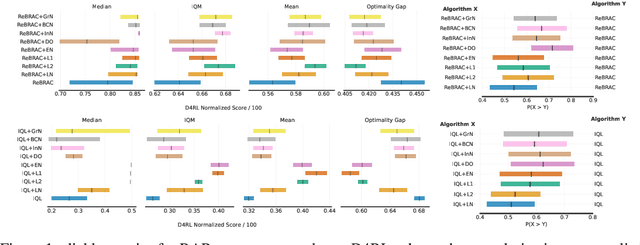
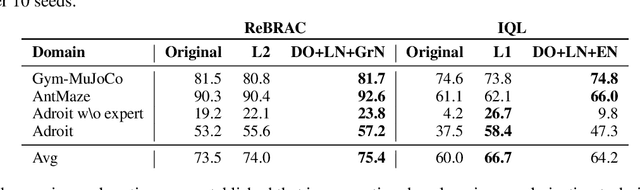
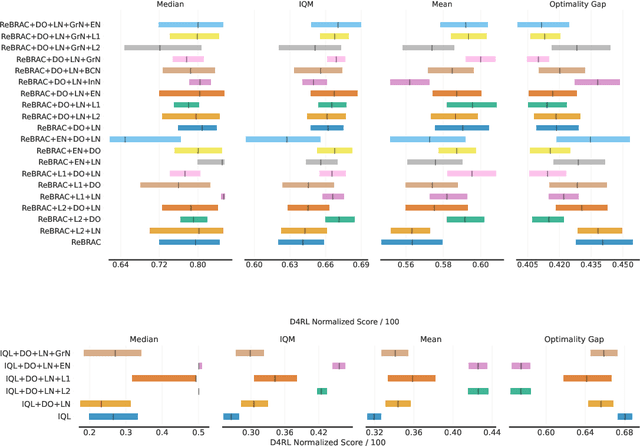
Deep learning regularization techniques, such as \emph{dropout}, \emph{layer normalization}, or \emph{weight decay}, are widely adopted in the construction of modern artificial neural networks, often resulting in more robust training processes and improved generalization capabilities. However, in the domain of \emph{Reinforcement Learning} (RL), the application of these techniques has been limited, usually applied to value function estimators \citep{hiraoka2021dropout, smith2022walk}, and may result in detrimental effects. This issue is even more pronounced in offline RL settings, which bear greater similarity to supervised learning but have received less attention. Recent work in continuous offline RL has demonstrated that while we can build sufficiently powerful critic networks, the generalization of actor networks remains a bottleneck. In this study, we empirically show that applying standard regularization techniques to actor networks in offline RL actor-critic algorithms yields improvements of 6\% on average across two algorithms and three different continuous D4RL domains.