 Add to Chrome
 Add to Firefox
 Add to Edge
Same Content, Different Answers: Cross-Modal Inconsistency in MLLMs
Dec 09, 2025
We introduce two new benchmarks REST and REST+(Render-Equivalence Stress Tests) to enable systematic evaluation of cross-modal inconsistency in multimodal large language models (MLLMs). MLLMs are trained to represent vision and language in the same embedding space, yet they cannot perform the same tasks in both modalities. Our benchmarks contain samples with the same semantic information in three modalities (image, text, mixed) and we show that state-of-the-art MLLMs cannot consistently reason over these different modalities. We evaluate 15 MLLMs and find that the degree of modality inconsistency varies substantially, even when accounting for problems with text recognition (OCR). Neither rendering text as image nor rendering an image as text solves the inconsistency. Even if OCR is correct, we find that visual characteristics (text colour and resolution, but not font) and the number of vision tokens have an impact on model performance. Finally, we find that our consistency score correlates with the modality gap between text and images, highlighting a mechanistic interpretation of cross-modal inconsistent MLLMs.

Enforcing Interpretability in Time Series Transformers: A Concept Bottleneck Framework
Oct 08, 2024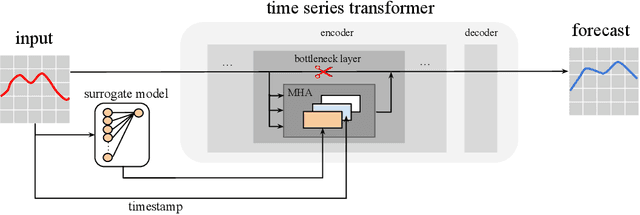
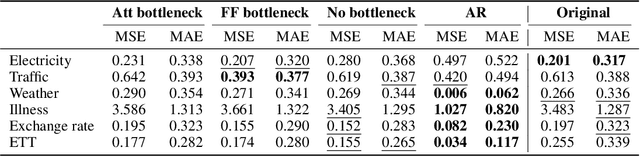
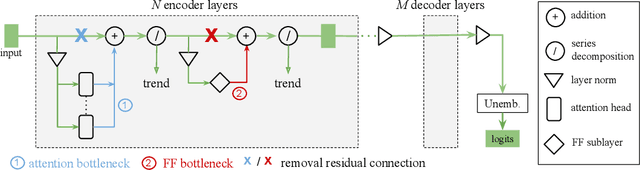
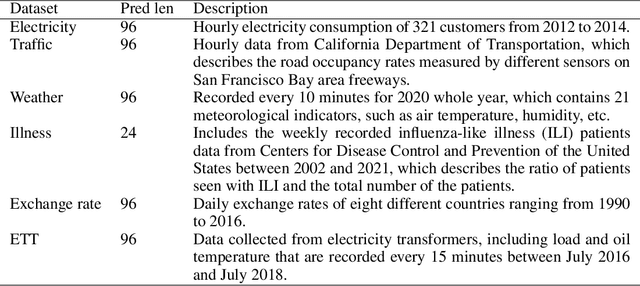
There has been a recent push of research on Transformer-based models for long-term time series forecasting, even though they are inherently difficult to interpret and explain. While there is a large body of work on interpretability methods for various domains and architectures, the interpretability of Transformer-based forecasting models remains largely unexplored. To address this gap, we develop a framework based on Concept Bottleneck Models to enforce interpretability of time series Transformers. We modify the training objective to encourage a model to develop representations similar to predefined interpretable concepts. In our experiments, we enforce similarity using Centered Kernel Alignment, and the predefined concepts include time features and an interpretable, autoregressive surrogate model (AR). We apply the framework to the Autoformer model, and present an in-depth analysis for a variety of benchmark tasks. We find that the model performance remains mostly unaffected, while the model shows much improved interpretability. Additionally, interpretable concepts become local, which makes the trained model easily intervenable. As a proof of concept, we demonstrate a successful intervention in the scenario of a time shift in the data, which eliminates the need to retrain.