 Add to Chrome
 Add to Firefox
 Add to Edge
Dash2Sim: Closed-Loop Driving Simulation from in-the-wild Dashcam Videos
Jun 05, 2026
Self-driving simulations typically rely on data collected in a small number of cities or on hand-authored synthetic scenarios. Dashcam videos cover a far broader range of locations and situations, including rare or long-tailed scenarios. They are considered less usable for simulation because it is difficult to recover accurate 4D scenes from monocular in-the-wild videos. Work zones are one such class of long-tailed situations that dashcams capture. We present Dash2Sim, a framework that turns in-the-wild monocular dashcam videos into metric, geo-referenced 4D driving logs compatible with existing simulators, and verifies eachone against an independently maintained map without annotations. We apply Dash2Sim to a large video corpus to create the ROADWork4D benchmark dataset, which spans 4,244 scenes with 2.7M 3D objects across 17 cities. On a verified subset ROADWork4D-CL (2,201 scenes), we study privileged closed-loop planners and find that work zone scenarios are difficult: while rule-based and hybrid planners generalize better than learning-based ones, all fall short, failing to make the lane changes that temporary work zone channels require. Beyond planning, dense depth recovered by Dash2Sim improves novel-view synthesis quality by up to 19% on perceptual metrics, suggesting its potential to provide rich conditioning for closed-loop sensor simulation from monocular videos.

"Do it my way!": Impact of Customizations on Trust perceptions in Human-Robot Collaboration
Oct 28, 2023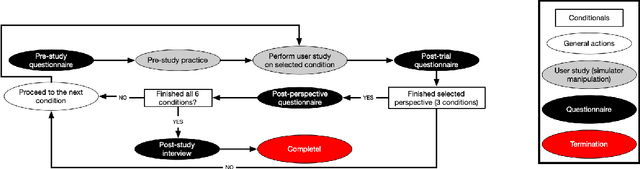
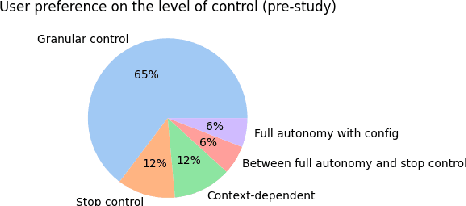
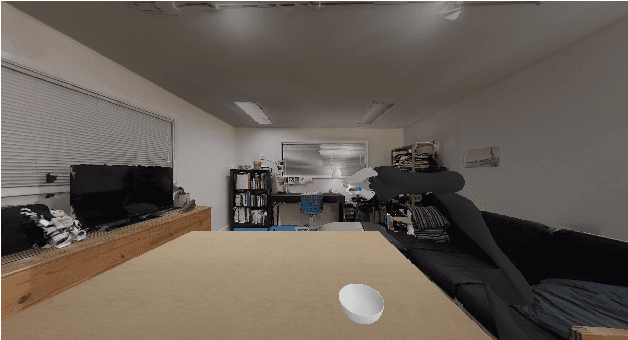
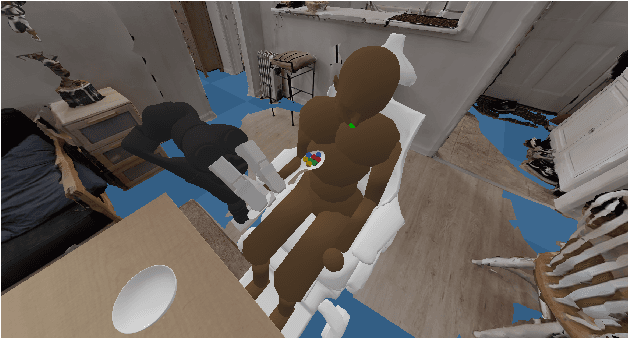
Trust has been shown to be a key factor in effective human-robot collaboration. In the context of assistive robotics, the effect of trust factors on human experience is further pronounced. Personalization of assistive robots is an orthogonal factor positively correlated with robot adoption and user perceptions. In this work, we investigate the relationship between these factors through a within-subjects study (N=17). We provide different levels of customization possibilities over baseline autonomous robot behavior and investigate its impact on trust. Our findings indicate that increased levels of customization was associated with higher trust and comfort perceptions. The assistive robot design process can benefit significantly from our insights for designing trustworthy and customized robots.
GAS-NeXt: Few-Shot Cross-Lingual Font Generator
Dec 15, 2022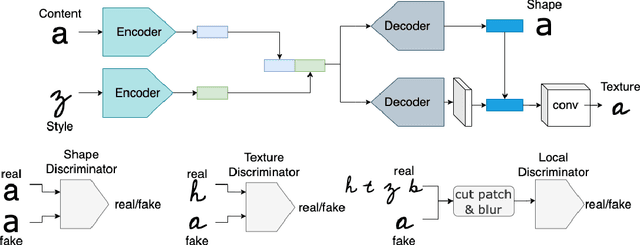

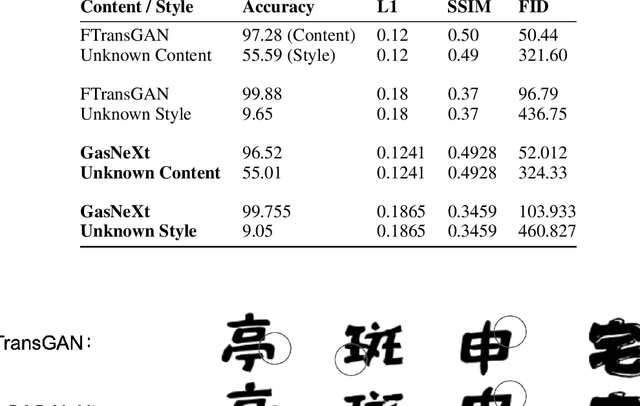
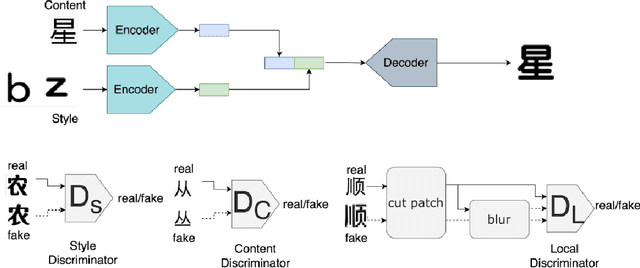
Generating new fonts is a time-consuming and labor-intensive task, especially in a language with a huge amount of characters like Chinese. Various deep learning models have demonstrated the ability to efficiently generate new fonts with a few reference characters of that style, but few models support cross-lingual font generation. This paper presents GAS-NeXt, a novel few-shot cross-lingual font generator based on AGIS-Net and Font Translator GAN, and improve the performance metrics such as Fr\'echet Inception Distance (FID), Structural Similarity Index Measure(SSIM), and Pixel-level Accuracy (pix-acc). Our approaches include replacing the original encoder and decoder with the idea of layer attention and context-aware attention from Font Translator GAN, while utilizing the shape, texture, and local discriminators of AGIS-Net. In our experiment on English-to-Chinese font translation, we observed better results in fonts with distinct local features than conventional Chinese fonts compared to results obtained from Font Translator GAN. We also validate our method on multiple languages and datasets.