 Add to Chrome
 Add to Firefox
 Add to Edge
Dash2Sim: Closed-Loop Driving Simulation from in-the-wild Dashcam Videos
Jun 05, 2026
Self-driving simulations typically rely on data collected in a small number of cities or on hand-authored synthetic scenarios. Dashcam videos cover a far broader range of locations and situations, including rare or long-tailed scenarios. They are considered less usable for simulation because it is difficult to recover accurate 4D scenes from monocular in-the-wild videos. Work zones are one such class of long-tailed situations that dashcams capture. We present Dash2Sim, a framework that turns in-the-wild monocular dashcam videos into metric, geo-referenced 4D driving logs compatible with existing simulators, and verifies eachone against an independently maintained map without annotations. We apply Dash2Sim to a large video corpus to create the ROADWork4D benchmark dataset, which spans 4,244 scenes with 2.7M 3D objects across 17 cities. On a verified subset ROADWork4D-CL (2,201 scenes), we study privileged closed-loop planners and find that work zone scenarios are difficult: while rule-based and hybrid planners generalize better than learning-based ones, all fall short, failing to make the lane changes that temporary work zone channels require. Beyond planning, dense depth recovered by Dash2Sim improves novel-view synthesis quality by up to 19% on perceptual metrics, suggesting its potential to provide rich conditioning for closed-loop sensor simulation from monocular videos.

Real-Time Whole-Body Control of Legged Robots with Model-Predictive Path Integral Control
Sep 16, 2024
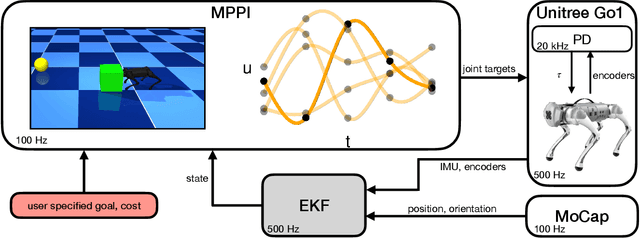

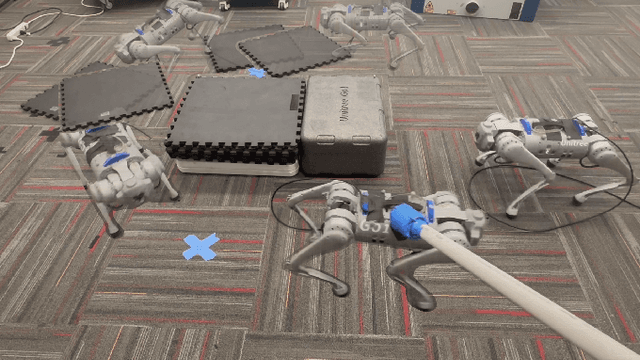
This paper presents a system for enabling real-time synthesis of whole-body locomotion and manipulation policies for real-world legged robots. Motivated by recent advancements in robot simulation, we leverage the efficient parallelization capabilities of the MuJoCo simulator to achieve fast sampling over the robot state and action trajectories. Our results show surprisingly effective real-world locomotion and manipulation capabilities with a very simple control strategy. We demonstrate our approach on several hardware and simulation experiments: robust locomotion over flat and uneven terrains, climbing over a box whose height is comparable to the robot, and pushing a box to a goal position. To our knowledge, this is the first successful deployment of whole-body sampling-based MPC on real-world legged robot hardware. Experiment videos and code can be found at: https://whole-body-mppi.github.io/