 Add to Chrome
 Add to Firefox
 Add to Edge
AlloBench: Measuring Online Tool Allocation Capability in LLM Agents
Jul 25, 2026
Creating a reusable tool is an investment: an agent pays a fixed cost now in exchange for the potential of future reuse. Therefore, a user should prefer an agent that creates a small number of highly reusable tools, rather than many one-offs. We introduce a paired benchmark that tests whether LLM agents exhibit conscious allocation behavior under a fixed budget in two contexts: an abstract text-based formulation and a code-construction task. We find that every frontier model we test---Claude Haiku, Claude Opus, GPT-5.4-mini, and GPT-5.6 Sol---acts near-optimally in the abstract framing but fails to transfer this ability to script-writing. Through further experiments, we identify the particular failure modes for each model. Notably, the first three models fail even when the scripts are not evaluated, while GPT-5.6 Sol stays selective under that weaker manipulation and collapses only at full construction. Furthermore, an open-source Qwen model policy-trained for abstract allocation generalizes this ability across held-out lexical variations, but sees no improvement at script allocation. Together, these results establish online tool allocation as a significant capability boundary, even for modern frontier models.

Lomekwi: Resource-Bounded Tool Discovery in LLM Agents
Jul 18, 2026Existing tool-use benchmarks report a single success rate for complex, multistep tasks. Inspired by ideas from cognitive science, we distinguish tool use from tool discovery and decompose the latter into curiosity (the model's ability to discover the parts needed to build the tool), recognition (the model's ability to discover the process of creating the tool), and efficiency (the model's use of the tool after creation). We show that this framework can be applied to existing discovery tasks, such as Voyager. In addition, we provide evidence that recognition inversely scales with model size, and we introduce and analyze a class of combinatorial games that demonstrates this. We further observe inverse scaling in a separate environment designed to emulate real-world tasks.
RankLLM: A Python Package for Reranking with LLMs
May 25, 2025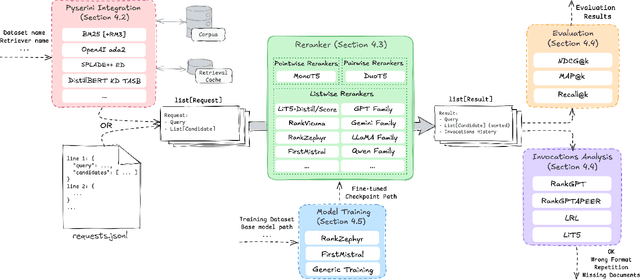
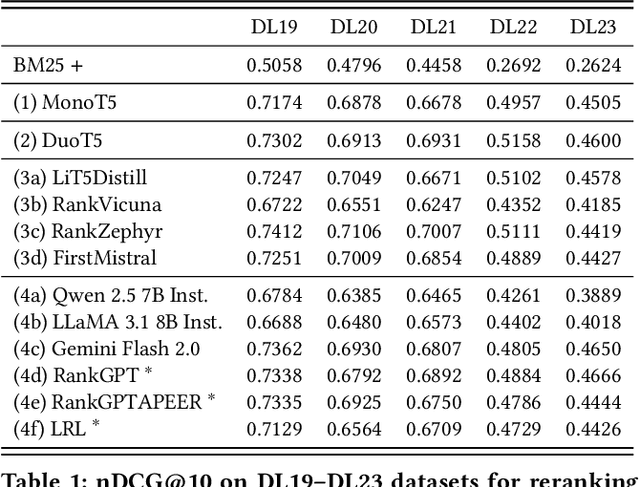
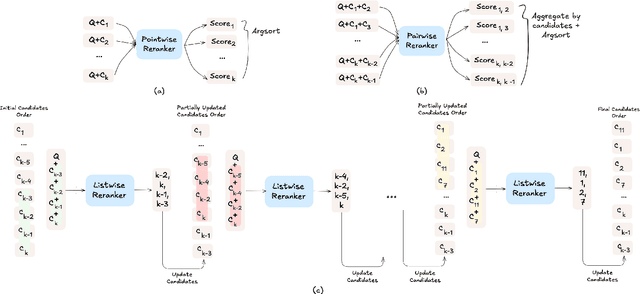
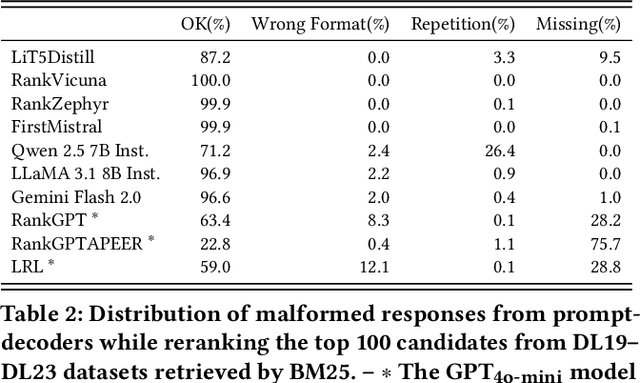
The adoption of large language models (LLMs) as rerankers in multi-stage retrieval systems has gained significant traction in academia and industry. These models refine a candidate list of retrieved documents, often through carefully designed prompts, and are typically used in applications built on retrieval-augmented generation (RAG). This paper introduces RankLLM, an open-source Python package for reranking that is modular, highly configurable, and supports both proprietary and open-source LLMs in customized reranking workflows. To improve usability, RankLLM features optional integration with Pyserini for retrieval and provides integrated evaluation for multi-stage pipelines. Additionally, RankLLM includes a module for detailed analysis of input prompts and LLM responses, addressing reliability concerns with LLM APIs and non-deterministic behavior in Mixture-of-Experts (MoE) models. This paper presents the architecture of RankLLM, along with a detailed step-by-step guide and sample code. We reproduce results from RankGPT, LRL, RankVicuna, RankZephyr, and other recent models. RankLLM integrates with common inference frameworks and a wide range of LLMs. This compatibility allows for quick reproduction of reported results, helping to speed up both research and real-world applications. The complete repository is available at rankllm.ai, and the package can be installed via PyPI.
Centralized Selection with Preferences in the Presence of Biases
Sep 07, 2024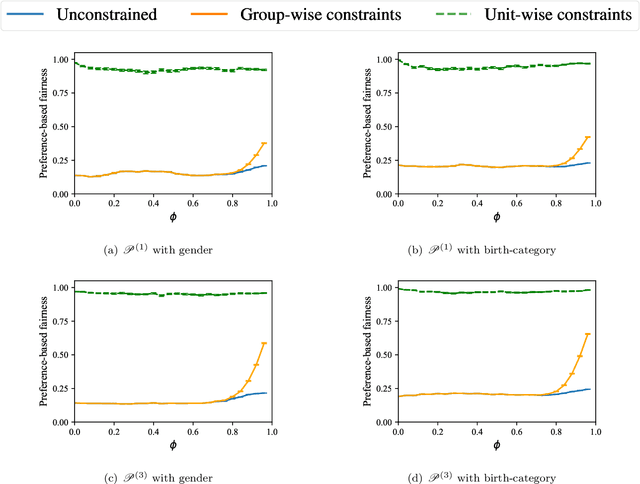
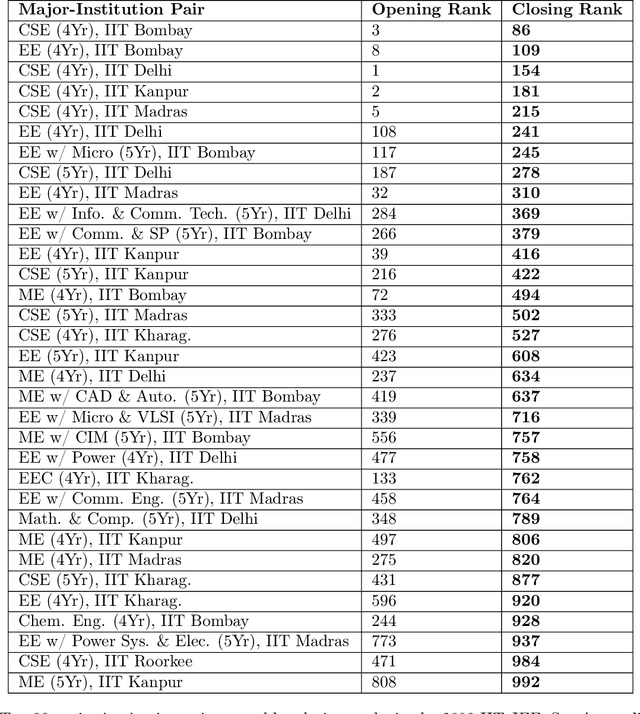
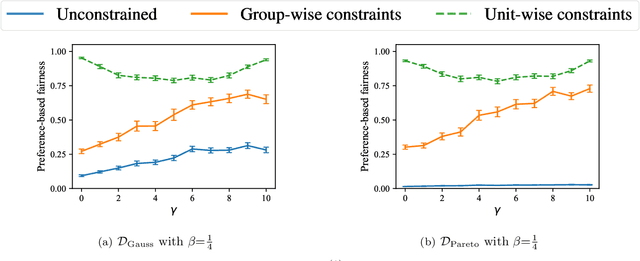
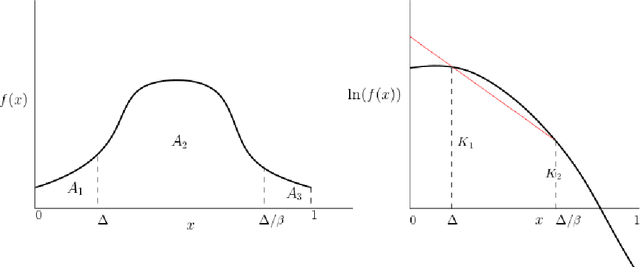
This paper considers the scenario in which there are multiple institutions, each with a limited capacity for candidates, and candidates, each with preferences over the institutions. A central entity evaluates the utility of each candidate to the institutions, and the goal is to select candidates for each institution in a way that maximizes utility while also considering the candidates' preferences. The paper focuses on the setting in which candidates are divided into multiple groups and the observed utilities of candidates in some groups are biased--systematically lower than their true utilities. The first result is that, in these biased settings, prior algorithms can lead to selections with sub-optimal true utility and significant discrepancies in the fraction of candidates from each group that get their preferred choices. Subsequently, an algorithm is presented along with proof that it produces selections that achieve near-optimal group fairness with respect to preferences while also nearly maximizing the true utility under distributional assumptions. Further, extensive empirical validation of these results in real-world and synthetic settings, in which the distributional assumptions may not hold, are presented.