 Add to Chrome
 Add to Firefox
 Add to Edge
Active Real-World Factor-Based Evaluation for Generalist Robot Policies
Jul 16, 2026
Generalist robot manipulation policies trained on large, diverse datasets have shown remarkable promise across a wide range of tasks. However, rigorously evaluating these policies remains a fundamental challenge. Real-world performance depends on a large combinatorial space of task factors including object poses and camera viewpoints, making full, exhaustive evaluation intractable. Additionally, real hardware evaluation is slow and resource-intensive, so current practice is to use narrow test suites that can miss critical failure modes and misrepresent true deployment readiness. We propose an active evaluation framework that addresses this challenge by treating policy evaluation as a sequential experimental design problem. Our approach fits a probabilistic surrogate model over a structured space of task factors and adaptively selects evaluation configurations to maximize information gain over the policy's performance distribution, allowing for sample-efficient characterization of policy behavior across unseen conditions and a systematic identification of failure-prone regions. We conduct 2331 real-world evaluations across 3 tasks with 3 factor variations and find that our approach typically saves the evaluator at least 20-40% of trials compared to typical random testing.

Bridging the Sim2Real gap with CARE: Supervised Detection Adaptation with Conditional Alignment and Reweighting
Feb 09, 2023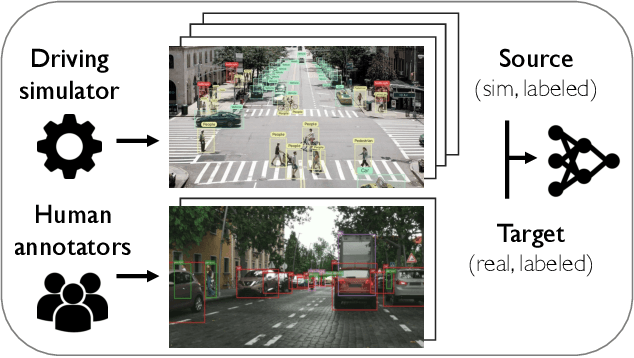


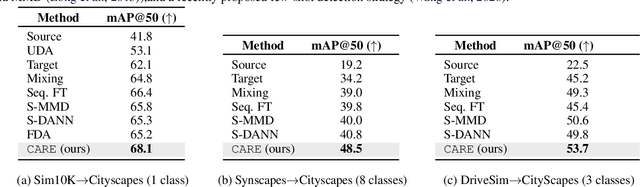
Sim2Real domain adaptation (DA) research focuses on the constrained setting of adapting from a labeled synthetic source domain to an unlabeled or sparsely labeled real target domain. However, for high-stakes applications (e.g. autonomous driving), it is common to have a modest amount of human-labeled real data in addition to plentiful auto-labeled source data (e.g. from a driving simulator). We study this setting of supervised sim2real DA applied to 2D object detection. We propose Domain Translation via Conditional Alignment and Reweighting (CARE) a novel algorithm that systematically exploits target labels to explicitly close the sim2real appearance and content gaps. We present an analytical justification of our algorithm and demonstrate strong gains over competing methods on standard benchmarks.