 Add to Chrome
 Add to Firefox
 Add to Edge
How Much Data Are Augmentations Worth? An Investigation into Scaling Laws, Invariance, and Implicit Regularization
Oct 12, 2022
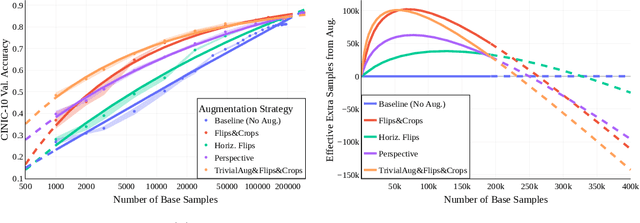
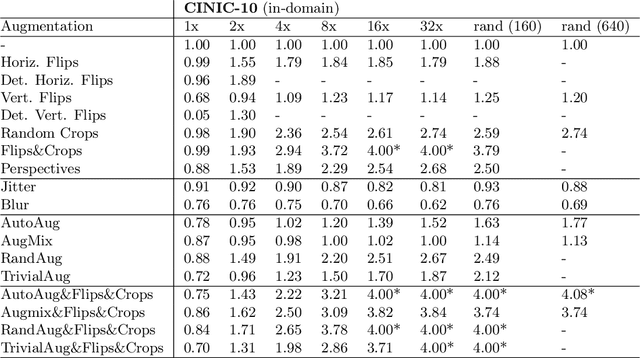
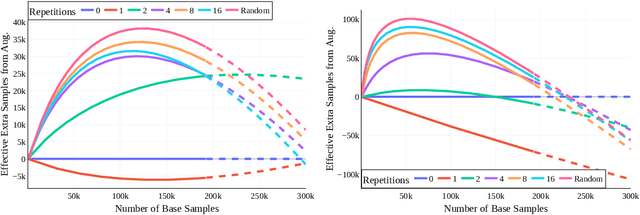
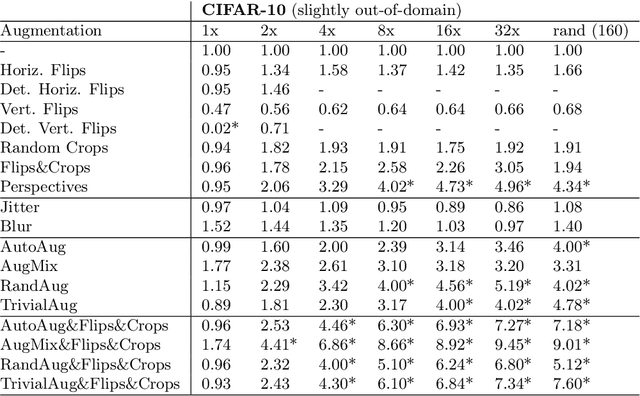
Despite the clear performance benefits of data augmentations, little is known about why they are so effective. In this paper, we disentangle several key mechanisms through which data augmentations operate. Establishing an exchange rate between augmented and additional real data, we find that in out-of-distribution testing scenarios, augmentations which yield samples that are diverse, but inconsistent with the data distribution can be even more valuable than additional training data. Moreover, we find that data augmentations which encourage invariances can be more valuable than invariance alone, especially on small and medium sized training sets. Following this observation, we show that augmentations induce additional stochasticity during training, effectively flattening the loss landscape.

The Lie Derivative for Measuring Learned Equivariance
Oct 06, 2022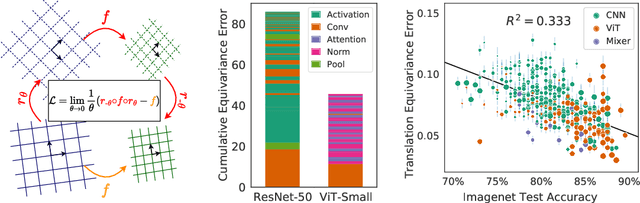
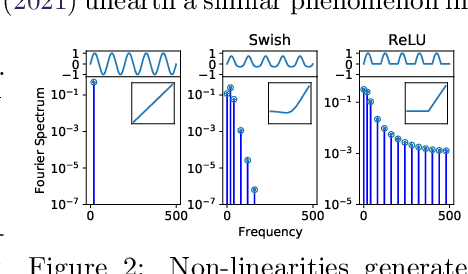
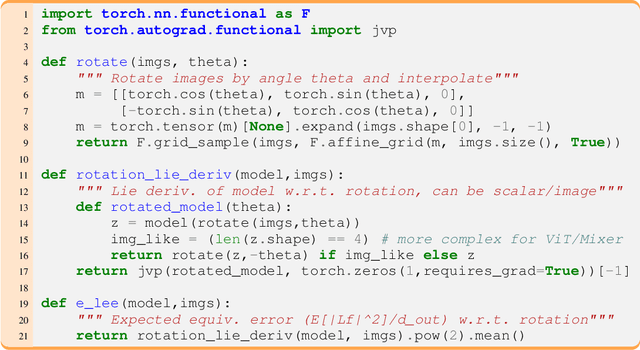
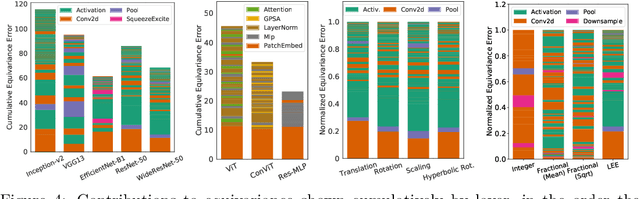
Equivariance guarantees that a model's predictions capture key symmetries in data. When an image is translated or rotated, an equivariant model's representation of that image will translate or rotate accordingly. The success of convolutional neural networks has historically been tied to translation equivariance directly encoded in their architecture. The rising success of vision transformers, which have no explicit architectural bias towards equivariance, challenges this narrative and suggests that augmentations and training data might also play a significant role in their performance. In order to better understand the role of equivariance in recent vision models, we introduce the Lie derivative, a method for measuring equivariance with strong mathematical foundations and minimal hyperparameters. Using the Lie derivative, we study the equivariance properties of hundreds of pretrained models, spanning CNNs, transformers, and Mixer architectures. The scale of our analysis allows us to separate the impact of architecture from other factors like model size or training method. Surprisingly, we find that many violations of equivariance can be linked to spatial aliasing in ubiquitous network layers, such as pointwise non-linearities, and that as models get larger and more accurate they tend to display more equivariance, regardless of architecture. For example, transformers can be more equivariant than convolutional neural networks after training.
Low-Precision Arithmetic for Fast Gaussian Processes
Jul 14, 2022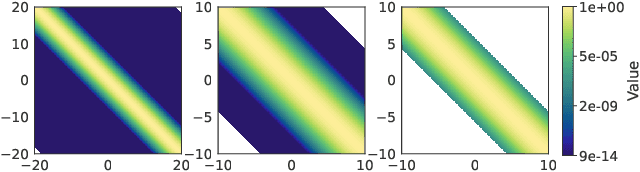
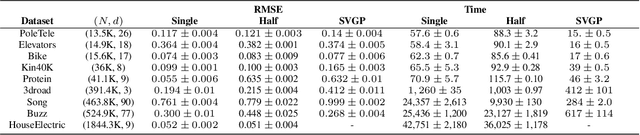

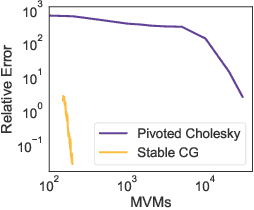
Low-precision arithmetic has had a transformative effect on the training of neural networks, reducing computation, memory and energy requirements. However, despite its promise, low-precision arithmetic has received little attention for Gaussian processes (GPs), largely because GPs require sophisticated linear algebra routines that are unstable in low-precision. We study the different failure modes that can occur when training GPs in half precision. To circumvent these failure modes, we propose a multi-faceted approach involving conjugate gradients with re-orthogonalization, mixed precision, and preconditioning. Our approach significantly improves the numerical stability and practical performance of conjugate gradients in low-precision over a wide range of settings, enabling GPs to train on $1.8$ million data points in $10$ hours on a single GPU, without any sparse approximations.
Volatility Based Kernels and Moving Average Means for Accurate Forecasting with Gaussian Processes
Jul 13, 2022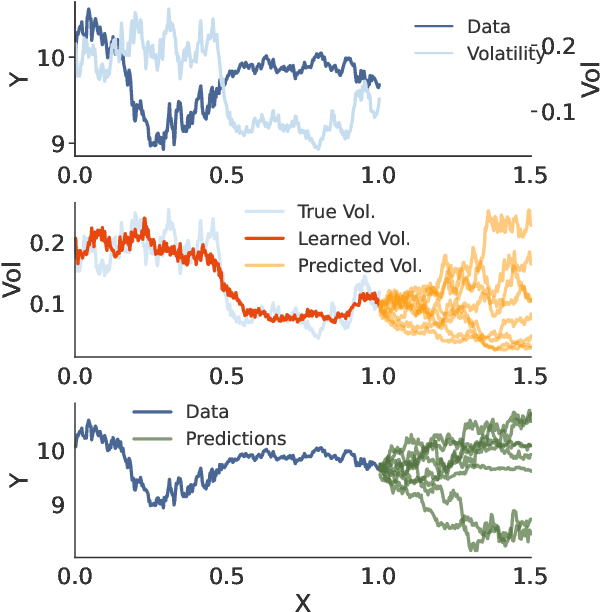
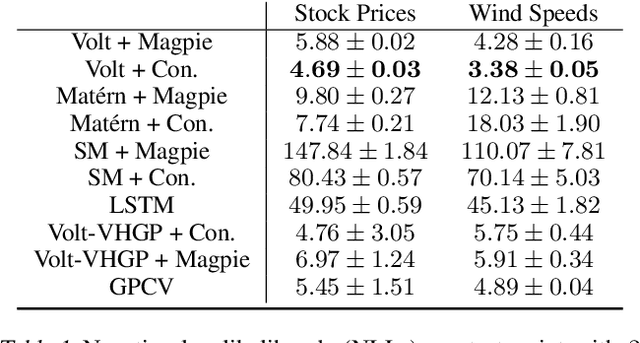

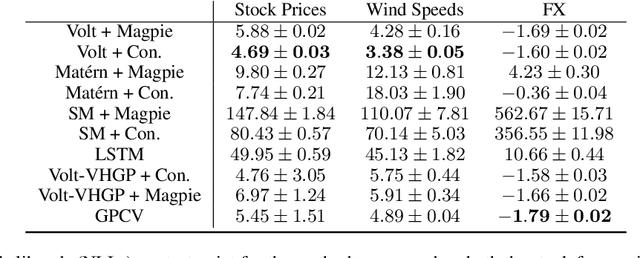
A broad class of stochastic volatility models are defined by systems of stochastic differential equations. While these models have seen widespread success in domains such as finance and statistical climatology, they typically lack an ability to condition on historical data to produce a true posterior distribution. To address this fundamental limitation, we show how to re-cast a class of stochastic volatility models as a hierarchical Gaussian process (GP) model with specialized covariance functions. This GP model retains the inductive biases of the stochastic volatility model while providing the posterior predictive distribution given by GP inference. Within this framework, we take inspiration from well studied domains to introduce a new class of models, Volt and Magpie, that significantly outperform baselines in stock and wind speed forecasting, and naturally extend to the multitask setting.
Transfer Learning with Deep Tabular Models
Jun 30, 2022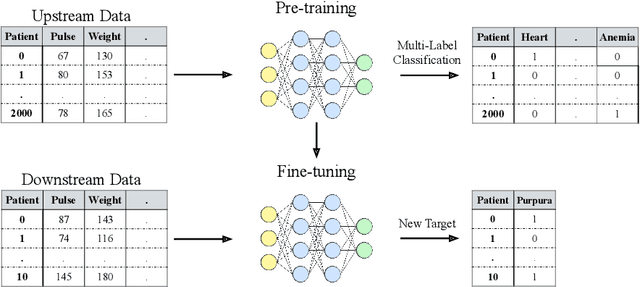
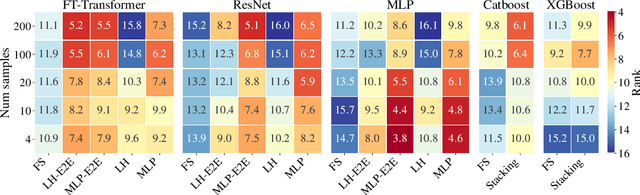
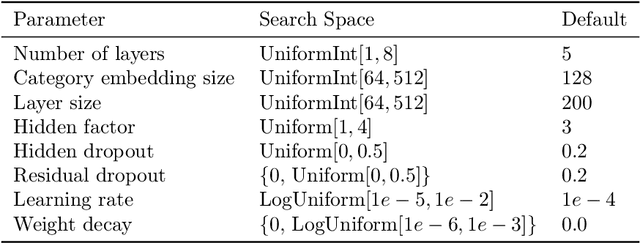
Recent work on deep learning for tabular data demonstrates the strong performance of deep tabular models, often bridging the gap between gradient boosted decision trees and neural networks. Accuracy aside, a major advantage of neural models is that they learn reusable features and are easily fine-tuned in new domains. This property is often exploited in computer vision and natural language applications, where transfer learning is indispensable when task-specific training data is scarce. In this work, we demonstrate that upstream data gives tabular neural networks a decisive advantage over widely used GBDT models. We propose a realistic medical diagnosis benchmark for tabular transfer learning, and we present a how-to guide for using upstream data to boost performance with a variety of tabular neural network architectures. Finally, we propose a pseudo-feature method for cases where the upstream and downstream feature sets differ, a tabular-specific problem widespread in real-world applications. Our code is available at https://github.com/LevinRoman/tabular-transfer-learning .
Low-Precision Stochastic Gradient Langevin Dynamics
Jun 20, 2022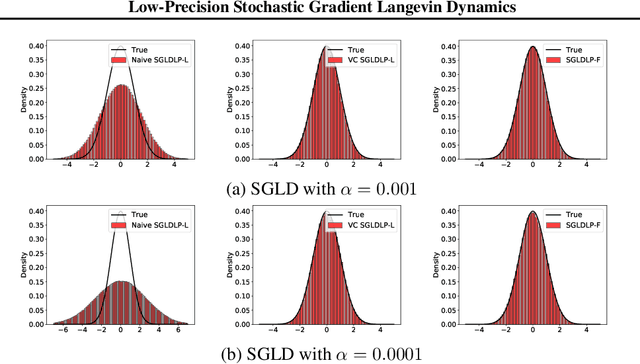
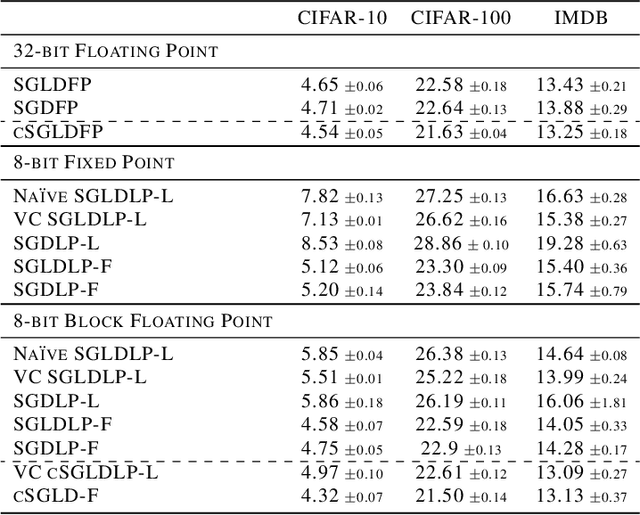
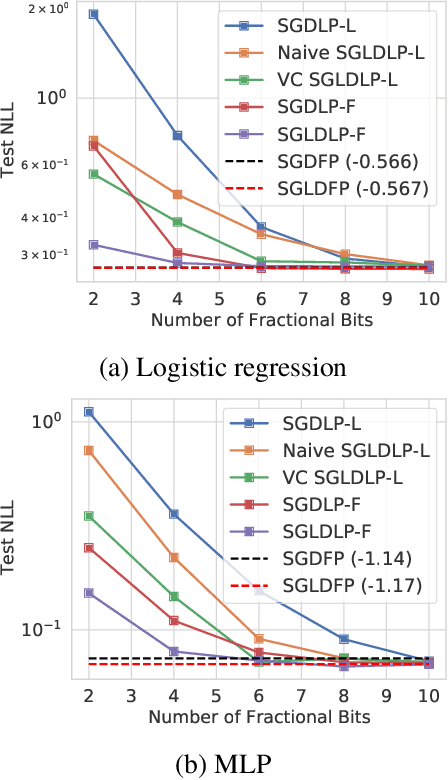
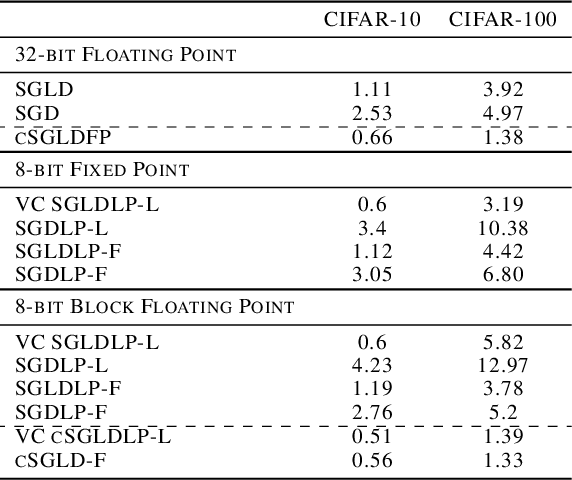
While low-precision optimization has been widely used to accelerate deep learning, low-precision sampling remains largely unexplored. As a consequence, sampling is simply infeasible in many large-scale scenarios, despite providing remarkable benefits to generalization and uncertainty estimation for neural networks. In this paper, we provide the first study of low-precision Stochastic Gradient Langevin Dynamics (SGLD), showing that its costs can be significantly reduced without sacrificing performance, due to its intrinsic ability to handle system noise. We prove that the convergence of low-precision SGLD with full-precision gradient accumulators is less affected by the quantization error than its SGD counterpart in the strongly convex setting. To further enable low-precision gradient accumulators, we develop a new quantization function for SGLD that preserves the variance in each update step. We demonstrate that low-precision SGLD achieves comparable performance to full-precision SGLD with only 8 bits on a variety of deep learning tasks.
Pre-Train Your Loss: Easy Bayesian Transfer Learning with Informative Priors
May 20, 2022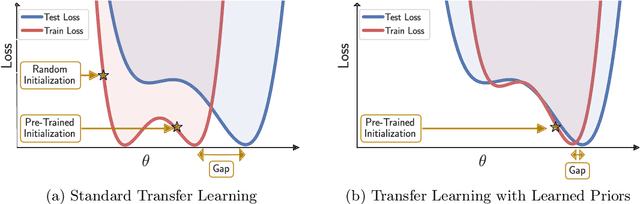

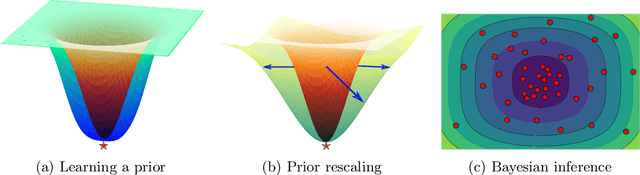
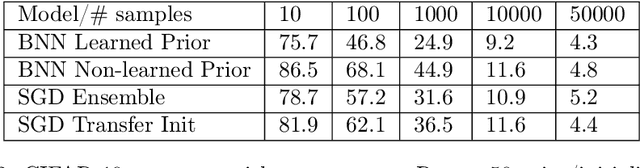
Deep learning is increasingly moving towards a transfer learning paradigm whereby large foundation models are fine-tuned on downstream tasks, starting from an initialization learned on the source task. But an initialization contains relatively little information about the source task. Instead, we show that we can learn highly informative posteriors from the source task, through supervised or self-supervised approaches, which then serve as the basis for priors that modify the whole loss surface on the downstream task. This simple modular approach enables significant performance gains and more data-efficient learning on a variety of downstream classification and segmentation tasks, serving as a drop-in replacement for standard pre-training strategies. These highly informative priors also can be saved for future use, similar to pre-trained weights, and stand in contrast to the zero-mean isotropic uninformative priors that are typically used in Bayesian deep learning.
Last Layer Re-Training is Sufficient for Robustness to Spurious Correlations
Apr 06, 2022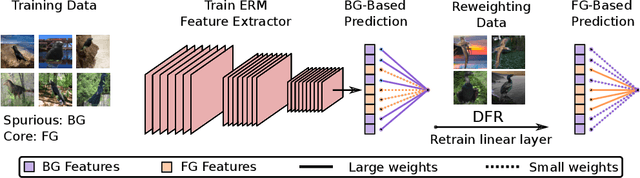
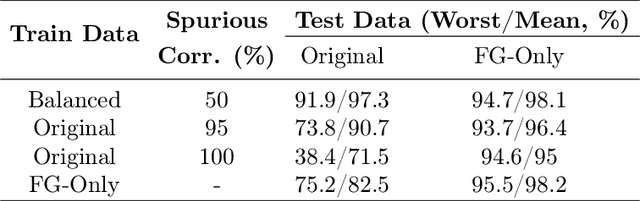
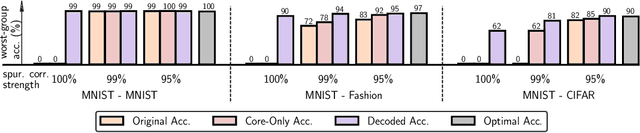
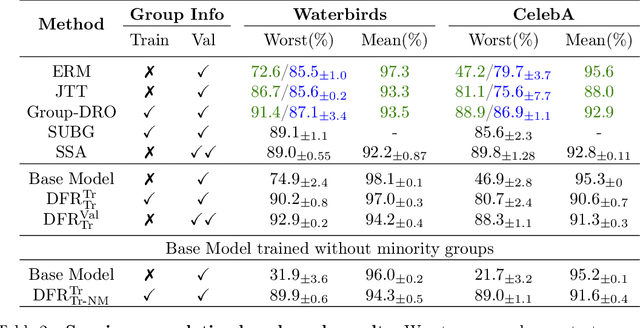
Neural network classifiers can largely rely on simple spurious features, such as backgrounds, to make predictions. However, even in these cases, we show that they still often learn core features associated with the desired attributes of the data, contrary to recent findings. Inspired by this insight, we demonstrate that simple last layer retraining can match or outperform state-of-the-art approaches on spurious correlation benchmarks, but with profoundly lower complexity and computational expenses. Moreover, we show that last layer retraining on large ImageNet-trained models can also significantly reduce reliance on background and texture information, improving robustness to covariate shift, after only minutes of training on a single GPU.
On Uncertainty, Tempering, and Data Augmentation in Bayesian Classification
Mar 30, 2022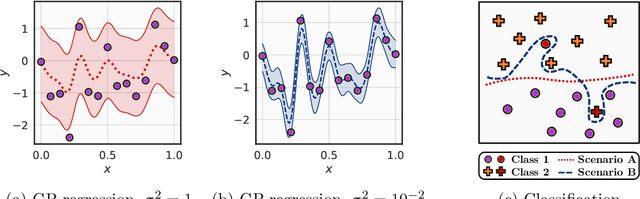
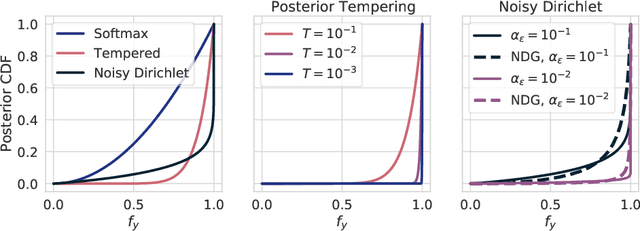
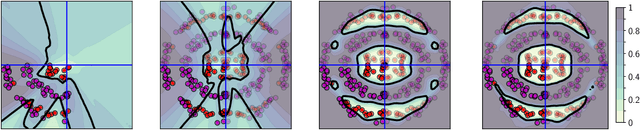
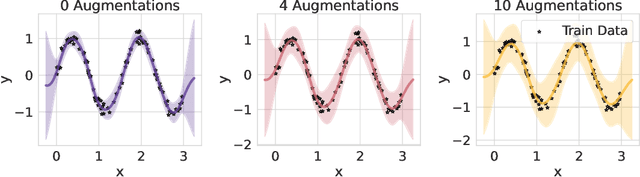
Aleatoric uncertainty captures the inherent randomness of the data, such as measurement noise. In Bayesian regression, we often use a Gaussian observation model, where we control the level of aleatoric uncertainty with a noise variance parameter. By contrast, for Bayesian classification we use a categorical distribution with no mechanism to represent our beliefs about aleatoric uncertainty. Our work shows that explicitly accounting for aleatoric uncertainty significantly improves the performance of Bayesian neural networks. We note that many standard benchmarks, such as CIFAR, have essentially no aleatoric uncertainty. Moreover, we show data augmentation in approximate inference has the effect of softening the likelihood, leading to underconfidence and profoundly misrepresenting our honest beliefs about aleatoric uncertainty. Accordingly, we find that a cold posterior, tempered by a power greater than one, often more honestly reflects our beliefs about aleatoric uncertainty than no tempering -- providing an explicit link between data augmentation and cold posteriors. We show that we can match or exceed the performance of posterior tempering by using a Dirichlet observation model, where we explicitly control the level of aleatoric uncertainty, without any need for tempering.
Accelerating Bayesian Optimization for Biological Sequence Design with Denoising Autoencoders
Mar 23, 2022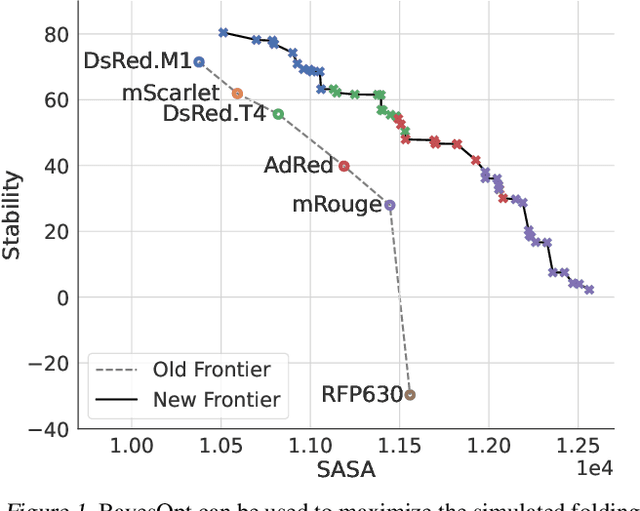
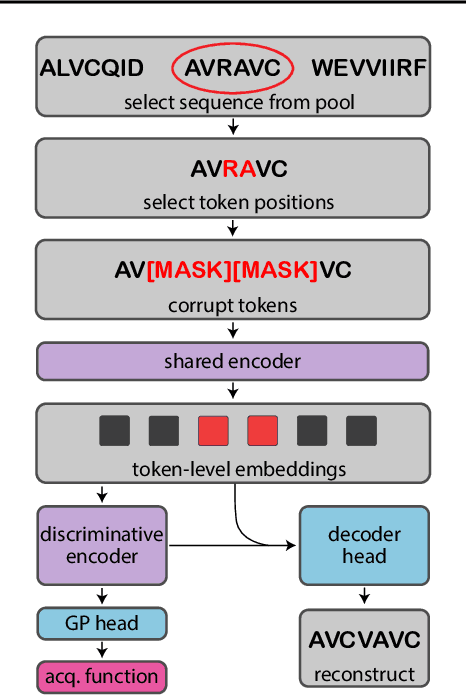
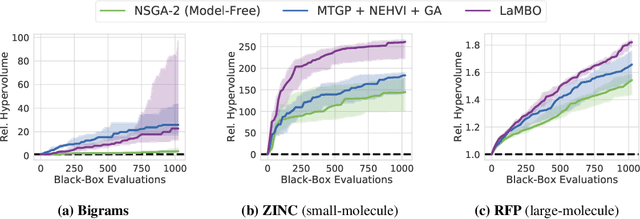
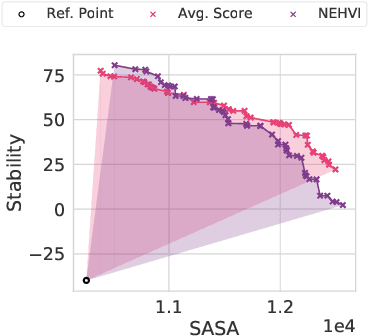
Bayesian optimization is a gold standard for query-efficient continuous optimization. However, its adoption for drug and antibody sequence design has been hindered by the discrete, high-dimensional nature of the decision variables. We develop a new approach (LaMBO) which jointly trains a denoising autoencoder with a discriminative multi-task Gaussian process head, enabling gradient-based optimization of multi-objective acquisition functions in the latent space of the autoencoder. These acquisition functions allow LaMBO to balance the explore-exploit trade-off over multiple design rounds, and to balance objective tradeoffs by optimizing sequences at many different points on the Pareto frontier. We evaluate LaMBO on a small-molecule task based on the ZINC dataset and introduce a new large-molecule task targeting fluorescent proteins. In our experiments, LaMBO outperforms genetic optimizers and does not require a large pretraining corpus, demonstrating that Bayesian optimization is practical and effective for biological sequence design.