 Add to Chrome
 Add to Firefox
 Add to Edge
IsoCLIP: Decomposing CLIP Projectors for Efficient Intra-modal Alignment
Mar 20, 2026
Vision-Language Models like CLIP are extensively used for inter-modal tasks which involve both visual and text modalities. However, when the individual modality encoders are applied to inherently intra-modal tasks like image-to-image retrieval, their performance suffers from the intra-modal misalignment. In this paper we study intra-modal misalignment in CLIP with a focus on the role of the projectors that map pre-projection image and text embeddings into the shared embedding space. By analyzing the form of the cosine similarity applied to projected features, and its interaction with the contrastive CLIP loss, we show that there is an inter-modal operator responsible for aligning the two modalities during training, and a second, intra-modal operator that only enforces intra-modal normalization but does nothing to promote intra-modal alignment. Via spectral analysis of the inter-modal operator, we identify an approximately isotropic subspace in which the two modalities are well-aligned, as well as anisotropic directions specific to each modality. We demonstrate that this aligned subspace can be directly obtained from the projector weights and that removing the anisotropic directions improves intra-modal alignment. Our experiments on intra-modal retrieval and classification benchmarks show that our training-free method reduces intra-modal misalignment, greatly lowers latency, and outperforms existing approaches across multiple pre-trained CLIP-like models. The code is publicly available at: https://github.com/simomagi/IsoCLIP.

SpectralGCD: Spectral Concept Selection and Cross-modal Representation Learning for Generalized Category Discovery
Feb 19, 2026Generalized Category Discovery (GCD) aims to identify novel categories in unlabeled data while leveraging a small labeled subset of known classes. Training a parametric classifier solely on image features often leads to overfitting to old classes, and recent multimodal approaches improve performance by incorporating textual information. However, they treat modalities independently and incur high computational cost. We propose SpectralGCD, an efficient and effective multimodal approach to GCD that uses CLIP cross-modal image-concept similarities as a unified cross-modal representation. Each image is expressed as a mixture over semantic concepts from a large task-agnostic dictionary, which anchors learning to explicit semantics and reduces reliance on spurious visual cues. To maintain the semantic quality of representations learned by an efficient student, we introduce Spectral Filtering which exploits a cross-modal covariance matrix over the softmaxed similarities measured by a strong teacher model to automatically retain only relevant concepts from the dictionary. Forward and reverse knowledge distillation from the same teacher ensures that the cross-modal representations of the student remain both semantically sufficient and well-aligned. Across six benchmarks, SpectralGCD delivers accuracy comparable to or significantly superior to state-of-the-art methods at a fraction of the computational cost. The code is publicly available at: https://github.com/miccunifi/SpectralGCD.
Cross the Gap: Exposing the Intra-modal Misalignment in CLIP via Modality Inversion
Feb 06, 2025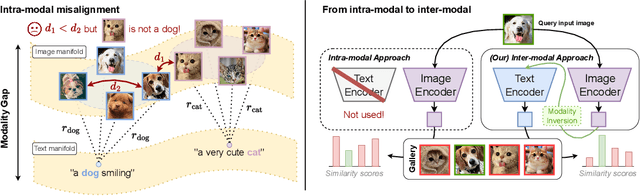


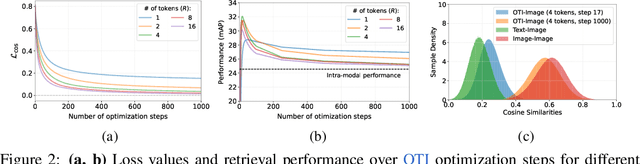
Pre-trained multi-modal Vision-Language Models like CLIP are widely used off-the-shelf for a variety of applications. In this paper, we show that the common practice of individually exploiting the text or image encoders of these powerful multi-modal models is highly suboptimal for intra-modal tasks like image-to-image retrieval. We argue that this is inherently due to the CLIP-style inter-modal contrastive loss that does not enforce any intra-modal constraints, leading to what we call intra-modal misalignment. To demonstrate this, we leverage two optimization-based modality inversion techniques that map representations from their input modality to the complementary one without any need for auxiliary data or additional trained adapters. We empirically show that, in the intra-modal tasks of image-to-image and text-to-text retrieval, approaching these tasks inter-modally significantly improves performance with respect to intra-modal baselines on more than fifteen datasets. Additionally, we demonstrate that approaching a native inter-modal task (e.g. zero-shot image classification) intra-modally decreases performance, further validating our findings. Finally, we show that incorporating an intra-modal term in the pre-training objective or narrowing the modality gap between the text and image feature embedding spaces helps reduce the intra-modal misalignment. The code is publicly available at: https://github.com/miccunifi/Cross-the-Gap.
RE-tune: Incremental Fine Tuning of Biomedical Vision-Language Models for Multi-label Chest X-ray Classification
Oct 23, 2024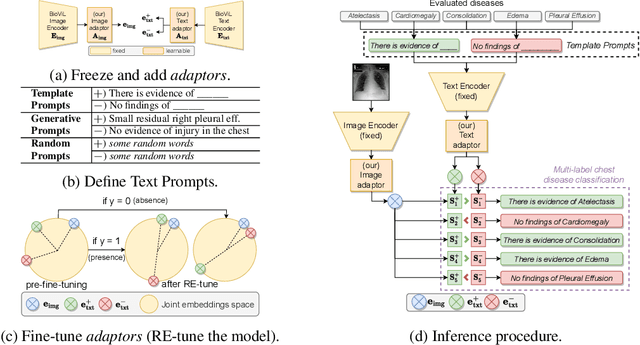

In this paper we introduce RE-tune, a novel approach for fine-tuning pre-trained Multimodal Biomedical Vision-Language models (VLMs) in Incremental Learning scenarios for multi-label chest disease diagnosis. RE-tune freezes the backbones and only trains simple adaptors on top of the Image and Text encoders of the VLM. By engineering positive and negative text prompts for diseases, we leverage the ability of Large Language Models to steer the training trajectory. We evaluate RE-tune in three realistic incremental learning scenarios: class-incremental, label-incremental, and data-incremental. Our results demonstrate that Biomedical VLMs are natural continual learners and prevent catastrophic forgetting. RE-tune not only achieves accurate multi-label classification results, but also prioritizes patient privacy and it distinguishes itself through exceptional computational efficiency, rendering it highly suitable for broad adoption in real-world healthcare settings.
Improving Zero-shot Generalization of Learned Prompts via Unsupervised Knowledge Distillation
Jul 03, 2024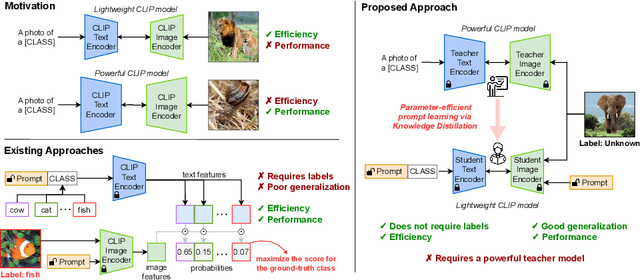
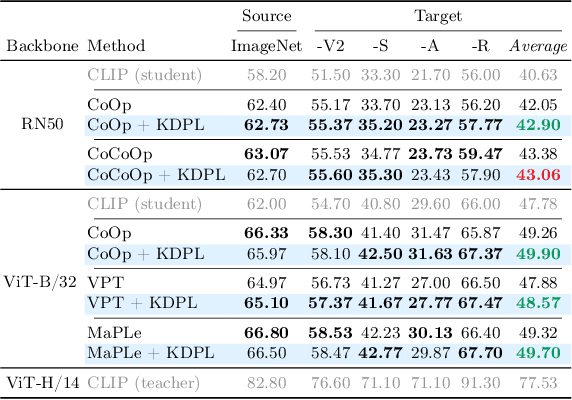
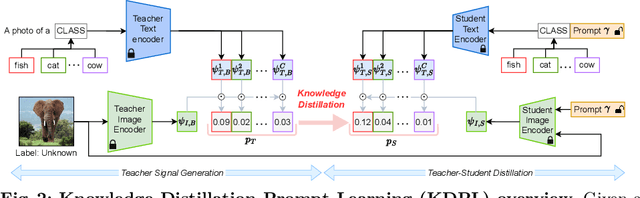
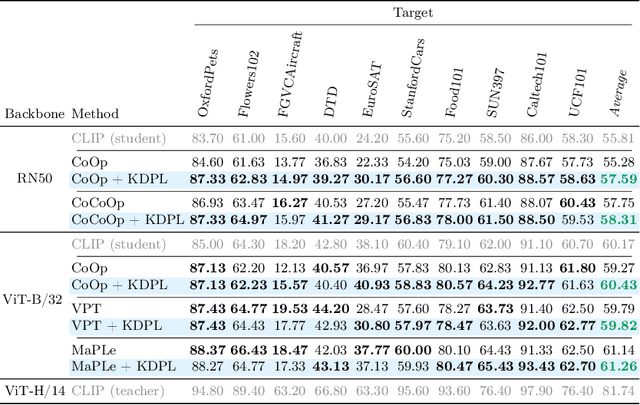
Vision-Language Models (VLMs) demonstrate remarkable zero-shot generalization to unseen tasks, but fall short of the performance of supervised methods in generalizing to downstream tasks with limited data. Prompt learning is emerging as a parameter-efficient method for adapting VLMs, but state-of-the-art approaches require annotated samples. In this paper we propose a novel approach to prompt learning based on unsupervised knowledge distillation from more powerful models. Our approach, which we call Knowledge Distillation Prompt Learning (KDPL), can be integrated into existing prompt learning techniques and eliminates the need for labeled examples during adaptation. Our experiments on more than ten standard benchmark datasets demonstrate that KDPL is very effective at improving generalization of learned prompts for zero-shot domain generalization, zero-shot cross-dataset generalization, and zero-shot base-to-novel class generalization problems. KDPL requires no ground-truth labels for adaptation, and moreover we show that even in the absence of any knowledge of training class names it can be used to effectively transfer knowledge. The code is publicly available at https://github.com/miccunifi/KDPL.