 Add to Chrome
 Add to Firefox
 Add to Edge
Predicting States of Understanding in Explanatory Interactions Using Cognitive Load-Related Linguistic Cues
Mar 20, 2026
We investigate how verbal and nonverbal linguistic features, exhibited by speakers and listeners in dialogue, can contribute to predicting the listener's state of understanding in explanatory interactions on a moment-by-moment basis. Specifically, we examine three linguistic cues related to cognitive load and hypothesised to correlate with listener understanding: the information value (operationalised with surprisal) and syntactic complexity of the speaker's utterances, and the variation in the listener's interactive gaze behaviour. Based on statistical analyses of the MUNDEX corpus of face-to-face dialogic board game explanations, we find that individual cues vary with the listener's level of understanding. Listener states ('Understanding', 'Partial Understanding', 'Non-Understanding' and 'Misunderstanding') were self-annotated by the listeners using a retrospective video-recall method. The results of a subsequent classification experiment, involving two off-the-shelf classifiers and a fine-tuned German BERT-based multimodal classifier, demonstrate that prediction of these four states of understanding is generally possible and improves when the three linguistic cues are considered alongside textual features.

Forms of Understanding of XAI-Explanations
Nov 15, 2023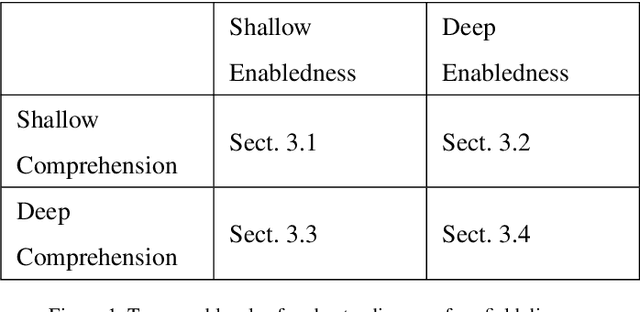
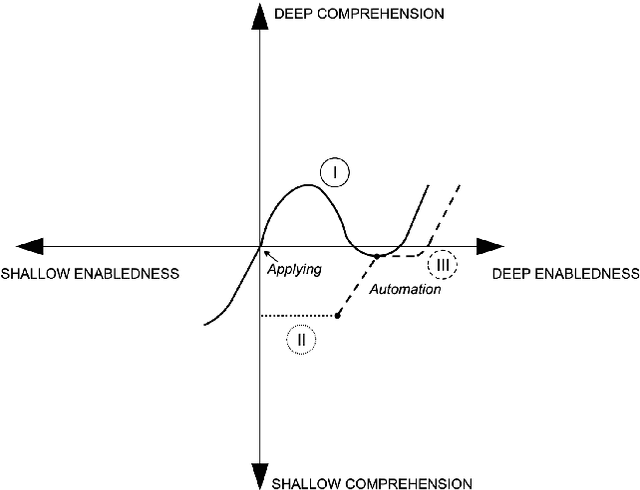
Explainability has become an important topic in computer science and artificial intelligence, leading to a subfield called Explainable Artificial Intelligence (XAI). The goal of providing or seeking explanations is to achieve (better) 'understanding' on the part of the explainee. However, what it means to 'understand' is still not clearly defined, and the concept itself is rarely the subject of scientific investigation. This conceptual article aims to present a model of forms of understanding in the context of XAI and beyond. From an interdisciplinary perspective bringing together computer science, linguistics, sociology, and psychology, a definition of understanding and its forms, assessment, and dynamics during the process of giving everyday explanations are explored. Two types of understanding are considered as possible outcomes of explanations, namely enabledness, 'knowing how' to do or decide something, and comprehension, 'knowing that' -- both in different degrees (from shallow to deep). Explanations regularly start with shallow understanding in a specific domain and can lead to deep comprehension and enabledness of the explanandum, which we see as a prerequisite for human users to gain agency. In this process, the increase of comprehension and enabledness are highly interdependent. Against the background of this systematization, special challenges of understanding in XAI are discussed.