 Add to Chrome
 Add to Firefox
 Add to Edge
SAGE: Scalable Automatic Gating Ensemble for Confident Negative Harvesting in Fraud Detection
May 19, 2026
Music streaming fraud, where bad actors artificially inflate stream counts to manipulate chart rankings and royalty payments, poses a significant threat to streaming services and legitimate content creators. Traditional fraud detection approaches struggle with a critical challenge: many legitimate edge cases, including super-fans and sleep-music sessions, exhibit activity patterns that closely mimic those of coordinated fraud. We present SAGE, a novel counterfactual-aware negative harvesting approach that combines SimHash-based stratified sampling with a modular gating ensemble for confident negative identification from unlabeled data. Our ensemble architecture employs pluggable statistical gates (currently instantiated with Mahalanobis distance and k-NN density) with configurable voting thresholds enabling adaptive precision-recall trade-offs. This addresses the representation bias problem in Positive-Unlabeled learning by ensuring comprehensive coverage of rare behavioral cohorts through floor-constrained sampling. Evaluation demonstrates strong precision and recall on held-out data. The approach generalizes across fraud detection domains, achieving strong performance on both customer-level and artist-level fraud without modification to the core methodology.

Physics-based reward driven image analysis in microscopy
Apr 23, 2024
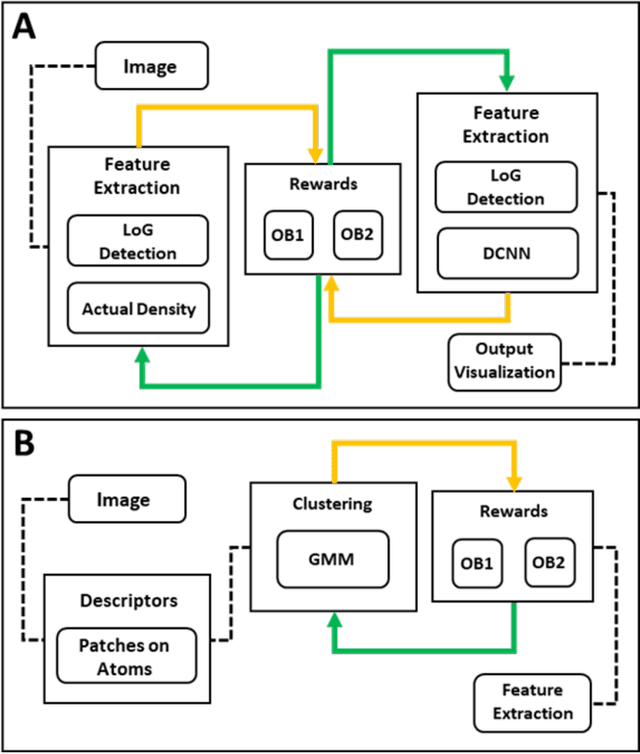
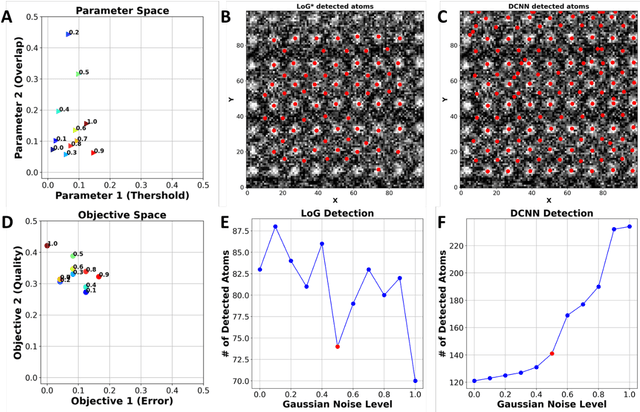

The rise of electron microscopy has expanded our ability to acquire nanometer and atomically resolved images of complex materials. The resulting vast datasets are typically analyzed by human operators, an intrinsically challenging process due to the multiple possible analysis steps and the corresponding need to build and optimize complex analysis workflows. We present a methodology based on the concept of a Reward Function coupled with Bayesian Optimization, to optimize image analysis workflows dynamically. The Reward Function is engineered to closely align with the experimental objectives and broader context and is quantifiable upon completion of the analysis. Here, cross-section, high-angle annular dark field (HAADF) images of ion-irradiated $(Y, Dy)Ba_2Cu_3O_{7-\delta}$ thin-films were used as a model system. The reward functions were formed based on the expected materials density and atomic spacings and used to drive multi-objective optimization of the classical Laplacian-of-Gaussian (LoG) method. These results can be benchmarked against the DCNN segmentation. This optimized LoG* compares favorably against DCNN in the presence of the additional noise. We further extend the reward function approach towards the identification of partially-disordered regions, creating a physics-driven reward function and action space of high-dimensional clustering. We pose that with correct definition, the reward function approach allows real-time optimization of complex analysis workflows at much higher speeds and lower computational costs than classical DCNN-based inference, ensuring the attainment of results that are both precise and aligned with the human-defined objectives.
Convex Factorization Machine for Regression
Aug 10, 2016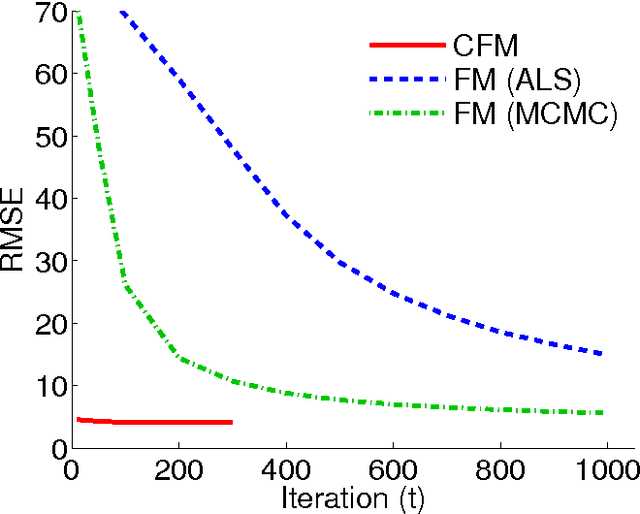
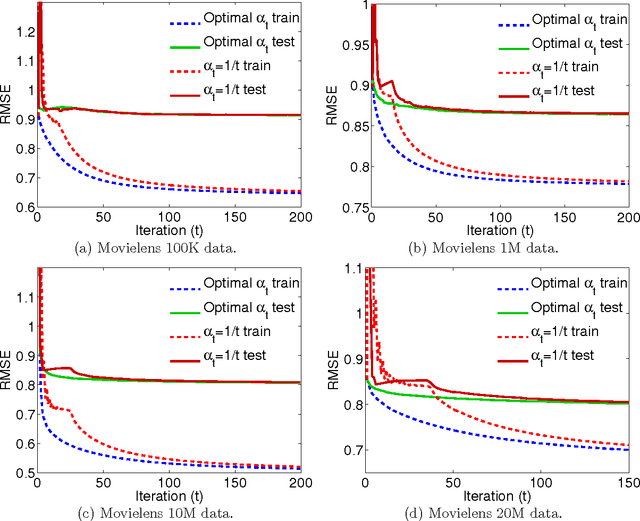
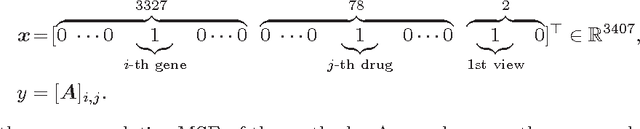
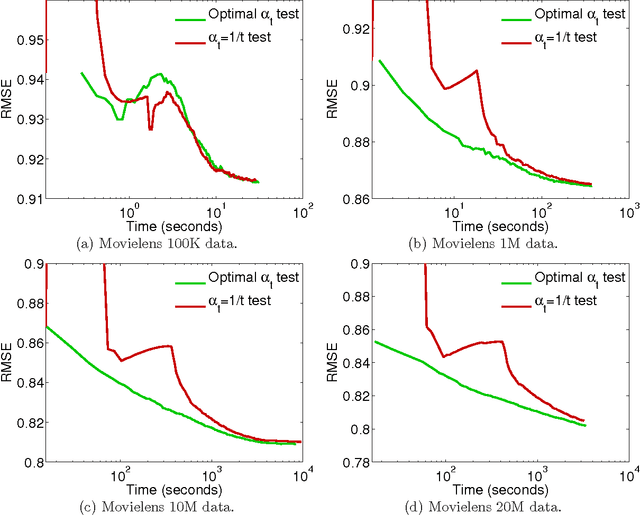
We propose the convex factorization machine (CFM), which is a convex variant of the widely used Factorization Machines (FMs). Specifically, we employ a linear+quadratic model and regularize the linear term with the $\ell_2$-regularizer and the quadratic term with the trace norm regularizer. Then, we formulate the CFM optimization as a semidefinite programming problem and propose an efficient optimization procedure with Hazan's algorithm. A key advantage of CFM over existing FMs is that it can find a globally optimal solution, while FMs may get a poor locally optimal solution since the objective function of FMs is non-convex. In addition, the proposed algorithm is simple yet effective and can be implemented easily. Finally, CFM is a general factorization method and can also be used for other factorization problems including including multi-view matrix factorization and tensor completion problems. Through synthetic and movielens datasets, we first show that the proposed CFM achieves results competitive to FMs. Furthermore, in a toxicogenomics prediction task, we show that CFM outperforms a state-of-the-art tensor factorization method.