 Add to Chrome
 Add to Firefox
 Add to Edge
Data-Aware Random Feature Kernel for Transformers
Mar 04, 2026
Transformers excel across domains, yet their quadratic attention complexity poses a barrier to scaling. Random-feature attention, as in Performers, can reduce this cost to linear in the sequence length by approximating the softmax kernel with positive random features drawn from an isotropic distribution. In pretrained models, however, queries and keys are typically anisotropic. This induces high Monte Carlo variance in isotropic sampling schemes unless one retrains the model or uses a large feature budget. Importance sampling can address this by adapting the sampling distribution to the input geometry, but complex data-dependent proposal distributions are often intractable. We show that by data aligning the softmax kernel, we obtain an attention mechanism which can both admit a tractable minimal-variance proposal distribution for importance sampling, and exhibits better training stability. Motivated by this finding, we introduce DARKFormer, a Data-Aware Random-feature Kernel transformer that features a data-aligned kernel geometry. DARKFormer learns the random-projection covariance, efficiently realizing an importance-sampled positive random-feature estimator for its data-aligned kernel. Empirically, DARKFormer narrows the performance gap with exact softmax attention, particularly in finetuning regimes where pretrained representations are anisotropic. By combining random-feature efficiency with data-aware kernels, DARKFormer advances kernel-based attention in resource-constrained settings.

Hiding in Plain Text: Detecting Concealed Jailbreaks via Activation Disentanglement
Feb 23, 2026Large language models (LLMs) remain vulnerable to jailbreak prompts that are fluent and semantically coherent, and therefore difficult to detect with standard heuristics. A particularly challenging failure mode occurs when an attacker tries to hide the malicious goal of their request by manipulating its framing to induce compliance. Because these attacks maintain malicious intent through a flexible presentation, defenses that rely on structural artifacts or goal-specific signatures can fail. Motivated by this, we introduce a self-supervised framework for disentangling semantic factor pairs in LLM activations at inference. We instantiate the framework for goal and framing and construct GoalFrameBench, a corpus of prompts with controlled goal and framing variations, which we use to train Representation Disentanglement on Activations (ReDAct) module to extract disentangled representations in a frozen LLM. We then propose FrameShield, an anomaly detector operating on the framing representations, which improves model-agnostic detection across multiple LLM families with minimal computational overhead. Theoretical guarantees for ReDAct and extensive empirical validations show that its disentanglement effectively powers FrameShield. Finally, we use disentanglement as an interpretability probe, revealing distinct profiles for goal and framing signals and positioning semantic disentanglement as a building block for both LLM safety and mechanistic interpretability.
SPOT: Sparsification with Attention Dynamics via Token Relevance in Vision Transformers
Nov 13, 2025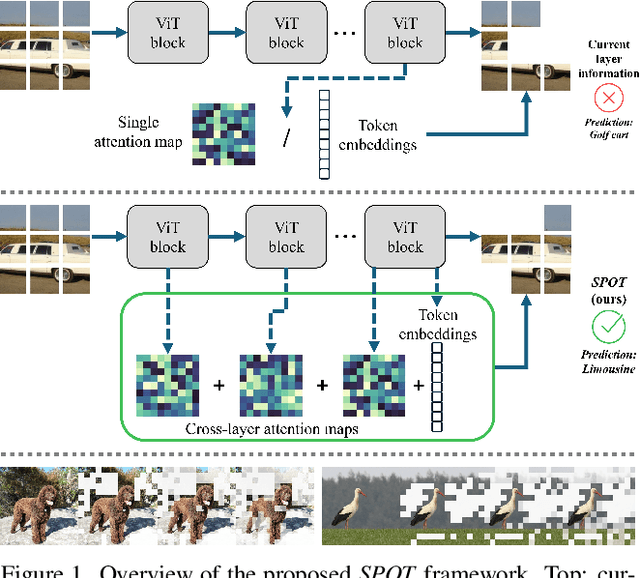
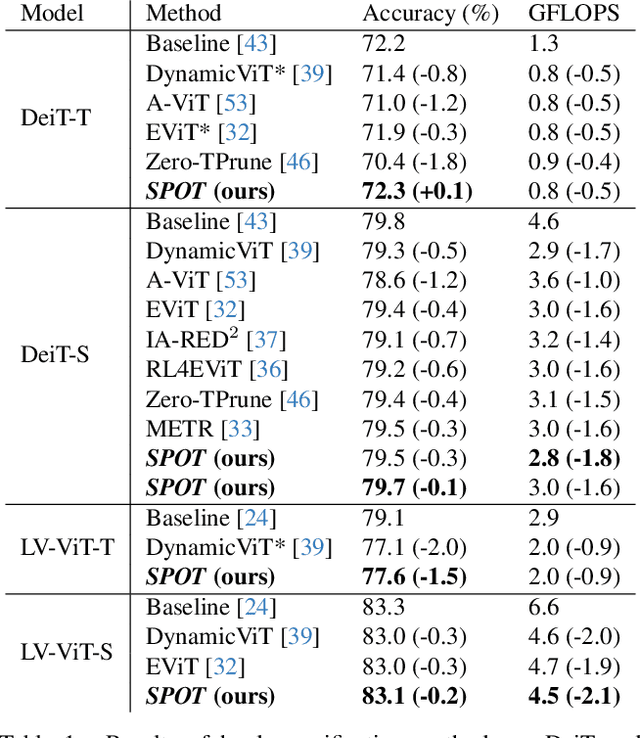
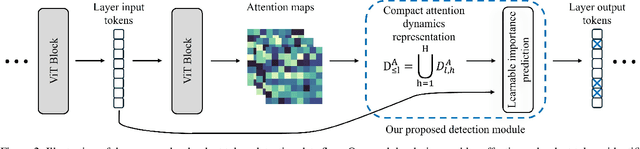
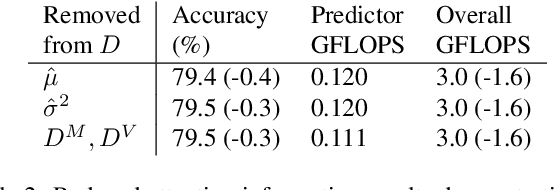
While Vision Transformers (ViT) have demonstrated remarkable performance across diverse tasks, their computational demands are substantial, scaling quadratically with the number of processed tokens. Compact attention representations, reflecting token interaction distributions, can guide early detection and reduction of less salient tokens prior to attention computation. Motivated by this, we present SParsification with attentiOn dynamics via Token relevance (SPOT), a framework for early detection of redundant tokens within ViTs that leverages token embeddings, interactions, and attention dynamics across layers to infer token importance, resulting in a more context-aware and interpretable relevance detection process. SPOT informs token sparsification and facilitates the elimination of such tokens, improving computational efficiency without sacrificing performance. SPOT employs computationally lightweight predictors that can be plugged into various ViT architectures and learn to derive effective input-specific token prioritization across layers. Its versatile design supports a range of performance levels adaptable to varying resource constraints. Empirical evaluations demonstrate significant efficiency gains of up to 40% compared to standard ViTs, while maintaining or even improving accuracy. Code and models are available at https://github.com/odedsc/SPOT .
Multi-Task Learning Improves Performance In Deep Argument Mining Models
Jul 03, 2023The successful analysis of argumentative techniques from user-generated text is central to many downstream tasks such as political and market analysis. Recent argument mining tools use state-of-the-art deep learning methods to extract and annotate argumentative techniques from various online text corpora, however each task is treated as separate and different bespoke models are fine-tuned for each dataset. We show that different argument mining tasks share common semantic and logical structure by implementing a multi-task approach to argument mining that achieves better performance than state-of-the-art methods for the same problems. Our model builds a shared representation of the input text that is common to all tasks and exploits similarities between tasks in order to further boost performance via parameter-sharing. Our results are important for argument mining as they show that different tasks share substantial similarities and suggest a holistic approach to the extraction of argumentative techniques from text.