 Add to Chrome
 Add to Firefox
 Add to Edge
How China-Origin Vision-Language Models Move from Refusal to Reframing in State Alignment
Aug 12, 2026
State-aligned distortion has been documented in China-origin text-based large language models (LLMs), but whether, and in what form, it arises in multimodal systems has not been systematically examined. We construct a balanced benchmark of 200 core entries spanning ten politically sensitive topics, plus a seven-variant visual-abstraction probe, and run nine vision-language models (VLMs), seven China-origin and two non-China, across four elicitation paradigms and two prompt languages, yielding 21,708 trials. Each response is audited on six dimensions -- explicit refusal, information integrity, visual grounding, state-aligned framing, language consistency, and response length -- by two independent frontier LLM judges, validated against three human experts on a 200-trial sample. Measuring each dimension separately lets us decompose multimodal censorship into individual signals rather than a single refusal-based score; in particular, refusal and framing are measured independently, so a model can stop refusing while still reframing. We find that (i) Chinese-language prompting roughly triples the odds of state-aligned framing, within every model; (ii) China-origin models reframe more than non-China models (direction robust across judges and human raters; magnitude 1.6--3.2x); (iii) the effect is strongest in text-only political commentary (36.5%) and is gated by recognition of the depicted subject rather than pixel detail, persisting even at silhouette for iconic images; and (iv) across four Qwen generations, state-aligned framing rises while explicit refusal falls: censorship migrates from a visible act (refusal) to an invisible one (fluent reframing). We argue this shift to invisible reframing is fundamentally a problem of human-AI interaction: it removes the very signal users rely on to recognize that information has been withheld.

Beyond Binary Detection: A Multi-Dimensional Taxonomy of Cancer Misinformation on Reddit
Jul 14, 2026Cancer-related discussions on social media provide an important space for information exchange and peer support, but also facilitate the spread of misinformation that may influence prevention, screening, and treatment decisions. Existing research on cancer misinformation often relies on narrow definitions, small-scale datasets, or binary labeling frameworks. We introduce a multi-dimensional taxonomy for characterizing cancer misinformation in Reddit discussions of breast, lung, colon, and prostate cancer. The taxonomy captures seven dimensions, including misinformation presence, information type, risk level, stance, and topical focus. Using expert-annotated data, we evaluate multiple large language models (LLMs) for scalable misinformation annotation and analyze cancer misinformation across Reddit communities. Our results show that cancer-related misinformation constitutes approximately 6\% of Reddit cancer discussions, with substantial variation across communities and misinformation topics. Few-shot prompting substantially improves classification performance, particularly for nuanced taxonomy dimensions. We additionally identify recurring misinformation narratives centered on unsupported treatments, distrust of conventional medicine, and misleading claims about diagnosis and screening. Our taxonomy, dataset, and findings provide a foundation for multi-dimensional modeling of online cancer misinformation.
LLM-Assisted Reranking to Operationalize Nuanced Objectives in Recommender Systems
Jun 01, 2026Recommender systems have grown from content-organization tools into sophisticated systems that shape daily behavior. By controlling what we see, they shape what we perceive, raising concerns about filter bubbles, radicalization, polarization, and social inequality. Large language models (LLMs) enable more powerful personalization, intensifying these dynamics. Yet most recommenders are tuned for engagement or limited accuracy metrics, with little attention to broader social implications, e.g. how personalization reshapes exposure in socially consequential domains. We investigate whether LLM-assisted reranking, while improving personalization, inadvertently amplifies exposure to ideologically extreme or conspiratorial political content, a risk theorized but not empirically characterized in news recommendation. Using real news-consumption histories, we rerank YouTube's sidebar candidates through zero-shot, instruction-based prompting. We compare a baseline prompt with a constrained variant that preserves topical relevance and broadens ideological exposure while reducing conspiratorial or extreme content. Without constraints, reranking strengthened personalization but increased exposure to conspiratorial and extremist material for users whose histories contained such content. Lightweight prompt-level regularization reduced promotion of extreme content and increased ideological diversity, with modest relevance loss. Synthetic experiments suggest that LLMs rerank via statistical regularities in language rather than semantic understanding of ideology, clarifying why naive prompts amplify these patterns and why regularization can reshape them. Together, our results highlight the power of LLMs to operationalize contextual nuance in high-stakes recommendation, and the need to evaluate LLM-assisted personalization beyond accuracy and treat prompt design as a value-laden rather than neutral default.
Stacking Models for Nearly Optimal Link Prediction in Complex Networks
Sep 17, 2019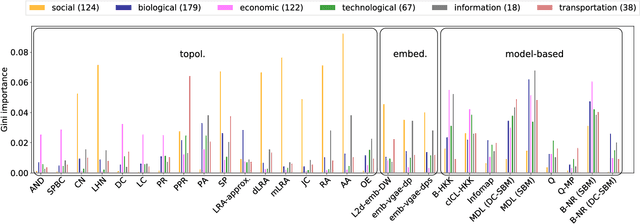
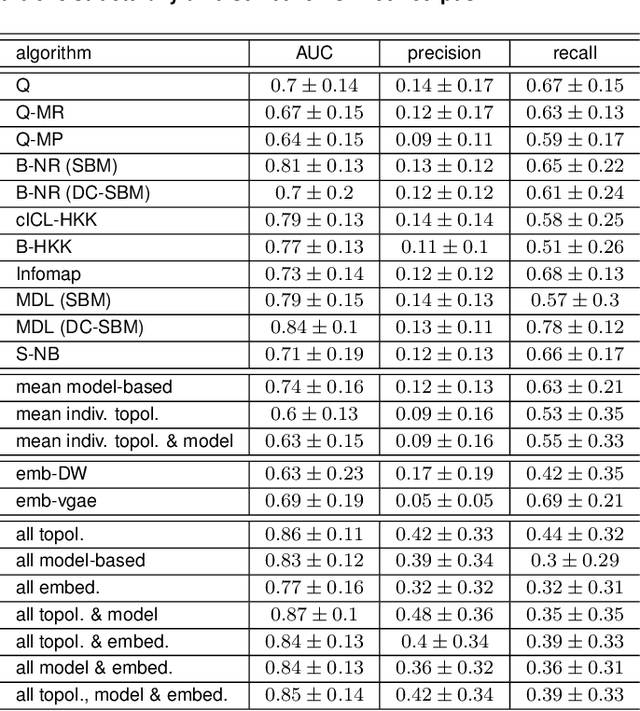
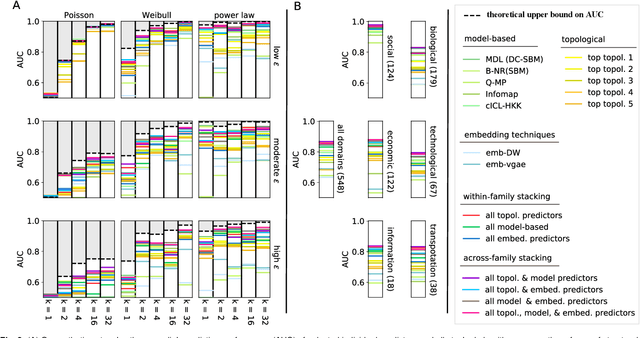
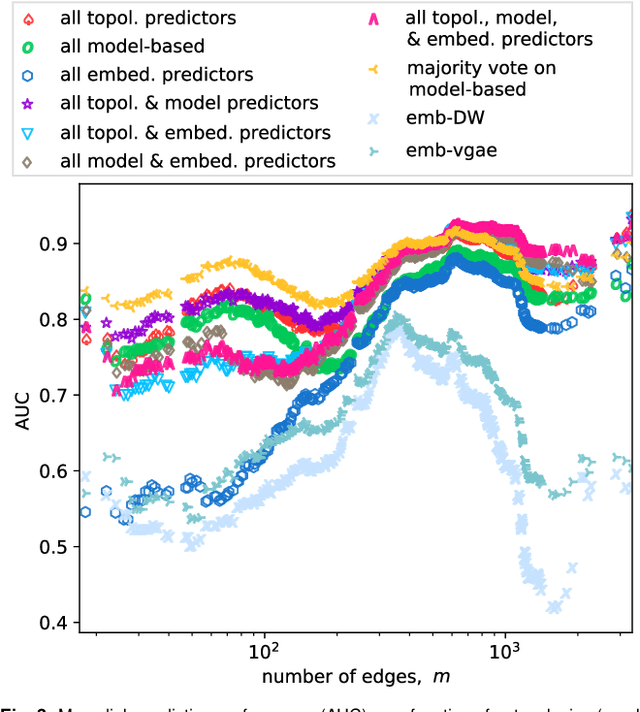
Most real-world networks are incompletely observed. Algorithms that can accurately predict which links are missing can dramatically speedup the collection of network data and improve the validity of network models. Many algorithms now exist for predicting missing links, given a partially observed network, but it has remained unknown whether a single best predictor exists, how link predictability varies across methods and networks from different domains, and how close to optimality current methods are. We answer these questions by systematically evaluating 203 individual link predictor algorithms, representing three popular families of methods, applied to a large corpus of 548 structurally diverse networks from six scientific domains. We first show that individual algorithms exhibit a broad diversity of prediction errors, such that no one predictor or family is best, or worst, across all realistic inputs. We then exploit this diversity via meta-learning to construct a series of "stacked" models that combine predictors into a single algorithm. Applied to a broad range of synthetic networks, for which we may analytically calculate optimal performance, these stacked models achieve optimal or nearly optimal levels of accuracy. Applied to real-world networks, stacked models are also superior, but their accuracy varies strongly by domain, suggesting that link prediction may be fundamentally easier in social networks than in biological or technological networks. These results indicate that the state-of-the-art for link prediction comes from combining individual algorithms, which achieves nearly optimal predictions. We close with a brief discussion of limitations and opportunities for further improvement of these results.
Tensor Embedding: A Supervised Framework for Human Behavioral Data Mining and Prediction
Aug 31, 2018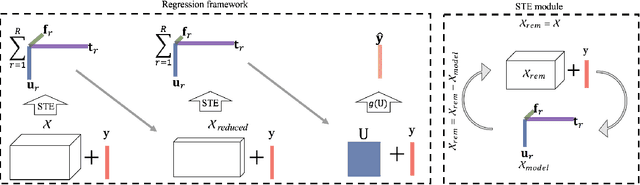
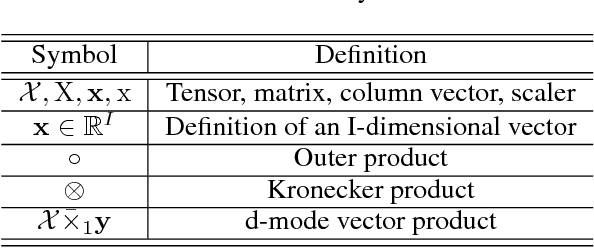
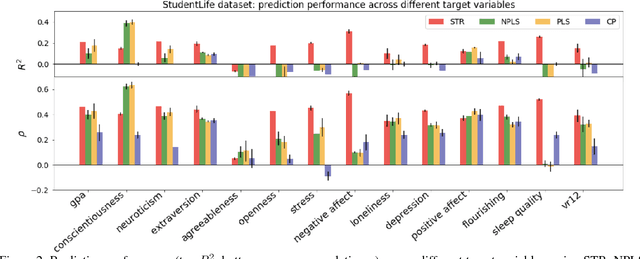
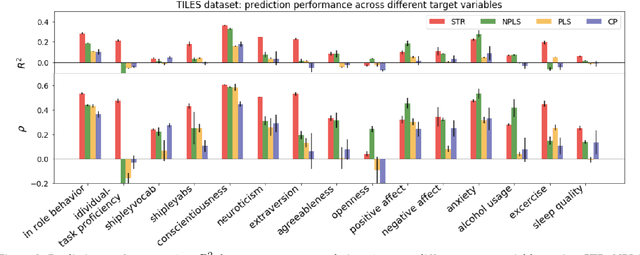
Today's densely instrumented world offers tremendous opportunities for continuous acquisition and analysis of multimodal sensor data providing temporal characterization of an individual's behaviors. Is it possible to efficiently couple such rich sensor data with predictive modeling techniques to provide contextual, and insightful assessments of individual performance and wellbeing? Prediction of different aspects of human behavior from these noisy, incomplete, and heterogeneous bio-behavioral temporal data is a challenging problem, beyond unsupervised discovery of latent structures. We propose a Supervised Tensor Embedding (STE) algorithm for high dimension multimodal data with join decomposition of input and target variable. Furthermore, we show that features selection will help to reduce the contamination in the prediction and increase the performance. The efficiently of the methods was tested via two different real world datasets.
Evaluating Overfit and Underfit in Models of Network Community Structure
Mar 01, 2018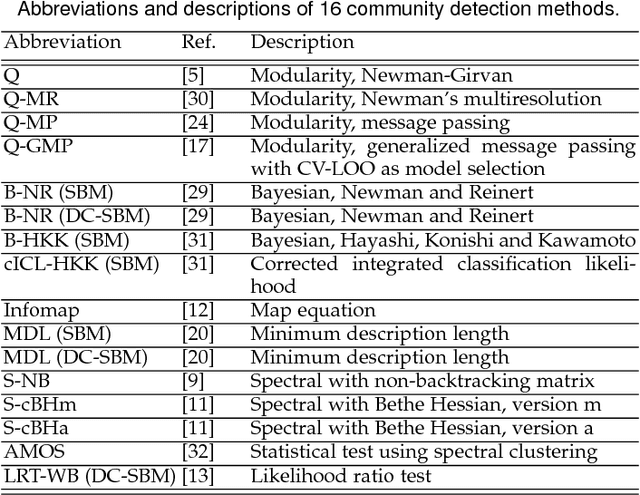
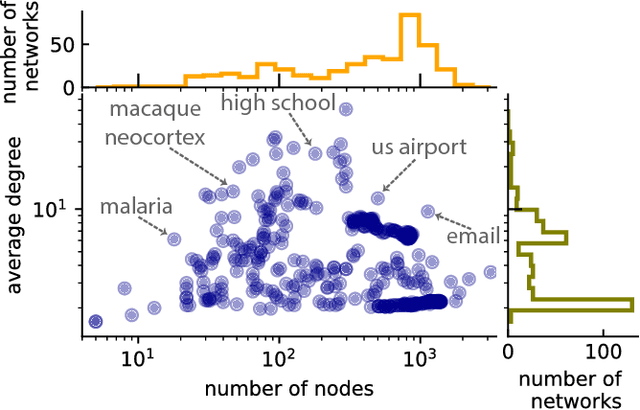
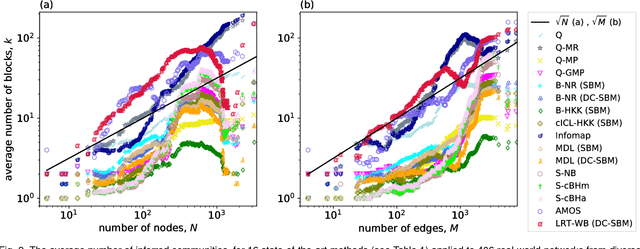
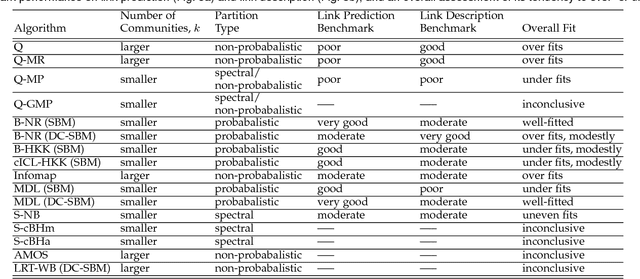
A common data mining task on networks is community detection, which seeks an unsupervised decomposition of a network into structural groups based on statistical regularities in the network's connectivity. Although many methods exist, the No Free Lunch theorem for community detection implies that each makes some kind of tradeoff, and no algorithm can be optimal on all inputs. Thus, different algorithms will over or underfit on different inputs, finding more, fewer, or just different communities than is optimal, and evaluation methods that use a metadata partition as a ground truth will produce misleading conclusions about general accuracy. Here, we present a broad evaluation of over and underfitting in community detection, comparing the behavior of 16 state-of-the-art community detection algorithms on a novel and structurally diverse corpus of 406 real-world networks. We find that (i) algorithms vary widely both in the number of communities they find and in their corresponding composition, given the same input, (ii) algorithms can be clustered into distinct high-level groups based on similarities of their outputs on real-world networks, and (iii) these differences induce wide variation in accuracy on link prediction and link description tasks. We introduce a new diagnostic for evaluating overfitting and underfitting in practice, and use it to roughly divide community detection methods into general and specialized learning algorithms. Across methods and inputs, Bayesian techniques based on the stochastic block model and a minimum description length approach to regularization represent the best general learning approach, but can be outperformed under specific circumstances. These results introduce both a theoretically principled approach to evaluate over and underfitting in models of network community structure and a realistic benchmark by which new methods may be evaluated and compared.
Detectability thresholds and optimal algorithms for community structure in dynamic networks
Jun 19, 2015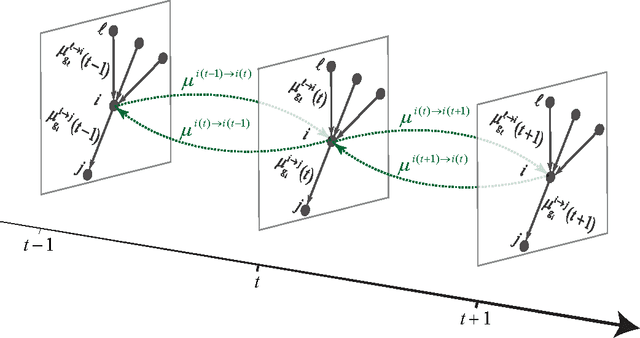
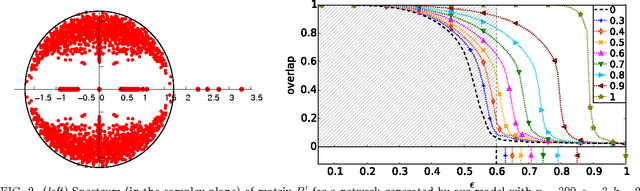
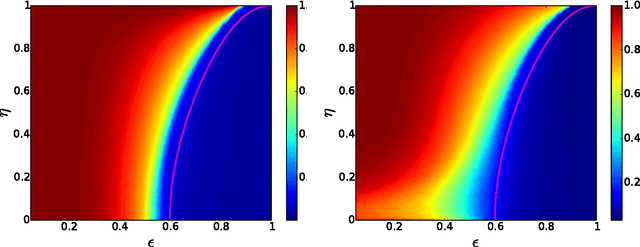
We study the fundamental limits on learning latent community structure in dynamic networks. Specifically, we study dynamic stochastic block models where nodes change their community membership over time, but where edges are generated independently at each time step. In this setting (which is a special case of several existing models), we are able to derive the detectability threshold exactly, as a function of the rate of change and the strength of the communities. Below this threshold, we claim that no algorithm can identify the communities better than chance. We then give two algorithms that are optimal in the sense that they succeed all the way down to this limit. The first uses belief propagation (BP), which gives asymptotically optimal accuracy, and the second is a fast spectral clustering algorithm, based on linearizing the BP equations. We verify our analytic and algorithmic results via numerical simulation, and close with a brief discussion of extensions and open questions.
* 9 pages, 3 figures