 Add to Chrome
 Add to Firefox
 Add to Edge
Participation and Representation in Local Government Speech
Apr 23, 2026
Local government meetings are the most common formal channel through which residents speak directly with elected officials, contest policies, and shape local agendas. However, data constraints typically limit the empirical study of these meetings to agendas, single cities, or short time horizons. We collect and transcribe a massive new dataset of city council meetings from 115 California cities over the last decade, using advanced transcription and diarization techniques to analyze the speech content of the meetings themselves. We document two sets of descriptive findings: First, city council meetings are frequent, long, and vary modestly across towns and time in topical content. Second, public participants are substantially older, whiter, more male, more liberal, and more likely to own homes than the registered voter population, and public participation surges when topics related to land use and zoning are included in meeting agendas. Given this skew, we examine the main policy lever municipalities have to shift participation patterns: meeting access costs. Exploiting pandemic-era variation in remote access, we show that eliminating remote options reduces the number of speakers, but does not clearly change the composition of speakers. Collectively, these results provide the most comprehensive empirical portrait to date of who participates in local democracy, what draws them in, and how institutional design choices shape both the volume and composition of public input.

Causal Effect Estimation with Latent Textual Treatments
Feb 17, 2026Understanding the causal effects of text on downstream outcomes is a central task in many applications. Estimating such effects requires researchers to run controlled experiments that systematically vary textual features. While large language models (LLMs) hold promise for generating text, producing and evaluating controlled variation requires more careful attention. In this paper, we present an end-to-end pipeline for the generation and causal estimation of latent textual interventions. Our work first performs hypothesis generation and steering via sparse autoencoders (SAEs), followed by robust causal estimation. Our pipeline addresses both computational and statistical challenges in text-as-treatment experiments. We demonstrate that naive estimation of causal effects suffers from significant bias as text inherently conflates treatment and covariate information. We describe the estimation bias induced in this setting and propose a solution based on covariate residualization. Our empirical results show that our pipeline effectively induces variation in target features and mitigates estimation error, providing a robust foundation for causal effect estimation in text-as-treatment settings.
Double and Single Descent in Causal Inference with an Application to High-Dimensional Synthetic Control
May 01, 2023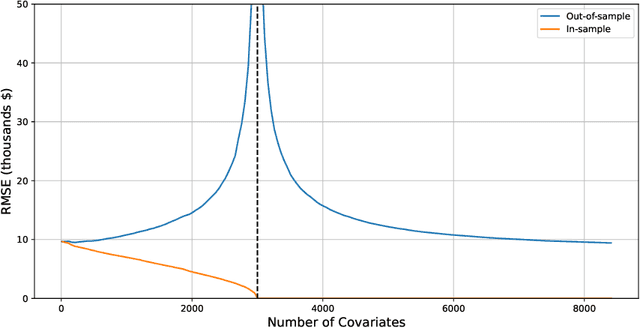
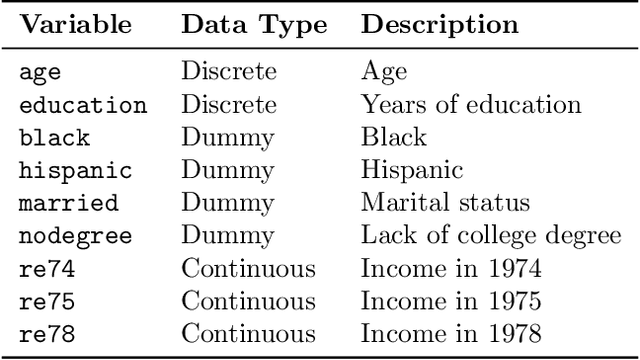
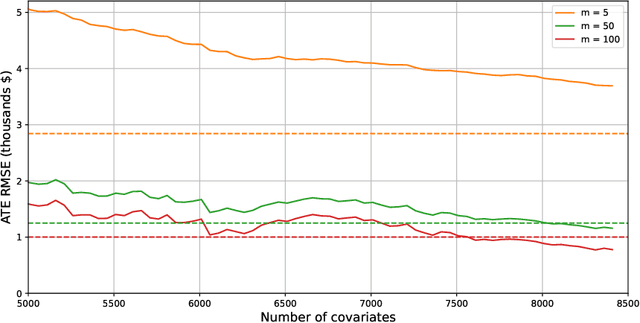
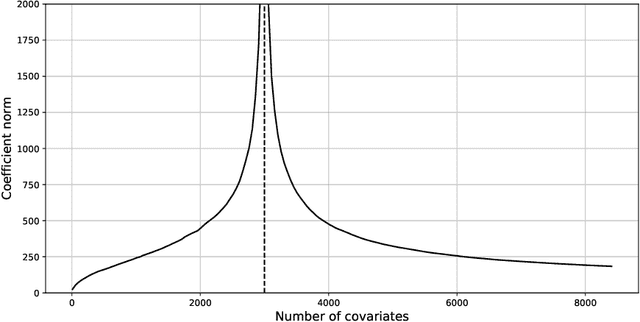
Motivated by a recent literature on the double-descent phenomenon in machine learning, we consider highly over-parametrized models in causal inference, including synthetic control with many control units. In such models, there may be so many free parameters that the model fits the training data perfectly. As a motivating example, we first investigate high-dimensional linear regression for imputing wage data, where we find that models with many more covariates than sample size can outperform simple ones. As our main contribution, we document the performance of high-dimensional synthetic control estimators with many control units. We find that adding control units can help improve imputation performance even beyond the point where the pre-treatment fit is perfect. We then provide a unified theoretical perspective on the performance of these high-dimensional models. Specifically, we show that more complex models can be interpreted as model-averaging estimators over simpler ones, which we link to an improvement in average performance. This perspective yields concrete insights into the use of synthetic control when control units are many relative to the number of pre-treatment periods.