 Add to Chrome
 Add to Firefox
 Add to Edge
Federated Learning Playground
Feb 23, 2026
We present Federated Learning Playground, an interactive browser-based platform inspired by and extends TensorFlow Playground that teaches core Federated Learning (FL) concepts. Users can experiment with heterogeneous client data distributions, model hyperparameters, and aggregation algorithms directly in the browser without coding or system setup, and observe their effects on client and global models through real-time visualizations, gaining intuition for challenges such as non-IID data, local overfitting, and scalability. The playground serves as an easy to use educational tool, lowering the entry barrier for newcomers to distributed AI while also offering a sandbox for rapidly prototyping and comparing FL methods. By democratizing exploration of FL, it promotes broader understanding and adoption of this important paradigm.

Advances and Open Challenges in Federated Learning with Foundation Models
Apr 29, 2024


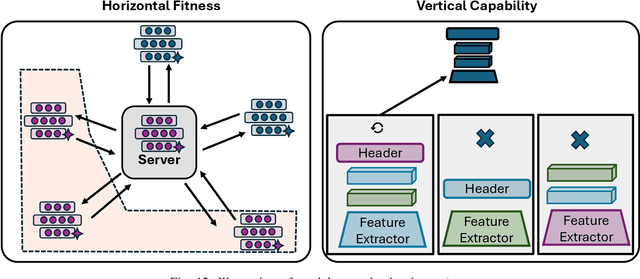
The integration of Foundation Models (FMs) with Federated Learning (FL) presents a transformative paradigm in Artificial Intelligence (AI), offering enhanced capabilities while addressing concerns of privacy, data decentralization, and computational efficiency. This paper provides a comprehensive survey of the emerging field of Federated Foundation Models (FedFM), elucidating their synergistic relationship and exploring novel methodologies, challenges, and future directions that the FL research field needs to focus on in order to thrive in the age of foundation models. A systematic multi-tiered taxonomy is proposed, categorizing existing FedFM approaches for model training, aggregation, trustworthiness, and incentivization. Key challenges, including how to enable FL to deal with high complexity of computational demands, privacy considerations, contribution evaluation, and communication efficiency, are thoroughly discussed. Moreover, the paper explores the intricate challenges of communication, scalability and security inherent in training/fine-tuning FMs via FL, highlighting the potential of quantum computing to revolutionize the training, inference, optimization and data encryption processes. This survey underscores the importance of further research to propel innovation in FedFM, emphasizing the need for developing trustworthy solutions. It serves as a foundational guide for researchers and practitioners interested in contributing to this interdisciplinary and rapidly advancing field.
Towards Personalized Federated Learning
Mar 01, 2021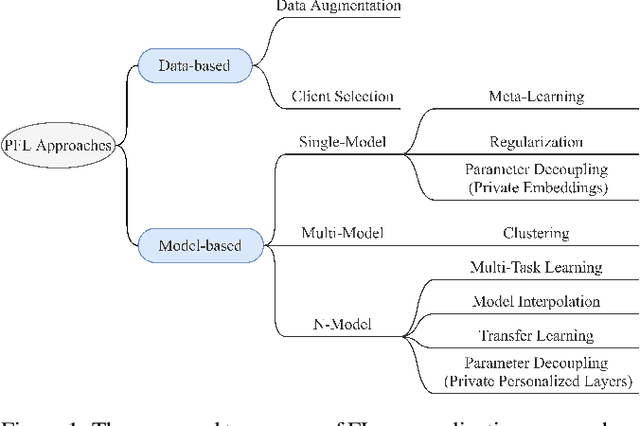
As artificial intelligence (AI)-empowered applications become widespread, there is growing awareness and concern for user privacy and data confidentiality. This has contributed to the popularity of federated learning (FL). FL applications often face data distribution and device capability heterogeneity across data owners. This has stimulated the rapid development of Personalized FL (PFL). In this paper, we complement existing surveys, which largely focus on the methods and applications of FL, with a review of recent advances in PFL. We discuss hurdles to PFL under the current FL settings, and present a unique taxonomy dividing PFL techniques into data-based and model-based approaches. We highlight their key ideas, and envision promising future trajectories of research towards new PFL architectural design, realistic PFL benchmarking, and trustworthy PFL approaches.