 Add to Chrome
 Add to Firefox
 Add to Edge
Long-Term and Short-Term Transistor Aging in Deep Neural Networks: Impact and Mitigation
Jun 02, 2026
Deep neural networks (DNNs) are used in a variety of real-world applications including, for example, image classification and speech recognition. The inference accuracy of DNN implemented on hardware in integrated circuits (ICs) degrades under phenomena such as transistor aging. Aging slows down the switching speed of transistors, resulting in system-level timing violations due to unsustainable clocks. To maintain reliability for the entire projected lifetime, designers add guardbands to prevent timing violations; however, adding large timing guardbands causes losses in performance (speed or throughput). This chapter provides a detailed discussion of the effects of long-term and short-term transistor aging on DNN inference accuracy. Furthermore, to mitigate aging effects on DNN's accuracy and keep them at bay, a methodology for aging-aware retraining is presented in order to generate a resilient DNN even when aggressive (i.e., smaller than required) guardbands are used. This improves the inference accuracy of the DNNs even in the presence of aging-induced degradation. These effects are discussed in this chapter along with mitigation strategies on a hardware implementation of a DNN for image classification on an off-the-shelf image dataset. The application of short-term aging as an excitation mechanism for the detection of hardware Trojans in integrated circuits is also briefly discussed.

Privacy-Preserving Collaborative Learning through Feature Extraction
Dec 13, 2022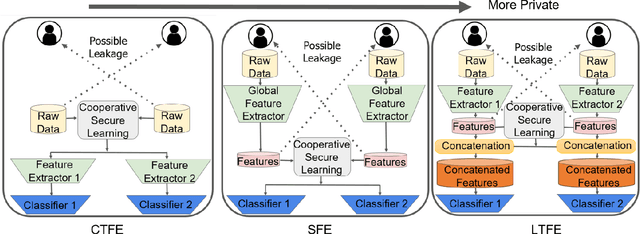

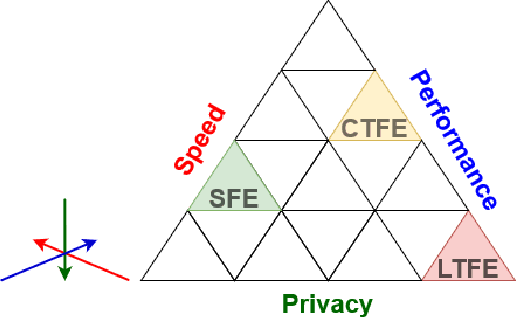
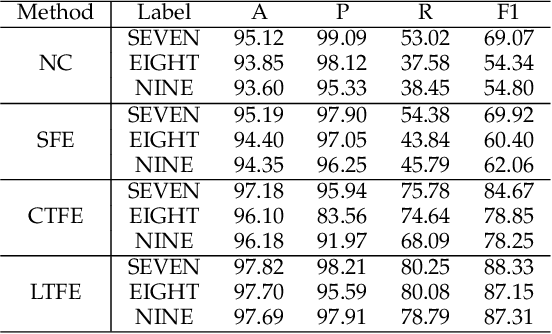
We propose a framework in which multiple entities collaborate to build a machine learning model while preserving privacy of their data. The approach utilizes feature embeddings from shared/per-entity feature extractors transforming data into a feature space for cooperation between entities. We propose two specific methods and compare them with a baseline method. In Shared Feature Extractor (SFE) Learning, the entities use a shared feature extractor to compute feature embeddings of samples. In Locally Trained Feature Extractor (LTFE) Learning, each entity uses a separate feature extractor and models are trained using concatenated features from all entities. As a baseline, in Cooperatively Trained Feature Extractor (CTFE) Learning, the entities train models by sharing raw data. Secure multi-party algorithms are utilized to train models without revealing data or features in plain text. We investigate the trade-offs among SFE, LTFE, and CTFE in regard to performance, privacy leakage (using an off-the-shelf membership inference attack), and computational cost. LTFE provides the most privacy, followed by SFE, and then CTFE. Computational cost is lowest for SFE and the relative speed of CTFE and LTFE depends on network architecture. CTFE and LTFE provide the best accuracy. We use MNIST, a synthetic dataset, and a credit card fraud detection dataset for evaluations.