 Add to Chrome
 Add to Firefox
 Add to Edge
An adaptive self-organizing fuzzy logic controller in a serious game for motor impairment rehabilitation
Apr 27, 2018


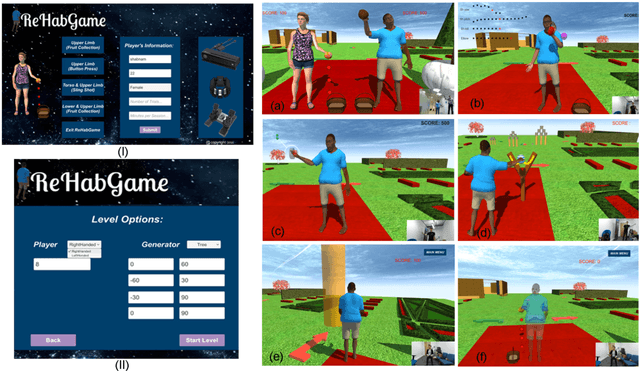
Rehabilitation robotics combined with video game technology provides a means of assisting in the rehabilitation of patients with neuromuscular disorders by performing various facilitation movements. The current work presents ReHabGame, a serious game using a fusion of implemented technologies that can be easily used by patients and therapists to assess and enhance sensorimotor performance and also increase the activities in the daily lives of patients. The game allows a player to control avatar movements through a Kinect Xbox, Myo armband and rudder foot pedal, and involves a series of reach-grasp-collect tasks whose difficulty levels are learnt by a fuzzy interface. The orientation, angular velocity, head and spine tilts and other data generated by the player are monitored and saved, whilst the task completion is calculated by solving an inverse kinematics algorithm which orientates the upper limb joints of the avatar. The different values in upper body quantities of movement provide fuzzy input from which crisp output is determined and used to generate an appropriate subsequent rehabilitation game level. The system can thus provide personalised, autonomously-learnt rehabilitation programmes for patients with neuromuscular disorders with superior predictions to guide the development of improved clinical protocols compared to traditional theraputic activities.
* 8 pages, 7 figures, 17096690

Intelligent Physiotherapy Through Procedural Content Generation
Apr 25, 2018

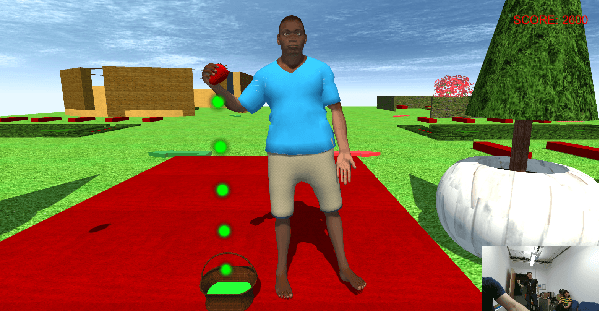
This paper describes an avenue for artificial and computational intelligence techniques applied within games research to be deployed for purposes of physical therapy. We provide an overview of prototypical research focussed on the application of motion sensor input devices and virtual reality equipment for rehabilitation of motor impairment an issue typical of patient's of traumatic brain injuries. We highlight how advances in procedural content generation and player modelling can stimulate development in this area by improving quality of rehabilitation programmes and measuring patient performance.
* 4 pages; 3 figures AAAI Publications, Twelfth Artificial Intelligence and Interactive Digital Entertainment Conference