 Add to Chrome
 Add to Firefox
 Add to Edge
Relatively Smart: A New Approach for Instance-Optimal Learning
Mar 02, 2026
We revisit the framework of Smart PAC learning, which seeks supervised learners which compete with semi-supervised learners that are provided full knowledge of the marginal distribution on unlabeled data. Prior work has shown that such marginal-by-marginal guarantees are possible for "most" marginals, with respect to an arbitrary fixed and known measure, but not more generally. We discover that this failure can be attributed to an "indistinguishability" phenomenon: There are marginals which cannot be statistically distinguished from other marginals that require different learning approaches. In such settings, semi-supervised learning cannot certify its guarantees from unlabeled data, rendering them arguably non-actionable. We propose relatively smart learning, a new framework which demands that a supervised learner compete only with the best "certifiable" semi-supervised guarantee. We show that such modest relaxation suffices to bypass the impossibility results from prior work. In the distribution-free setting, we show that the OIG learner is relatively smart up to squaring the sample complexity, and show that no supervised learning algorithm can do better. For distribution-family settings, we show that relatively smart learning can be impossible or can require idiosyncratic learning approaches, and its difficulty can be non-monotone in the inclusion order on distribution families.

Learning with Multiple Correct Answers -- A Trichotomy of Regret Bounds under Different Feedback Models
Feb 10, 2026We study an online learning problem with multiple correct answers, where each instance admits a set of valid labels, and in each round the learner must output a valid label for the queried example. This setting is motivated by language generation tasks, in which a prompt may admit many acceptable completions, but not every completion is acceptable. We study this problem under three feedback models. For each model, we characterize the optimal mistake bound in the realizable setting using an appropriate combinatorial dimension. We then establish a trichotomy of regret bounds across the three models in the agnostic setting. Our results also imply sample complexity bounds for the batch setup that depend on the respective combinatorial dimensions.
A Novel Data-Dependent Learning Paradigm for Large Hypothesis Classes
Nov 13, 2025We address the general task of learning with a set of candidate models that is too large to have a uniform convergence of empirical estimates to true losses. While the common approach to such challenges is SRM (or regularization) based learning algorithms, we propose a novel learning paradigm that relies on stronger incorporation of empirical data and requires less algorithmic decisions to be based on prior assumptions. We analyze the generalization capabilities of our approach and demonstrate its merits in several common learning assumptions, including similarity of close points, clustering of the domain into highly label-homogeneous regions, Lipschitzness assumptions of the labeling rule, and contrastive learning assumptions. Our approach allows utilizing such assumptions without the need to know their true parameters a priori.
Query-Efficient Locally Private Hypothesis Selection via the Scheffe Graph
Sep 19, 2025We propose an algorithm with improved query-complexity for the problem of hypothesis selection under local differential privacy constraints. Given a set of $k$ probability distributions $Q$, we describe an algorithm that satisfies local differential privacy, performs $\tilde{O}(k^{3/2})$ non-adaptive queries to individuals who each have samples from a probability distribution $p$, and outputs a probability distribution from the set $Q$ which is nearly the closest to $p$. Previous algorithms required either $\Omega(k^2)$ queries or many rounds of interactive queries. Technically, we introduce a new object we dub the Scheff\'e graph, which captures structure of the differences between distributions in $Q$, and may be of more broad interest for hypothesis selection tasks.
Sample-Optimal Locally Private Hypothesis Selection and the Provable Benefits of Interactivity
Dec 09, 2023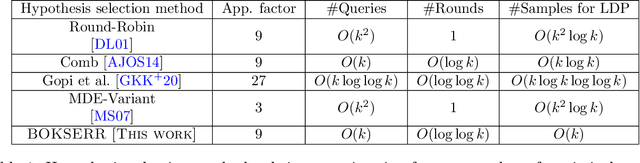
We study the problem of hypothesis selection under the constraint of local differential privacy. Given a class $\mathcal{F}$ of $k$ distributions and a set of i.i.d. samples from an unknown distribution $h$, the goal of hypothesis selection is to pick a distribution $\hat{f}$ whose total variation distance to $h$ is comparable with the best distribution in $\mathcal{F}$ (with high probability). We devise an $\varepsilon$-locally-differentially-private ($\varepsilon$-LDP) algorithm that uses $\Theta\left(\frac{k}{\alpha^2\min \{\varepsilon^2,1\}}\right)$ samples to guarantee that $d_{TV}(h,\hat{f})\leq \alpha + 9 \min_{f\in \mathcal{F}}d_{TV}(h,f)$ with high probability. This sample complexity is optimal for $\varepsilon<1$, matching the lower bound of Gopi et al. (2020). All previously known algorithms for this problem required $\Omega\left(\frac{k\log k}{\alpha^2\min \{ \varepsilon^2 ,1\}} \right)$ samples to work. Moreover, our result demonstrates the power of interaction for $\varepsilon$-LDP hypothesis selection. Namely, it breaks the known lower bound of $\Omega\left(\frac{k\log k}{\alpha^2\min \{ \varepsilon^2 ,1\}} \right)$ for the sample complexity of non-interactive hypothesis selection. Our algorithm breaks this barrier using only $\Theta(\log \log k)$ rounds of interaction. To prove our results, we define the notion of \emph{critical queries} for a Statistical Query Algorithm (SQA) which may be of independent interest. Informally, an SQA is said to use a small number of critical queries if its success relies on the accuracy of only a small number of queries it asks. We then design an LDP algorithm that uses a smaller number of critical queries.