 Add to Chrome
 Add to Firefox
 Add to Edge
Tabular Foundation Models for Clinical Survival Analysis via Survival-Aware Adaptation
Jun 10, 2026
Predicting time-to-event outcomes such as mortality is a fundamental task in clinical decision-making, commonly addressed through survival analysis. While classical statistical and deep learning approaches have been widely studied, they typically require task-specific training and sufficient labeled data. Recent advances in tabular foundation models offer a new paradigm by learning general-purpose representations for structured data. However, their applicability to censored time-to-event prediction in clinical settings remains underexplored, as typical applications are restricted to discrete classification rather than survival analysis tasks. In this work, we propose a lightweight adaptation approach for applying tabular foundation models to clinical survival analysis by directly training a survival-aware head on top of the pretrained representations. We study representative architectures, including TabPFN, TabDPT, and TabICL, and adapt them using a multi-task logistic regression (MTLR) head to model right-censored time-to-event outcomes. We evaluate this approach on a diverse set of public survival benchmarks and two large-scale ICU cohorts, MIMIC-IV and eICU. Our results show that this transfer learning approach achieves competitive or superior performance compared to strong baselines. On MIMIC-IV, TabDPT-FT-MTLR reaches a C-index of 0.856, corresponding to a relative improvement of +1.4% over the best non-FM baseline (DeepSurv, 0.844) and +6.7% over the best zero-shot model (0.802). On eICU, TabICL-FT-MTLR achieves 0.797, yielding gains of +1.7% (DeepSurv, 0.784) and +6.4% (0.749), respectively. These findings highlight the importance of combining pretrained tabular representations with survival-aware objectives and suggest that tabular foundation models provide a practical and effective alternative for clinical survival prediction.

A Machine Learning Approach to Online Fault Classification in HPC Systems
Jul 27, 2020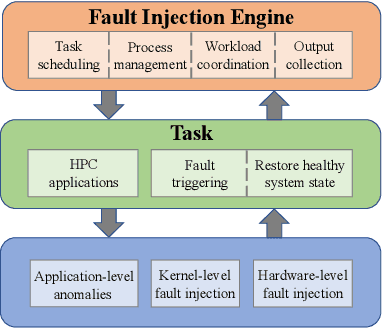
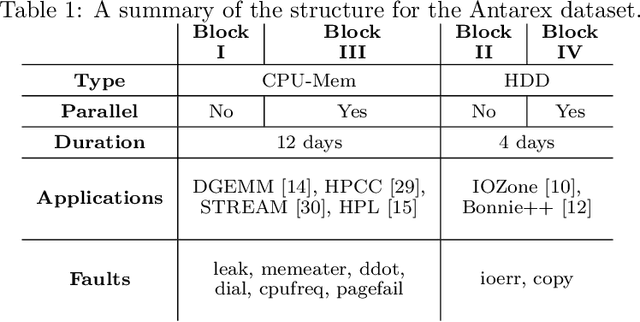
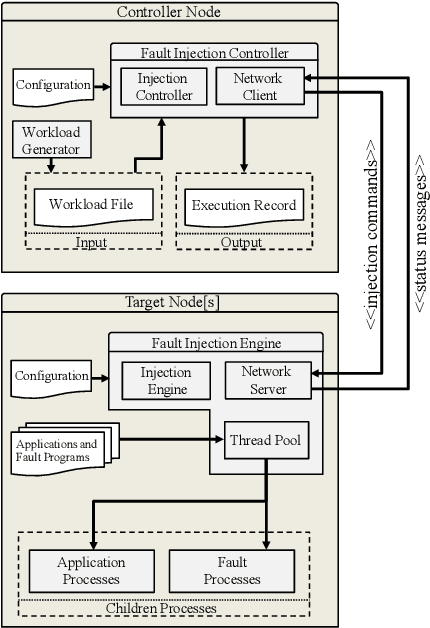
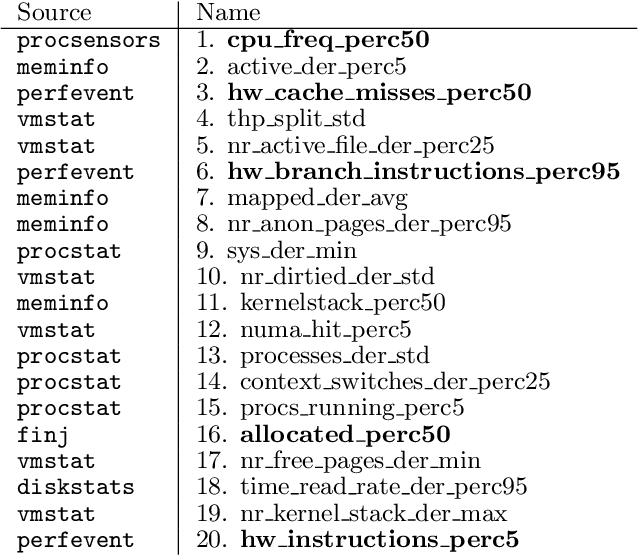
As High-Performance Computing (HPC) systems strive towards the exascale goal, failure rates both at the hardware and software levels will increase significantly. Thus, detecting and classifying faults in HPC systems as they occur and initiating corrective actions before they can transform into failures becomes essential for continued operation. Central to this objective is fault injection, which is the deliberate triggering of faults in a system so as to observe their behavior in a controlled environment. In this paper, we propose a fault classification method for HPC systems based on machine learning. The novelty of our approach rests with the fact that it can be operated on streamed data in an online manner, thus opening the possibility to devise and enact control actions on the target system in real-time. We introduce a high-level, easy-to-use fault injection tool called FINJ, with a focus on the management of complex experiments. In order to train and evaluate our machine learning classifiers, we inject faults to an in-house experimental HPC system using FINJ, and generate a fault dataset which we describe extensively. Both FINJ and the dataset are publicly available to facilitate resiliency research in the HPC systems field. Experimental results demonstrate that our approach allows almost perfect classification accuracy to be reached for different fault types with low computational overhead and minimal delay.
* arXiv admin note: text overlap with arXiv:1807.10056, arXiv:1810.11208