 Add to Chrome
 Add to Firefox
 Add to Edge
Common to Whom? Regional Cultural Commonsense and LLM Bias in India
Jan 22, 2026
Existing cultural commonsense benchmarks treat nations as monolithic, assuming uniform practices within national boundaries. But does cultural commonsense hold uniformly within a nation, or does it vary at the sub-national level? We introduce Indica, the first benchmark designed to test LLMs' ability to address this question, focusing on India - a nation of 28 states, 8 union territories, and 22 official languages. We collect human-annotated answers from five Indian regions (North, South, East, West, and Central) across 515 questions spanning 8 domains of everyday life, yielding 1,630 region-specific question-answer pairs. Strikingly, only 39.4% of questions elicit agreement across all five regions, demonstrating that cultural commonsense in India is predominantly regional, not national. We evaluate eight state-of-the-art LLMs and find two critical gaps: models achieve only 13.4%-20.9% accuracy on region-specific questions, and they exhibit geographic bias, over-selecting Central and North India as the "default" (selected 30-40% more often than expected) while under-representing East and West. Beyond India, our methodology provides a generalizable framework for evaluating cultural commonsense in any culturally heterogeneous nation, from question design grounded in anthropological taxonomy, to regional data collection, to bias measurement.

PANGeA: Procedural Artificial Narrative using Generative AI for Turn-Based Video Games
Apr 30, 2024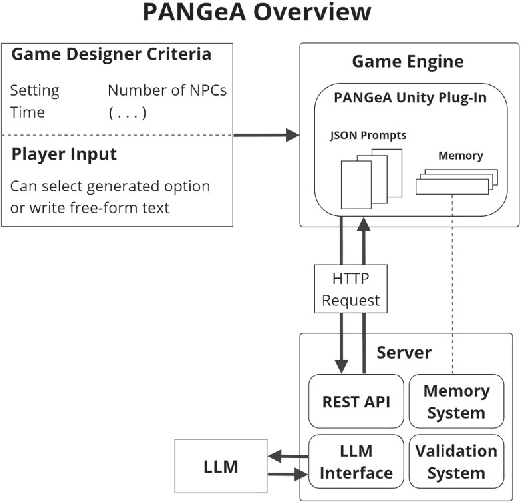
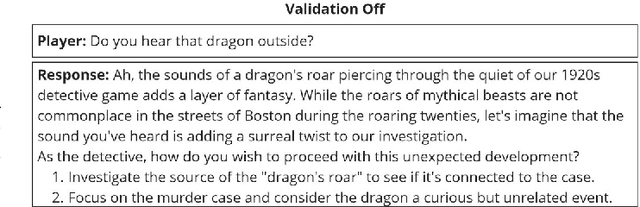
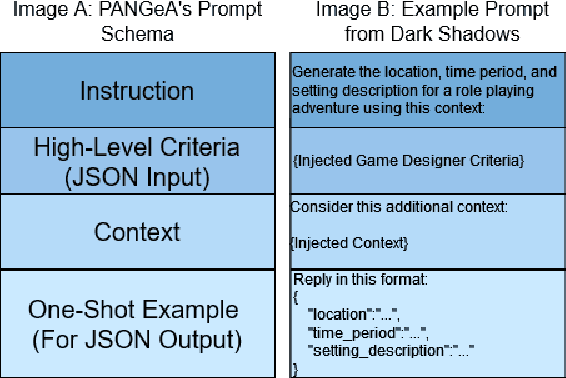
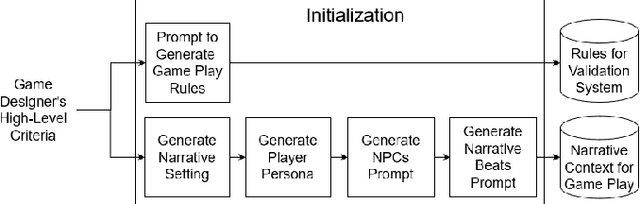
This research introduces Procedural Artificial Narrative using Generative AI (PANGeA), a structured approach for leveraging large language models (LLMs), guided by a game designer's high-level criteria, to generate narrative content for turn-based role-playing video games (RPGs). Distinct from prior applications of LLMs used for video game design, PANGeA innovates by not only generating game level data (which includes, but is not limited to, setting, key items, and non-playable characters (NPCs)), but by also fostering dynamic, free-form interactions between the player and the environment that align with the procedural game narrative. The NPCs generated by PANGeA are personality-biased and express traits from the Big 5 Personality Model in their generated responses. PANGeA addresses challenges behind ingesting free-form text input, which can prompt LLM responses beyond the scope of the game narrative. A novel validation system that uses the LLM's intelligence evaluates text input and aligns generated responses with the unfolding narrative. Making these interactions possible, PANGeA is supported by a server that hosts a custom memory system that supplies context for augmenting generated responses thus aligning them with the procedural narrative. For its broad application, the server has a REST interface enabling any game engine to integrate directly with PANGeA, as well as an LLM interface adaptable with local or private LLMs. PANGeA's ability to foster dynamic narrative generation by aligning responses with the procedural narrative is demonstrated through an empirical study and ablation test of two versions of a demo game. These are, a custom, browser-based GPT and a Unity demo. As the results show, PANGeA holds potential to assist game designers in using LLMs to generate narrative-consistent content even when provided varied and unpredictable, free-form text input.
A Framework for Leveraging Human Computation Gaming to Enhance Knowledge Graphs for Accuracy Critical Generative AI Applications
Apr 30, 2024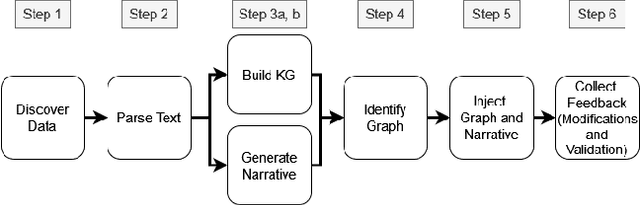
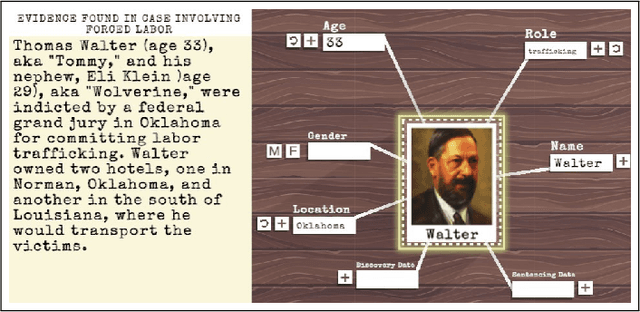
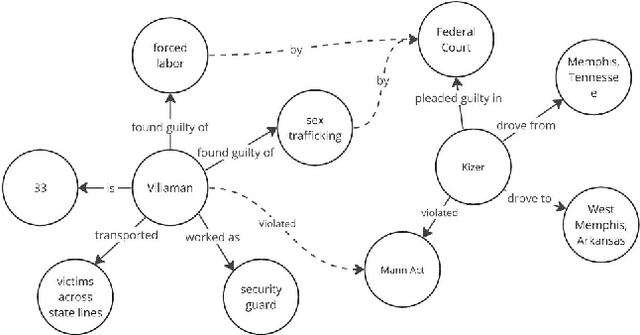
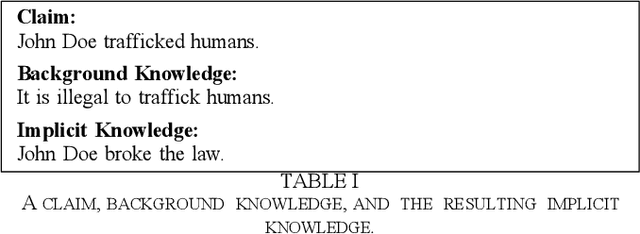
External knowledge graphs (KGs) can be used to augment large language models (LLMs), while simultaneously providing an explainable knowledge base of facts that can be inspected by a human. This approach may be particularly valuable in domains where explainability is critical, like human trafficking data analysis. However, creating KGs can pose challenges. KGs parsed from documents may comprise explicit connections (those directly stated by a document) but miss implicit connections (those obvious to a human although not directly stated). To address these challenges, this preliminary research introduces the GAME-KG framework, standing for "Gaming for Augmenting Metadata and Enhancing Knowledge Graphs." GAME-KG is a federated approach to modifying explicit as well as implicit connections in KGs by using crowdsourced feedback collected through video games. GAME-KG is shown through two demonstrations: a Unity test scenario from Dark Shadows, a video game that collects feedback on KGs parsed from US Department of Justice (DOJ) Press Releases on human trafficking, and a following experiment where OpenAI's GPT-4 is prompted to answer questions based on a modified and unmodified KG. Initial results suggest that GAME-KG can be an effective framework for enhancing KGs, while simultaneously providing an explainable set of structured facts verified by humans.