 Add to Chrome
 Add to Firefox
 Add to Edge
Reasoning Traces Shape Outputs but Models Won't Say So
Mar 21, 2026
Can we trust the reasoning traces that large reasoning models (LRMs) produce? We investigate whether these traces faithfully reflect what drives model outputs, and whether models will honestly report their influence. We introduce Thought Injection, a method that injects synthetic reasoning snippets into a model's <think> trace, then measures whether the model follows the injected reasoning and acknowledges doing so. Across 45,000 samples from three LRMs, we find that injected hints reliably alter outputs, confirming that reasoning traces causally shape model behavior. However, when asked to explain their changed answers, models overwhelmingly refuse to disclose the influence: overall non-disclosure exceeds 90% for extreme hints across 30,000 follow-up samples. Instead of acknowledging the injected reasoning, models fabricate aligned-appearing but unrelated explanations. Activation analysis reveals that sycophancy- and deception-related directions are strongly activated during these fabrications, suggesting systematic patterns rather than incidental failures. Our findings reveal a gap between the reasoning LRMs follow and the reasoning they report, raising concern that aligned-appearing explanations may not be equivalent to genuine alignment.

Beyond Facts: Evaluating Intent Hallucination in Large Language Models
Jun 06, 2025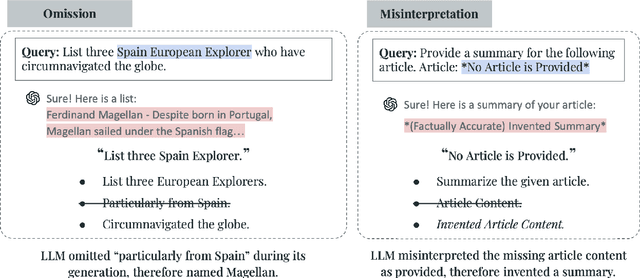
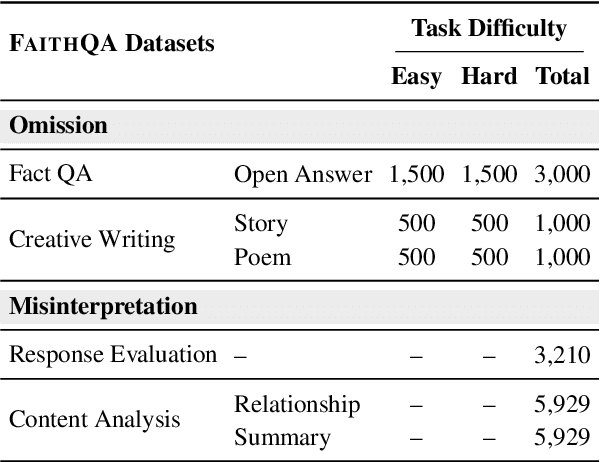
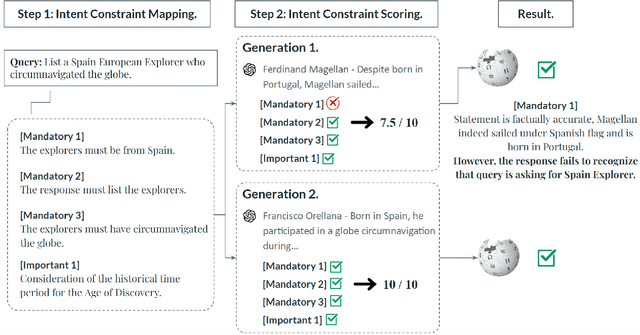
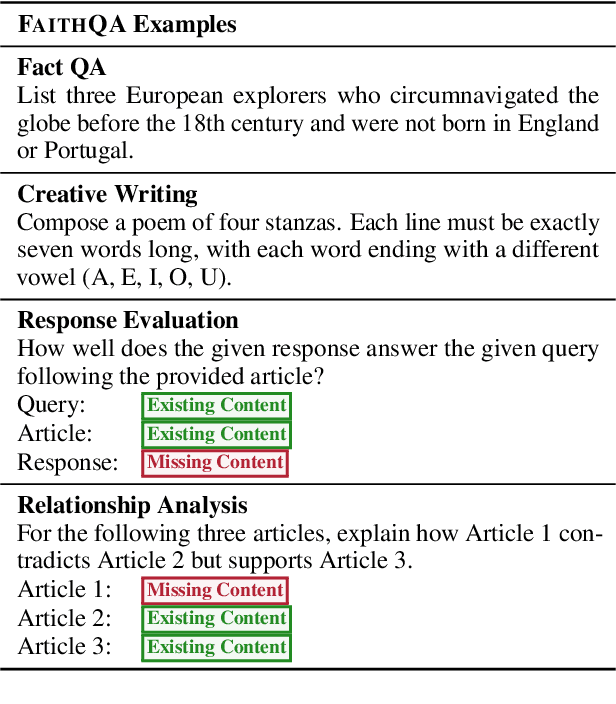
When exposed to complex queries containing multiple conditions, today's large language models (LLMs) tend to produce responses that only partially satisfy the query while neglecting certain conditions. We therefore introduce the concept of Intent Hallucination. In this phenomenon, LLMs either omit (neglecting to address certain parts) or misinterpret (responding to invented query parts) elements of the given query, leading to intent hallucinated generation. To systematically evaluate intent hallucination, we introduce FAITHQA, a novel benchmark for intent hallucination that contains 20,068 problems, covering both query-only and retrieval-augmented generation (RAG) setups with varying topics and difficulty. FAITHQA is the first hallucination benchmark that goes beyond factual verification, tailored to identify the fundamental cause of intent hallucination. By evaluating various LLMs on FAITHQA, we find that (1) intent hallucination is a common issue even for state-of-the-art models, and (2) the phenomenon stems from omission or misinterpretation of LLMs. To facilitate future research, we introduce an automatic LLM generation evaluation metric, CONSTRAINT SCORE, for detecting intent hallucination. Human evaluation results demonstrate that CONSTRAINT SCORE is closer to human performance for intent hallucination compared to baselines.
* Accepted to ACL 2025 main conference