 Add to Chrome
 Add to Firefox
 Add to Edge
Towards Model-based Run-time Cybersecurity: On Control-Flow Anomaly Detection, Attack Identification, and Hardware Monitoring
Aug 12, 2026
Methods to increase the resilience of systems to cyber-attacks become increasingly important. Control-flow monitoring provides a principled basis to ensure integrity and detect possible anomalies at run-time. Once anomalies have been detected, so-called attack trees can be used to identify possible types of attacks. However, this approach is vulnerable to camouflage, by which attackers try to evade detection (and correct identification) by deliberately manipulating also the system's observed control flow. In this paper, we outline a model-based approach that provides more robust intrusion detection and attack identification through an architecture that combines software- with hardware-based monitoring. In this approach, software-level observation indicates suspicious activities, while hardware-level monitoring checks them separately in more detail, making it much harder for attacks to camouflage themselves and go undetected. We illustrate the approach with an authentication-service example that captures a realistic failure mode: a software-level observer sees an anomalous but apparently harmless control-flow deviation, maps it to a benign root cause in an attack tree, but misses the true intrusion. A second, independent hardware control-flow monitor observes the actual transition sequence and thereby changes the attack-tree diagnosis from a low-severity configuration or maintenance issue to a high-confidence code-injection or control-flow hijack. In this scenario, the proposed combination of control-flow anomaly detection, attack-tree based intrusion identification, and hardware-based monitoring can improve not only anomaly detection, but also the diagnostic precision of attack-tree-based cyber-attack identification.

Learning Biomechanically Plausible Human Motion from Sparse Radar Point Clouds
Aug 04, 2026Radar-based human pose estimation has focused on improving learning algorithms while representing the body as unconstrained keypoint coordinates. We address the underexplored dimension of anatomical fidelity by integrating a full-body skeletal model into a differentiable, end-to-end trainable radar-based pose estimation framework, in which the pose network is supervised through forward kinematics while subject-specific geometry is fitted beforehand. Subject-specific body segment proportions are predicted from radar point cloud features to scale a biomechanical skeleton. A motion prediction network maps temporal radar sequences to generalized coordinates, and differentiable forward kinematics converts predicted joint angles into 3D positions. A contact classification loss encourages physically plausible foot-ground interaction. Under leave-one-subject-out cross-validation on 11 healthy participants performing rehabilitation exercises, the framework achieves 6.456 +/- 1.759 cm mean per-joint position error (MPJPE), 8.083 +/- 0.884 degrees mean per-joint angle error (MPJAE), 0.935 +/- 0.009 contact classification F1, and 3.4 +/- 1.3 % scaling error. This proof-of-concept study demonstrates the feasibility of recovering interpretable biomechanical descriptors from a single low-cost radar sensor in a controlled laboratory setting, a prerequisite for future clinical motion analysis.
What DINO saw: ALiBi positional encoding reduces positional bias in Vision Transformers
Mar 17, 2026Vision transformers (ViTs) - especially feature foundation models like DINOv2 - learn rich representations useful for many downstream tasks. However, architectural choices (such as positional encoding) can lead to these models displaying positional biases and artefacts independent of semantic content. This makes zero-shot adaption difficult in fields like material science, where images are often cross-sections of homogeneous microstructure (i.e. having no preferred direction). In this work, we investigate the positional bias in ViTs via linear probing, finding it present across a range of objectives and positional encodings, and subsequently reduce it by finetuning models to use ALiBi relative positional encoding. We demonstrate that these models retain desirable general semantics and their unbiased features can be used successfully in trainable segmentation of complex microscopy images.
Cube: A Roblox View of 3D Intelligence
Mar 19, 2025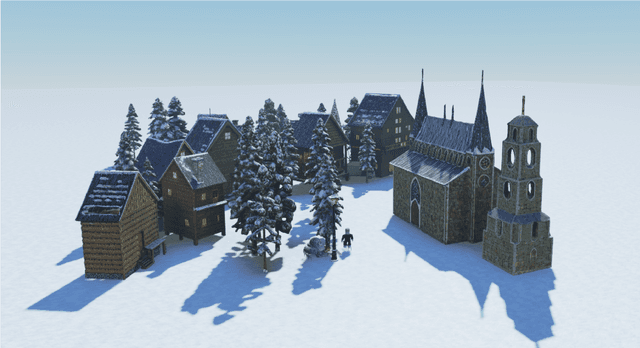
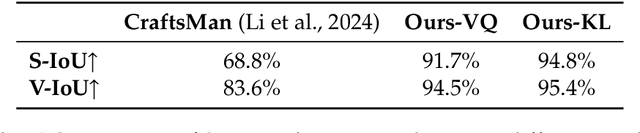
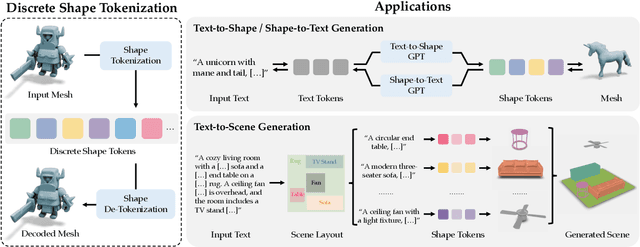
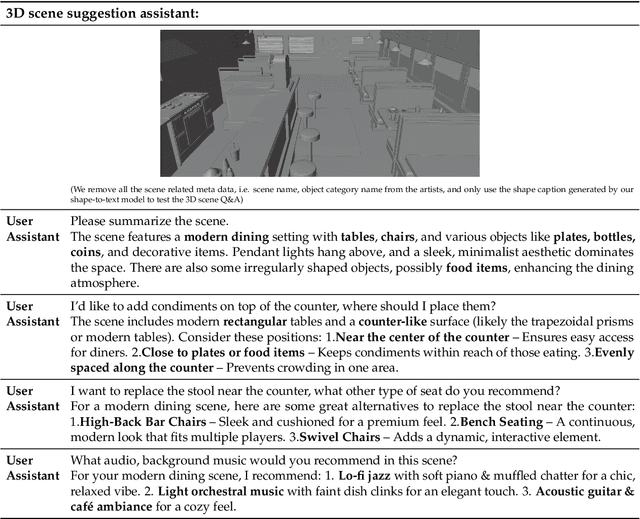
Foundation models trained on vast amounts of data have demonstrated remarkable reasoning and generation capabilities in the domains of text, images, audio and video. Our goal at Roblox is to build such a foundation model for 3D intelligence, a model that can support developers in producing all aspects of a Roblox experience, from generating 3D objects and scenes to rigging characters for animation to producing programmatic scripts describing object behaviors. We discuss three key design requirements for such a 3D foundation model and then present our first step towards building such a model. We expect that 3D geometric shapes will be a core data type and describe our solution for 3D shape tokenizer. We show how our tokenization scheme can be used in applications for text-to-shape generation, shape-to-text generation and text-to-scene generation. We demonstrate how these applications can collaborate with existing large language models (LLMs) to perform scene analysis and reasoning. We conclude with a discussion outlining our path to building a fully unified foundation model for 3D intelligence.
FlashTex: Fast Relightable Mesh Texturing with LightControlNet
Feb 20, 2024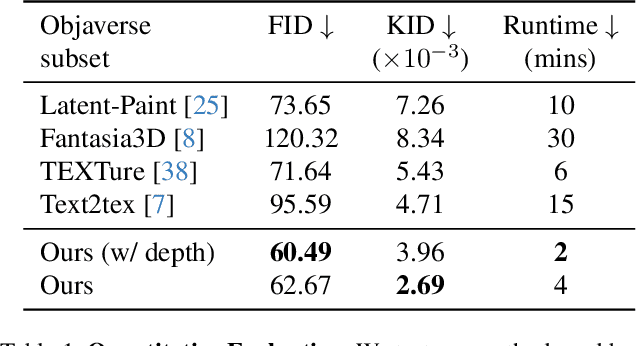

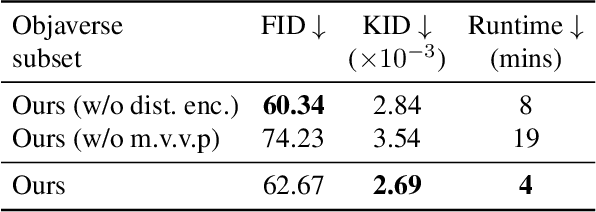
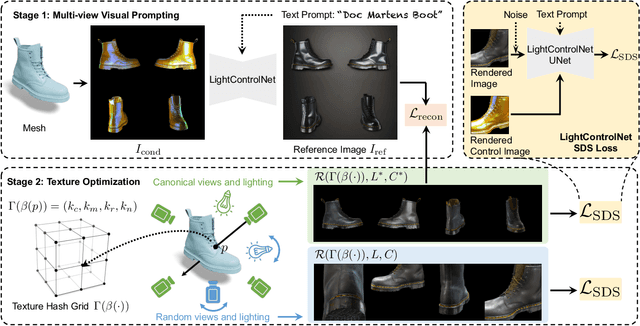
Manually creating textures for 3D meshes is time-consuming, even for expert visual content creators. We propose a fast approach for automatically texturing an input 3D mesh based on a user-provided text prompt. Importantly, our approach disentangles lighting from surface material/reflectance in the resulting texture so that the mesh can be properly relit and rendered in any lighting environment. We introduce LightControlNet, a new text-to-image model based on the ControlNet architecture, which allows the specification of the desired lighting as a conditioning image to the model. Our text-to-texture pipeline then constructs the texture in two stages. The first stage produces a sparse set of visually consistent reference views of the mesh using LightControlNet. The second stage applies a texture optimization based on Score Distillation Sampling (SDS) that works with LightControlNet to increase the texture quality while disentangling surface material from lighting. Our pipeline is significantly faster than previous text-to-texture methods, while producing high-quality and relightable textures.