 Add to Chrome
 Add to Firefox
 Add to Edge
Towards Model-based Run-time Cybersecurity: On Control-Flow Anomaly Detection, Attack Identification, and Hardware Monitoring
Aug 12, 2026
Methods to increase the resilience of systems to cyber-attacks become increasingly important. Control-flow monitoring provides a principled basis to ensure integrity and detect possible anomalies at run-time. Once anomalies have been detected, so-called attack trees can be used to identify possible types of attacks. However, this approach is vulnerable to camouflage, by which attackers try to evade detection (and correct identification) by deliberately manipulating also the system's observed control flow. In this paper, we outline a model-based approach that provides more robust intrusion detection and attack identification through an architecture that combines software- with hardware-based monitoring. In this approach, software-level observation indicates suspicious activities, while hardware-level monitoring checks them separately in more detail, making it much harder for attacks to camouflage themselves and go undetected. We illustrate the approach with an authentication-service example that captures a realistic failure mode: a software-level observer sees an anomalous but apparently harmless control-flow deviation, maps it to a benign root cause in an attack tree, but misses the true intrusion. A second, independent hardware control-flow monitor observes the actual transition sequence and thereby changes the attack-tree diagnosis from a low-severity configuration or maintenance issue to a high-confidence code-injection or control-flow hijack. In this scenario, the proposed combination of control-flow anomaly detection, attack-tree based intrusion identification, and hardware-based monitoring can improve not only anomaly detection, but also the diagnostic precision of attack-tree-based cyber-attack identification.

A Unified Framework for Runtime Verification and Model-Based Diagnosis in LOLA
Jun 18, 2026We present an integrated framework that unifies runtime verification and model-based diagnosis within the stream specification language LOLA. By encoding system descriptions, component health states, and observations into a single stream-based formalism, the approach enables continuous, online fault localization directly alongside fault detection, without requiring separate toolchains. The framework supports both time-invariant and transient faults, and naturally accommodates nondeterministic observations.
Analyzing Robustness of Angluin's L* Algorithm in Presence of Noise
Sep 21, 2022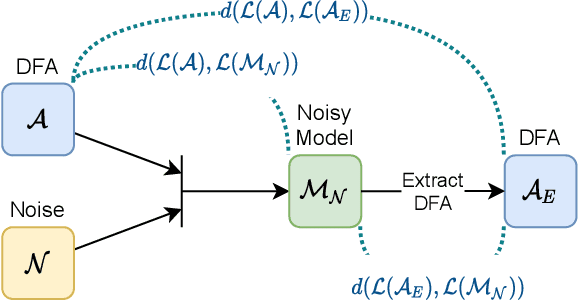
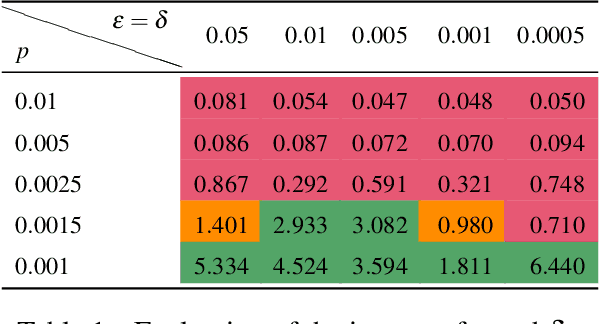
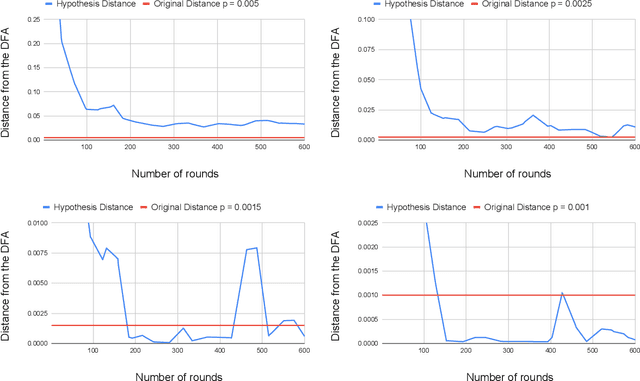
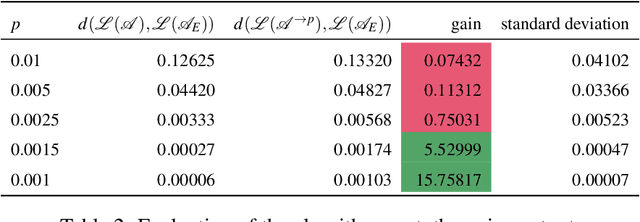
Angluin's L* algorithm learns the minimal (complete) deterministic finite automaton (DFA) of a regular language using membership and equivalence queries. Its probabilistic approximatively correct (PAC) version substitutes an equivalence query by a large enough set of random membership queries to get a high level confidence to the answer. Thus it can be applied to any kind of (also non-regular) device and may be viewed as an algorithm for synthesizing an automaton abstracting the behavior of the device based on observations. Here we are interested on how Angluin's PAC learning algorithm behaves for devices which are obtained from a DFA by introducing some noise. More precisely we study whether Angluin's algorithm reduces the noise and produces a DFA closer to the original one than the noisy device. We propose several ways to introduce the noise: (1) the noisy device inverts the classification of words w.r.t. the DFA with a small probability, (2) the noisy device modifies with a small probability the letters of the word before asking its classification w.r.t. the DFA, and (3) the noisy device combines the classification of a word w.r.t. the DFA and its classification w.r.t. a counter automaton. Our experiments were performed on several hundred DFAs. Our main contributions, bluntly stated, consist in showing that: (1) Angluin's algorithm behaves well whenever the noisy device is produced by a random process, (2) but poorly with a structured noise, and, that (3) almost surely randomness yields systems with non-recursively enumerable languages.
* In Proceedings GandALF 2022, arXiv:2209.09333
Responsible and Regulatory Conform Machine Learning for Medicine: A Survey of Technical Challenges and Solutions
Jul 20, 2021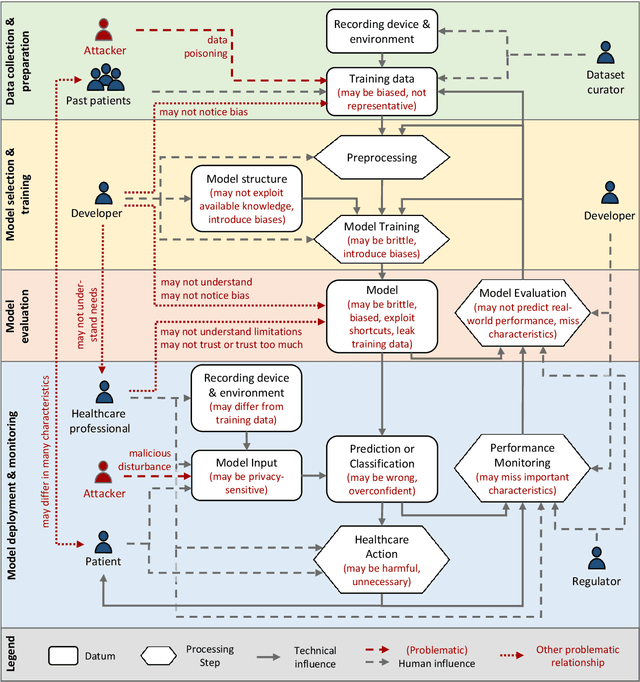
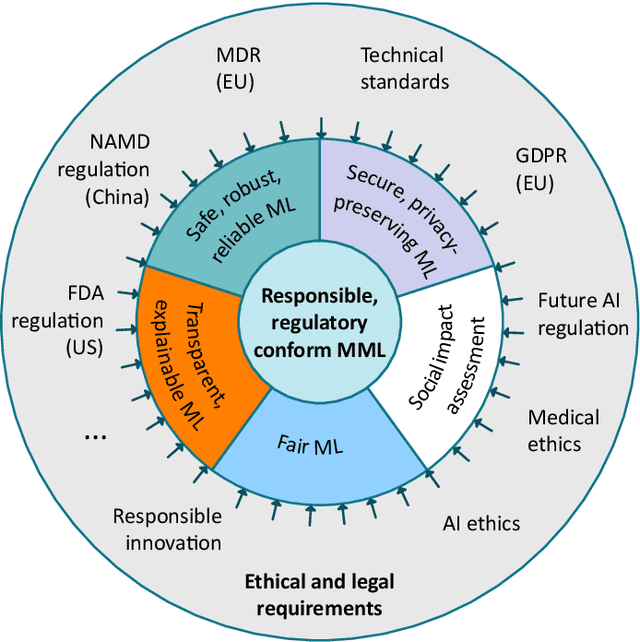
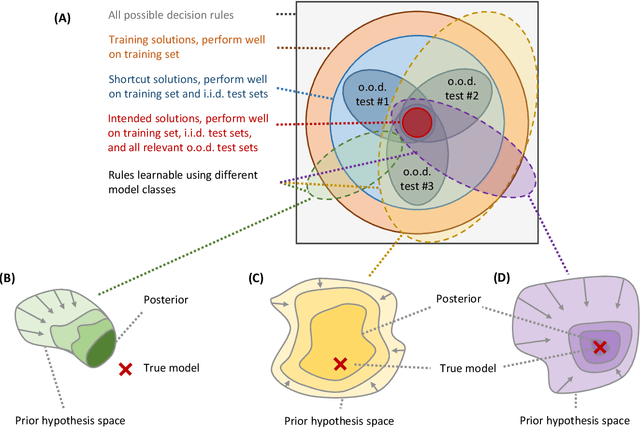
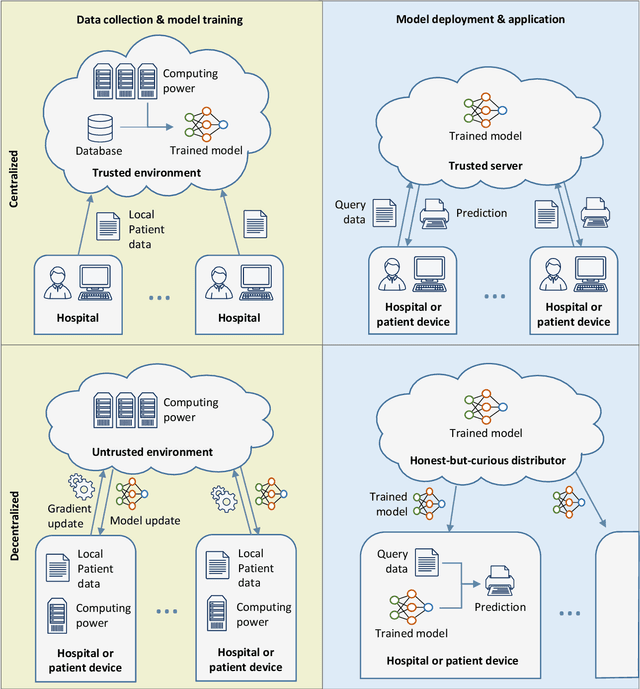
Machine learning is expected to fuel significant improvements in medical care. To ensure that fundamental principles such as beneficence, respect for human autonomy, prevention of harm, justice, privacy, and transparency are respected, medical machine learning applications must be developed responsibly. In this paper, we survey the technical challenges involved in creating medical machine learning systems responsibly and in conformity with existing regulations, as well as possible solutions to address these challenges. We begin by providing a brief overview of existing regulations affecting medical machine learning, showing that properties such as safety, robustness, reliability, privacy, security, transparency, explainability, and nondiscrimination are all demanded already by existing law and regulations - albeit, in many cases, to an uncertain degree. Next, we discuss the underlying technical challenges, possible ways for addressing them, and their respective merits and drawbacks. We notice that distribution shift, spurious correlations, model underspecification, and data scarcity represent severe challenges in the medical context (and others) that are very difficult to solve with classical black-box deep neural networks. Important measures that may help to address these challenges include the use of large and representative datasets and federated learning as a means to that end, the careful exploitation of domain knowledge wherever feasible, the use of inherently transparent models, comprehensive model testing and verification, as well as stakeholder inclusion.
Property-Directed Verification of Recurrent Neural Networks
Sep 22, 2020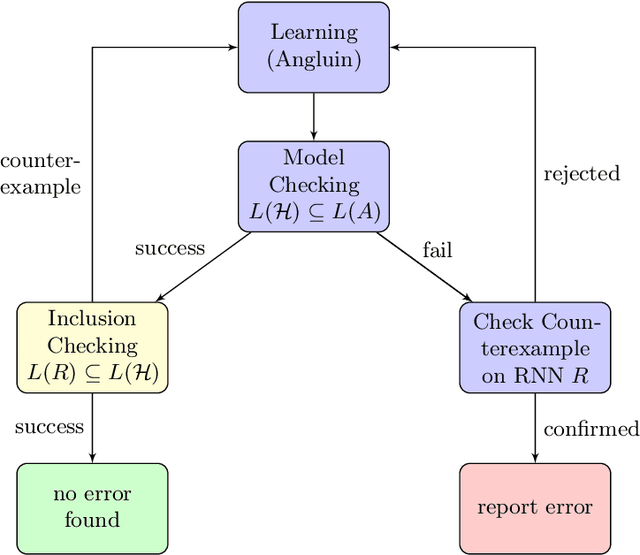
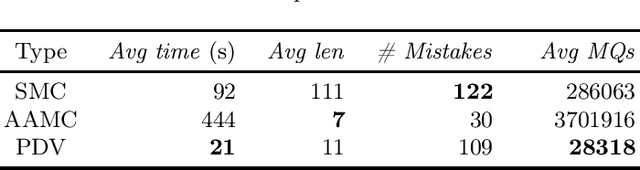
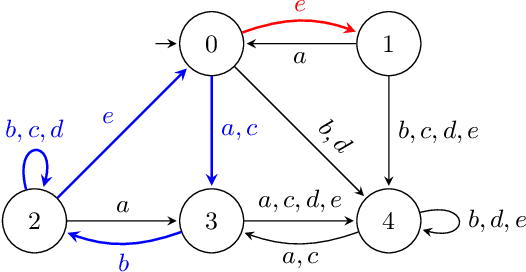
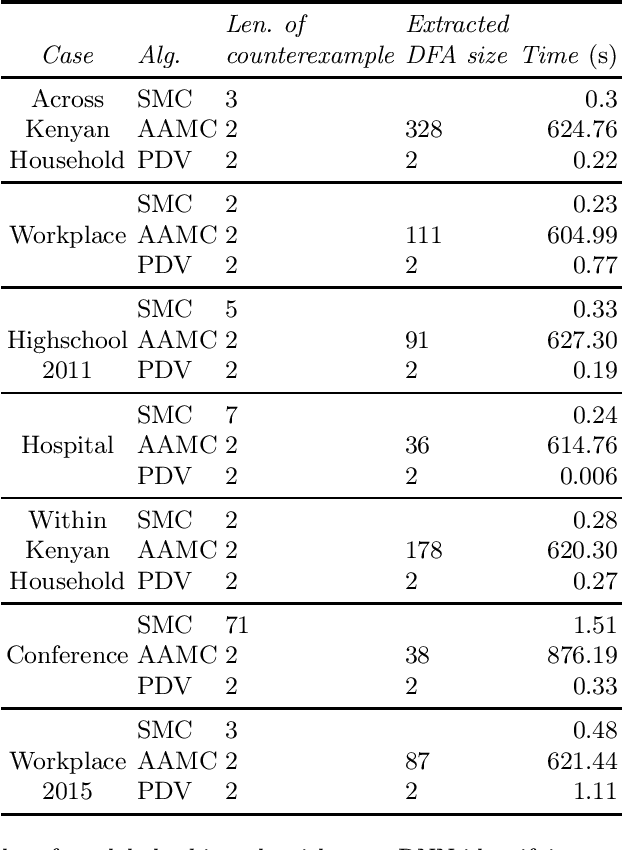
This paper presents a property-directed approach to verifying recurrent neural networks (RNNs). To this end, we learn a deterministic finite automaton as a surrogate model from a given RNN using active automata learning. This model may then be analyzed using model checking as verification technique. The term property-directed reflects the idea that our procedure is guided and controlled by the given property rather than performing the two steps separately. We show that this not only allows us to discover small counterexamples fast, but also to generalize them by pumping towards faulty flows hinting at the underlying error in the RNN.