 Add to Chrome
 Add to Firefox
 Add to Edge
JEPA-DNA: Grounding Genomic Foundation Models through Joint-Embedding Predictive Architectures
Feb 19, 2026
Genomic Foundation Models (GFMs) have largely relied on Masked Language Modeling (MLM) or Next Token Prediction (NTP) to learn the language of life. While these paradigms excel at capturing local genomic syntax and fine-grained motif patterns, they often fail to capture the broader functional context, resulting in representations that lack a global biological perspective. We introduce JEPA-DNA, a novel pre-training framework that integrates the Joint-Embedding Predictive Architecture (JEPA) with traditional generative objectives. JEPA-DNA introduces latent grounding by coupling token-level recovery with a predictive objective in the latent space by supervising a CLS token. This forces the model to predict the high-level functional embeddings of masked genomic segments rather than focusing solely on individual nucleotides. JEPA-DNA extends both NTP and MLM paradigms and can be deployed either as a standalone from-scratch objective or as a continual pre-training enhancement for existing GFMs. Our evaluations across a diverse suite of genomic benchmarks demonstrate that JEPA-DNA consistently yields superior performance in supervised and zero-shot tasks compared to generative-only baselines. By providing a more robust and biologically grounded representation, JEPA-DNA offers a scalable path toward foundation models that understand not only the genomic alphabet, but also the underlying functional logic of the sequence.

The Point of View of a Sentiment: Towards Clinician Bias Detection in Psychiatric Notes
May 31, 2024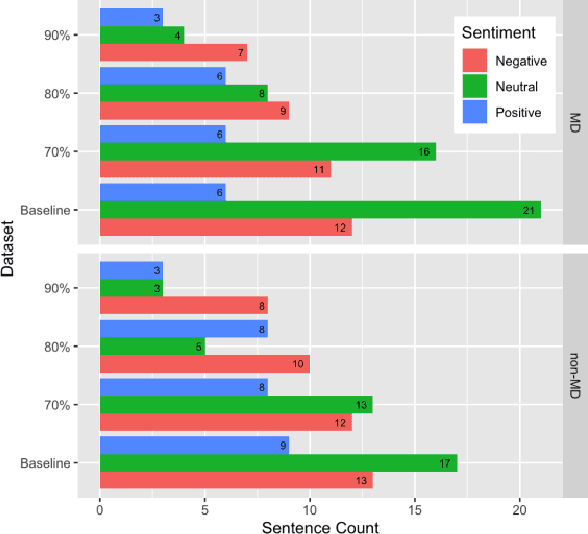
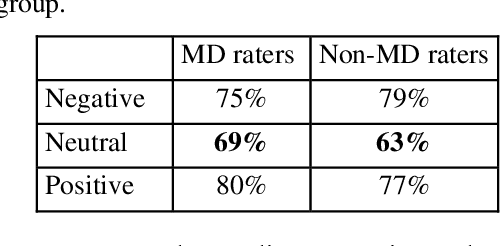
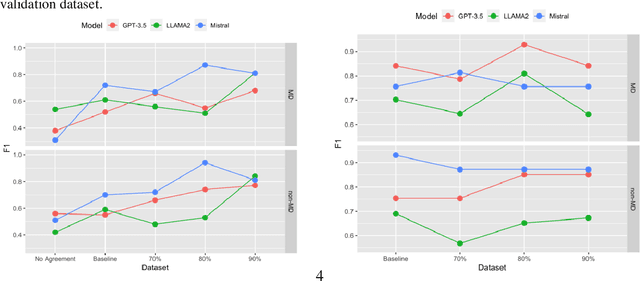
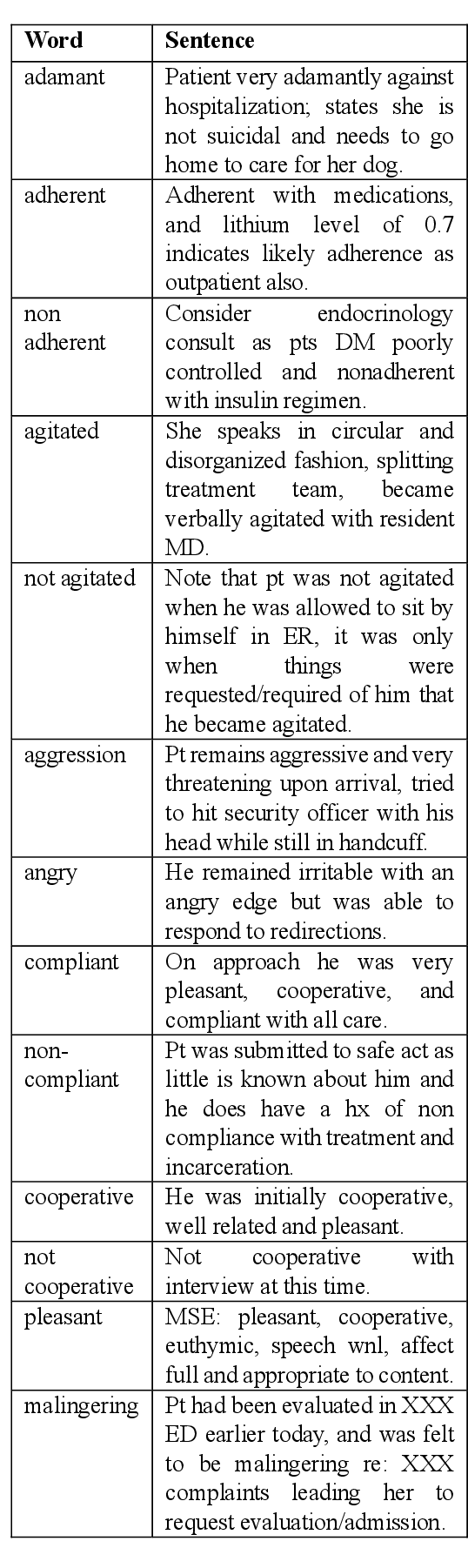
In psychiatry, negative patient descriptions and stigmatizing language can contribute to healthcare disparities in two ways: (1) read by patients they can harm their trust and engagement with the medical center; (2) read by future providers they may negatively influence the future perspective of a patient. By leveraging large language models, this work aims to identify the sentiment expressed in psychiatric clinical notes based on the reader's point of view. Extracting sentences from the Mount Sinai Health System's large and diverse clinical notes, we used prompts and in-context learning to adapt three large language models (GPT-3.5, Llama 2, Mistral) to classify the sentiment conveyed by the sentences according to the provider or non-provider point of view. Results showed that GPT-3.5 aligns best to provider point of view, whereas Mistral aligns best to non-provider point of view.
Extracting Social Support and Social Isolation Information from Clinical Psychiatry Notes: Comparing a Rule-based NLP System and a Large Language Model
Mar 25, 2024Background: Social support (SS) and social isolation (SI) are social determinants of health (SDOH) associated with psychiatric outcomes. In electronic health records (EHRs), individual-level SS/SI is typically documented as narrative clinical notes rather than structured coded data. Natural language processing (NLP) algorithms can automate the otherwise labor-intensive process of data extraction. Data and Methods: Psychiatric encounter notes from Mount Sinai Health System (MSHS, n=300) and Weill Cornell Medicine (WCM, n=225) were annotated and established a gold standard corpus. A rule-based system (RBS) involving lexicons and a large language model (LLM) using FLAN-T5-XL were developed to identify mentions of SS and SI and their subcategories (e.g., social network, instrumental support, and loneliness). Results: For extracting SS/SI, the RBS obtained higher macro-averaged f-scores than the LLM at both MSHS (0.89 vs. 0.65) and WCM (0.85 vs. 0.82). For extracting subcategories, the RBS also outperformed the LLM at both MSHS (0.90 vs. 0.62) and WCM (0.82 vs. 0.81). Discussion and Conclusion: Unexpectedly, the RBS outperformed the LLMs across all metrics. Intensive review demonstrates that this finding is due to the divergent approach taken by the RBS and LLM. The RBS were designed and refined to follow the same specific rules as the gold standard annotations. Conversely, the LLM were more inclusive with categorization and conformed to common English-language understanding. Both approaches offer advantages and are made available open-source for future testing.