 Add to Chrome
 Add to Firefox
 Add to Edge
A Hierarchical, Model-Based System for High-Performance Humanoid Soccer
Dec 10, 2025
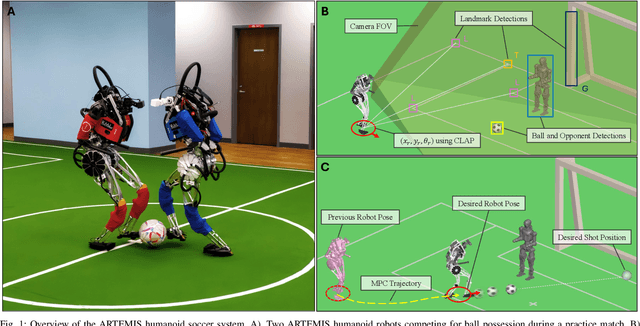
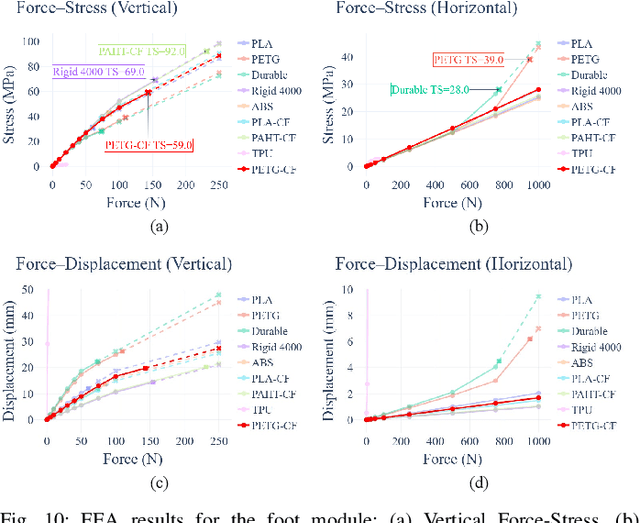
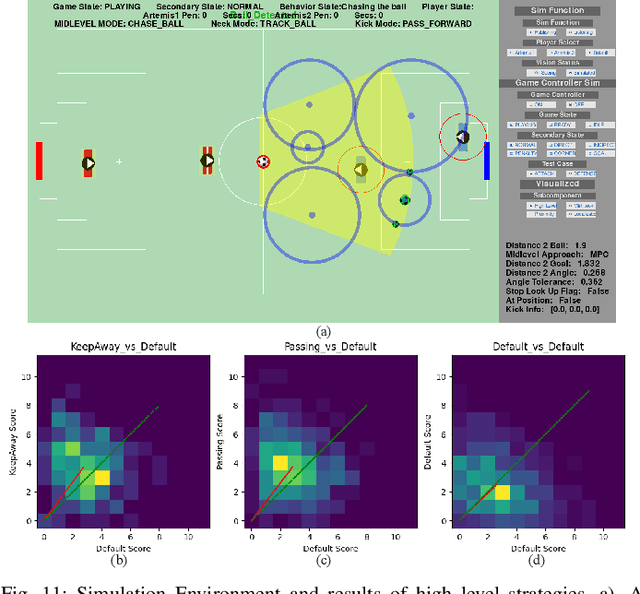
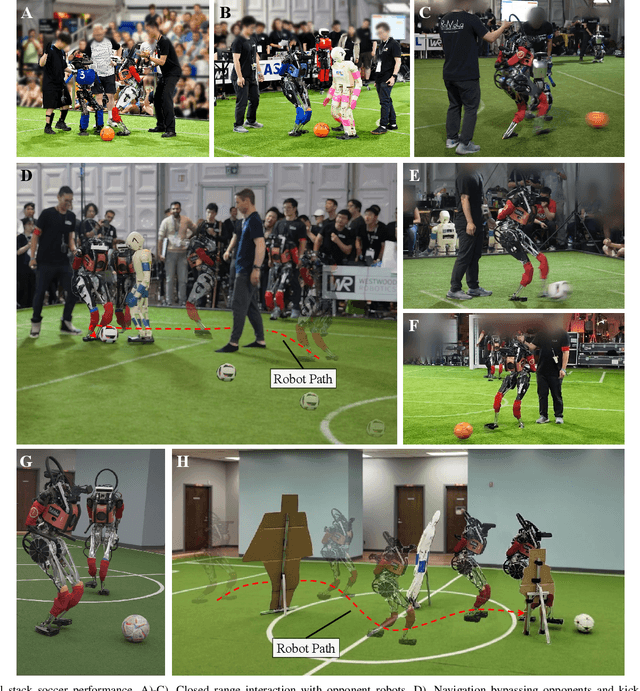
The development of athletic humanoid robots has gained significant attention as advances in actuation, sensing, and control enable increasingly dynamic, real-world capabilities. RoboCup, an international competition of fully autonomous humanoid robots, provides a uniquely challenging benchmark for such systems, culminating in the long-term goal of competing against human soccer players by 2050. This paper presents the hardware and software innovations underlying our team's victory in the RoboCup 2024 Adult-Sized Humanoid Soccer Competition. On the hardware side, we introduce an adult-sized humanoid platform built with lightweight structural components, high-torque quasi-direct-drive actuators, and a specialized foot design that enables powerful in-gait kicks while preserving locomotion robustness. On the software side, we develop an integrated perception and localization framework that combines stereo vision, object detection, and landmark-based fusion to provide reliable estimates of the ball, goals, teammates, and opponents. A mid-level navigation stack then generates collision-aware, dynamically feasible trajectories, while a centralized behavior manager coordinates high-level decision making, role selection, and kick execution based on the evolving game state. The seamless integration of these subsystems results in fast, precise, and tactically effective gameplay, enabling robust performance under the dynamic and adversarial conditions of real matches. This paper presents the design principles, system architecture, and experimental results that contributed to ARTEMIS's success as the 2024 Adult-Sized Humanoid Soccer champion.

CLAP: Clustering to Localize Across n Possibilities, A Simple, Robust Geometric Approach in the Presence of Symmetries
Sep 10, 2025In this paper, we present our localization method called CLAP, Clustering to Localize Across $n$ Possibilities, which helped us win the RoboCup 2024 adult-sized autonomous humanoid soccer competition. Competition rules limited our sensor suite to stereo vision and an inertial sensor, similar to humans. In addition, our robot had to deal with varying lighting conditions, dynamic feature occlusions, noise from high-impact stepping, and mistaken features from bystanders and neighboring fields. Therefore, we needed an accurate, and most importantly robust localization algorithm that would be the foundation for our path-planning and game-strategy algorithms. CLAP achieves these requirements by clustering estimated states of our robot from pairs of field features to localize its global position and orientation. Correct state estimates naturally cluster together, while incorrect estimates spread apart, making CLAP resilient to noise and incorrect inputs. CLAP is paired with a particle filter and an extended Kalman filter to improve consistency and smoothness. Tests of CLAP with other landmark-based localization methods showed similar accuracy. However, tests with increased false positive feature detection showed that CLAP outperformed other methods in terms of robustness with very little divergence and velocity jumps. Our localization performed well in competition, allowing our robot to shoot faraway goals and narrowly defend our goal.