 Add to Chrome
 Add to Firefox
 Add to Edge
DexDirect: Direct Kinesthetic Arm Guidance for Efficient Dexterous Demonstration Collection
Jul 30, 2026
Scalable collection of dexterous manipulation demonstrations remains a major bottleneck for robot learning. High-fidelity interfaces often require costly hardware and extensive setup, while low-setup, low cost alternatives tend to provide less precise control and impose greater cognitive workload on operators. We present DexDirect, a direct kinesthetic arm guidance for efficient dexterous demonstration collection. The operator drags a 6-DoF gravity-compensated robot arm directly by a handle, while a single webcam retargets operator's other hand onto a 16 joints 13-DoF dexterous robot hand. User studies suggest DexDirect collects 17.2x and 3.2x more successful demonstrations compared to purely vision (AnyTeleop) and pose-tracking (TeleDex) baselines. An adapted NASA-TLX shows DexDirect greatly reduces mental demand, effort, and frustration, despite raising physical demand. A diffusion policy trained on DexDirect demonstrations reaches a 90% success rate on a cube pick-and-place task. These results suggest that direct kinesthetic arm guidance combined with vision-based hand retargeting provides an efficient low-setup and scalable interface for collecting dexterous manipulation demonstrations

MIDAS Hand: Modular low-Impedance Direct-drive Anthropomorphic Sensing Hand
Jul 16, 2026Dexterous manipulation is limited not only by algorithms but by a shortage of accessible hand hardware that combines human-scale morphology, ease of manufacturing or maintenance, tactile sensing, and practical cost. Existing dexterous hands tend to optimize some of these properties at the expense of others. We present MIDAS Hand, a low-cost, open-source, human-scale dexterous hand with integrated tactile sensing for manipulation research. MIDAS Hand provides 16 total degrees of freedom (DoF) with 13 active DoF, directly driven actuation with measurably low backdrive torque, and 283 three-axis tactile taxels in a compact 700 g package with a bill of materials under 3,000 USD. Built from 3D-printed components, it assembles in under three hours while providing the strength, repeatability, and maintainability needed for repeated real-world experiments. Alongside the hardware, we release a full stack: design files, build documentation, control and tactile Python APIs, simulation models, and retargeting and teleoperation pipelines. We characterize MIDAS Hand through workspace and grasp-taxonomy analysis, payload and reliability tests, backdrivability measurements, and teleoperation demonstrations with tactile sensing, showing that it offers a balanced, reproducible platform for tactile dexterous manipulation and human-to-robot data collection. Project page: https://midas-hand.com
DexEXO: A Wearability-First Dexterous Exoskeleton for Operator-Agnostic Demonstration and Learning
Mar 18, 2026Scaling dexterous robot learning is constrained by the difficulty of collecting high-quality demonstrations across diverse operators. Existing wearable interfaces often trade comfort and cross-user adaptability for kinematic fidelity, while embodiment mismatch between demonstration and deployment requires visual post-processing before policy training. We present DexEXO, a wearability-first hand exoskeleton that aligns visual appearance, contact geometry, and kinematics at the hardware level. DexEXO features a pose-tolerant thumb mechanism and a slider-based finger interface analytically modeled to support hand lengths from 140~mm to 217~mm, reducing operator-specific fitting and enabling scalable cross-operator data collection. A passive hand visually matches the deployed robot, allowing direct policy training from raw wrist-mounted RGB observations. User studies demonstrate improved comfort and usability compared to prior wearable systems. Using visually aligned observations alone, we train diffusion policies that achieve competitive performance while substantially simplifying the end-to-end pipeline. These results show that prioritizing wearability and hardware-level embodiment alignment reduces both human and algorithmic bottlenecks without sacrificing task performance. Project Page: https://dexexo-research.github.io/
A Hierarchical, Model-Based System for High-Performance Humanoid Soccer
Dec 10, 2025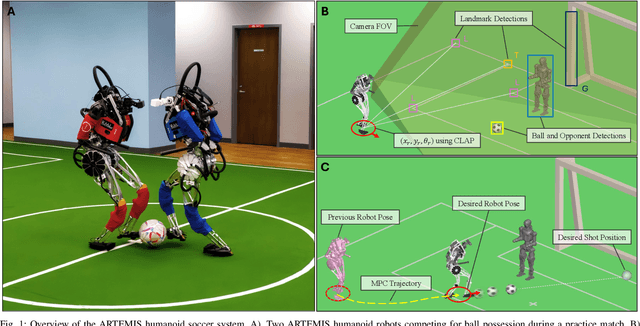
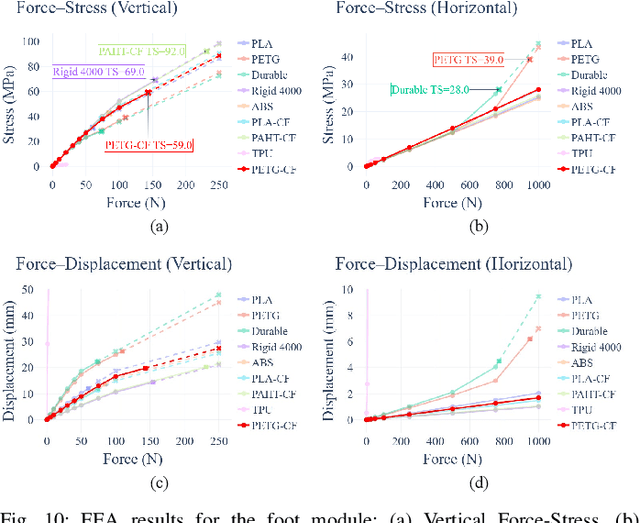
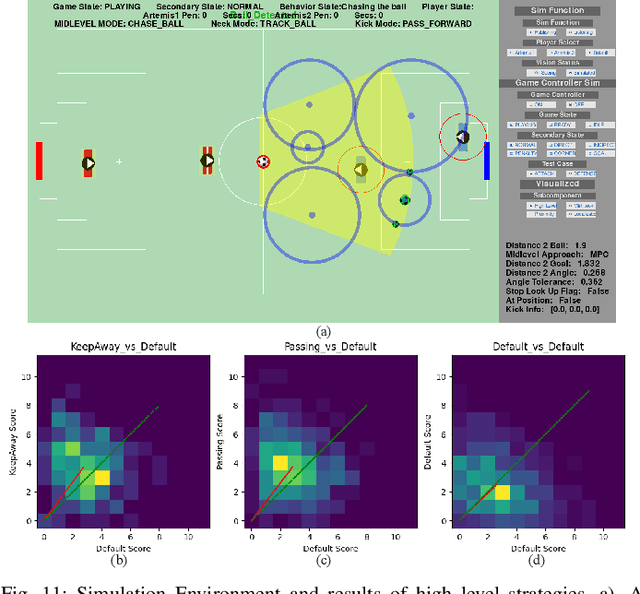
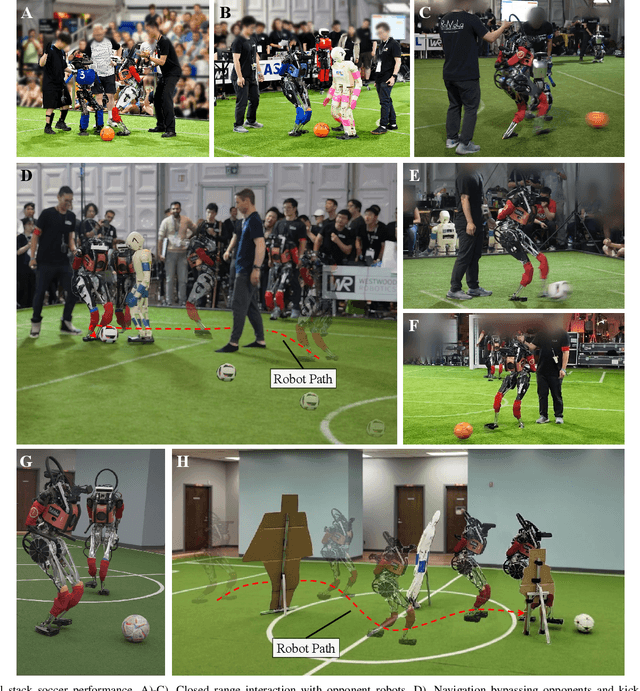
The development of athletic humanoid robots has gained significant attention as advances in actuation, sensing, and control enable increasingly dynamic, real-world capabilities. RoboCup, an international competition of fully autonomous humanoid robots, provides a uniquely challenging benchmark for such systems, culminating in the long-term goal of competing against human soccer players by 2050. This paper presents the hardware and software innovations underlying our team's victory in the RoboCup 2024 Adult-Sized Humanoid Soccer Competition. On the hardware side, we introduce an adult-sized humanoid platform built with lightweight structural components, high-torque quasi-direct-drive actuators, and a specialized foot design that enables powerful in-gait kicks while preserving locomotion robustness. On the software side, we develop an integrated perception and localization framework that combines stereo vision, object detection, and landmark-based fusion to provide reliable estimates of the ball, goals, teammates, and opponents. A mid-level navigation stack then generates collision-aware, dynamically feasible trajectories, while a centralized behavior manager coordinates high-level decision making, role selection, and kick execution based on the evolving game state. The seamless integration of these subsystems results in fast, precise, and tactically effective gameplay, enabling robust performance under the dynamic and adversarial conditions of real matches. This paper presents the design principles, system architecture, and experimental results that contributed to ARTEMIS's success as the 2024 Adult-Sized Humanoid Soccer champion.