 Add to Chrome
 Add to Firefox
 Add to Edge
GPT4o-Receipt: A Dataset and Human Study for AI-Generated Document Forensics
Mar 12, 2026
Can humans detect AI-generated financial documents better than machines? We present GPT4o-Receipt, a benchmark of 1,235 receipt images pairing GPT-4o-generated receipts with authentic ones from established datasets, evaluated by five state-of-the-art multimodal LLMs and a 30-annotator crowdsourced perceptual study. Our findings reveal a striking paradox: humans are better at seeing AI artifacts, yet worse at detecting AI documents. Human annotators exhibit the largest visual discrimination gap of any evaluator, yet their binary detection F1 falls well below Claude Sonnet 4 and below Gemini 2.5 Flash. This paradox resolves once the mechanism is understood: the dominant forensic signals in AI-generated receipts are arithmetic errors -- invisible to visual inspection but systematically verifiable by LLMs. Humans cannot perceive that a subtotal is incorrect; LLMs verify it in milliseconds. Beyond the human--LLM comparison, our five-model evaluation reveals dramatic performance disparities and calibration differences that render simple accuracy metrics insufficient for detector selection. GPT4o-Receipt, the evaluation framework, and all results are released publicly to support future research in AI document forensics.

Classification under Nuisance Parameters and Generalized Label Shift in Likelihood-Free Inference
Feb 08, 2024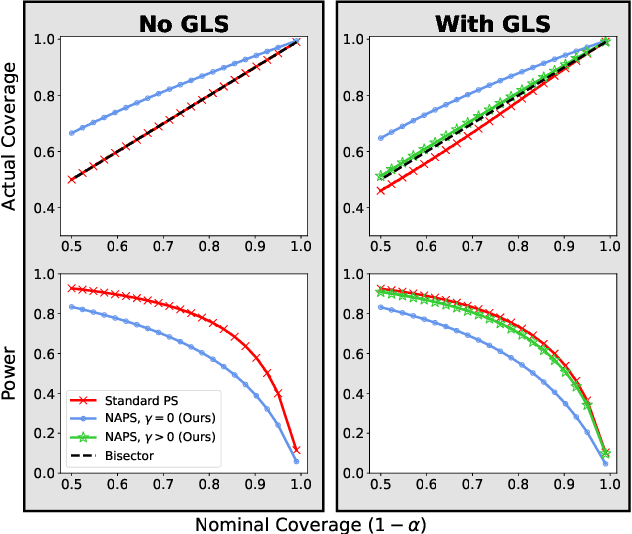
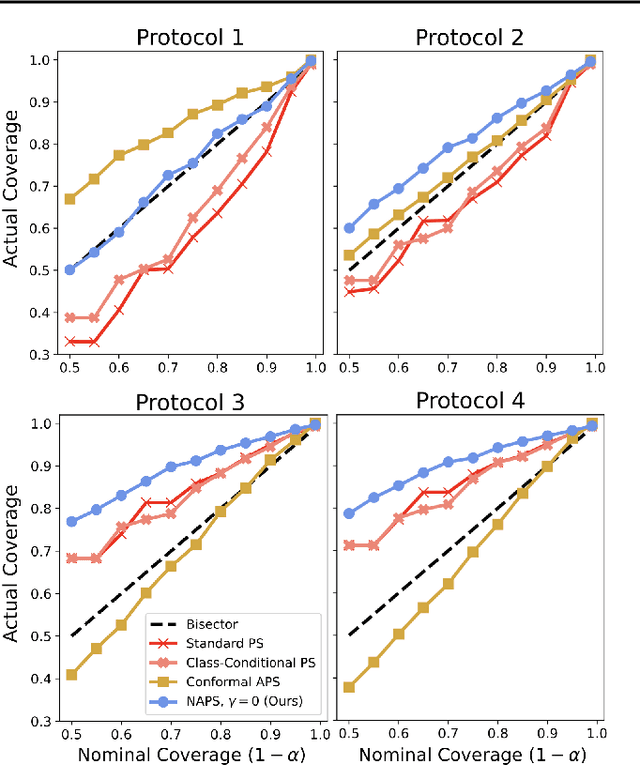
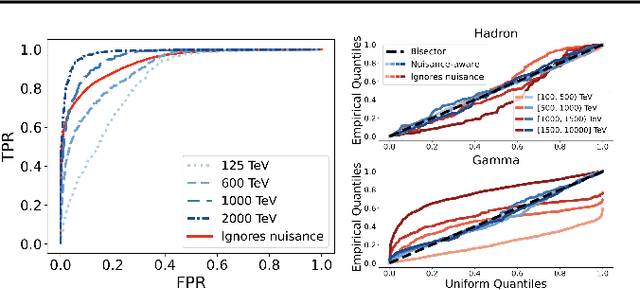
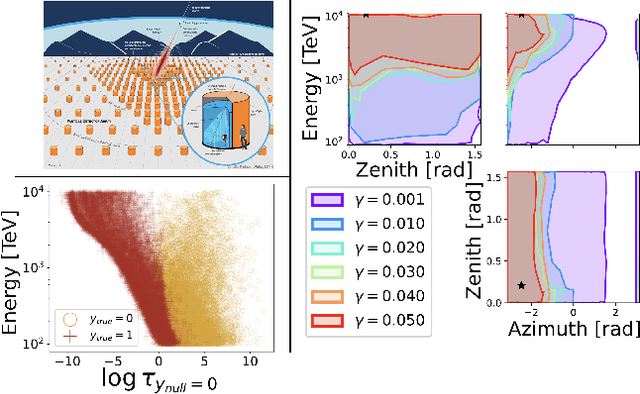
An open scientific challenge is how to classify events with reliable measures of uncertainty, when we have a mechanistic model of the data-generating process but the distribution over both labels and latent nuisance parameters is different between train and target data. We refer to this type of distributional shift as generalized label shift (GLS). Direct classification using observed data $\mathbf{X}$ as covariates leads to biased predictions and invalid uncertainty estimates of labels $Y$. We overcome these biases by proposing a new method for robust uncertainty quantification that casts classification as a hypothesis testing problem under nuisance parameters. The key idea is to estimate the classifier's receiver operating characteristic (ROC) across the entire nuisance parameter space, which allows us to devise cutoffs that are invariant under GLS. Our method effectively endows a pre-trained classifier with domain adaptation capabilities and returns valid prediction sets while maintaining high power. We demonstrate its performance on two challenging scientific problems in biology and astroparticle physics with data from realistic mechanistic models.