 Add to Chrome
 Add to Firefox
 Add to Edge
SpeechDx: A Multi-Task Benchmark for Clinical Speech AI
Jun 15, 2026
Speech offers a uniquely informative window into health by simultaneously engaging neurological, motor, respiratory, and vocal systems. Current clinical speech AI methods have largely progressed through isolated condition-specific studies, making results difficult to compare and generalization difficult to assess. We introduce SpeechDx, a large-scale benchmark for clinical speech AI spanning 12 datasets and 27 tasks across diverse health conditions. To enable evaluation across shared clinical mechanisms, SpeechDx structures tasks by the stage of speech production they disrupt: conceptualization, formulation, and articulation. The benchmark tests generalization by including tasks with limited labeled data and evaluating the same health condition across multiple datasets, distinguishing clinically meaningful patterns from dataset artefacts. We systematically evaluate 12 state-of-the-art audio encoders across all tasks and under zero-shot cross-condition transfer. Results show that large-scale speech models represent the strongest overall baselines, domain-specific models improve performance only on closely matched tasks, and no current representation generalizes reliably across the clinical speech landscape. SpeechDx establishes a shared evaluation framework for tracking progress toward general-purpose clinical speech representations

Lumosaic: Hyperspectral Video via Active Illumination and Coded-Exposure Pixels
Feb 25, 2026We present Lumosaic, a compact active hyperspectral video system designed for real-time capture of dynamic scenes. Our approach combines a narrowband LED array with a coded-exposure-pixel (CEP) camera capable of high-speed, per-pixel exposure control, enabling joint encoding of scene information across space, time, and wavelength within each video frame. Unlike passive snapshot systems that divide light across multiple spectral channels simultaneously and assume no motion during a frame's exposure, Lumosaic actively synchronizes illumination and pixel-wise exposure, improving photon utilization and preserving spectral fidelity under motion. A learning-based reconstruction pipeline then recovers 31-channel hyperspectral (400-700 nm) video at 30 fps and VGA resolution, producing temporally coherent and spectrally accurate reconstructions. Experiments on synthetic and real data demonstrate that Lumosaic significantly improves reconstruction fidelity and temporal stability over existing snapshot hyperspectral imaging systems, enabling robust hyperspectral video across diverse materials and motion conditions.
SplitSR: An End-to-End Approach to Super-Resolution on Mobile Devices
Jan 20, 2021
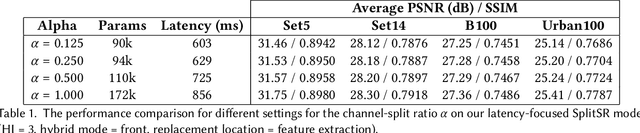
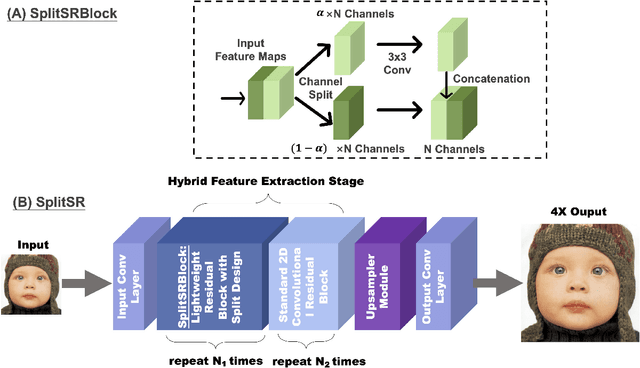

Super-resolution (SR) is a coveted image processing technique for mobile apps ranging from the basic camera apps to mobile health. Existing SR algorithms rely on deep learning models with significant memory requirements, so they have yet to be deployed on mobile devices and instead operate in the cloud to achieve feasible inference time. This shortcoming prevents existing SR methods from being used in applications that require near real-time latency. In this work, we demonstrate state-of-the-art latency and accuracy for on-device super-resolution using a novel hybrid architecture called SplitSR and a novel lightweight residual block called SplitSRBlock. The SplitSRBlock supports channel-splitting, allowing the residual blocks to retain spatial information while reducing the computation in the channel dimension. SplitSR has a hybrid design consisting of standard convolutional blocks and lightweight residual blocks, allowing people to tune SplitSR for their computational budget. We evaluate our system on a low-end ARM CPU, demonstrating both higher accuracy and up to 5 times faster inference than previous approaches. We then deploy our model onto a smartphone in an app called ZoomSR to demonstrate the first-ever instance of on-device, deep learning-based SR. We conducted a user study with 15 participants to have them assess the perceived quality of images that were post-processed by SplitSR. Relative to bilinear interpolation -- the existing standard for on-device SR -- participants showed a statistically significant preference when looking at both images (Z=-9.270, p<0.01) and text (Z=-6.486, p<0.01).