 Add to Chrome
 Add to Firefox
 Add to Edge
Lumosaic: Hyperspectral Video via Active Illumination and Coded-Exposure Pixels
Feb 25, 2026
We present Lumosaic, a compact active hyperspectral video system designed for real-time capture of dynamic scenes. Our approach combines a narrowband LED array with a coded-exposure-pixel (CEP) camera capable of high-speed, per-pixel exposure control, enabling joint encoding of scene information across space, time, and wavelength within each video frame. Unlike passive snapshot systems that divide light across multiple spectral channels simultaneously and assume no motion during a frame's exposure, Lumosaic actively synchronizes illumination and pixel-wise exposure, improving photon utilization and preserving spectral fidelity under motion. A learning-based reconstruction pipeline then recovers 31-channel hyperspectral (400-700 nm) video at 30 fps and VGA resolution, producing temporally coherent and spectrally accurate reconstructions. Experiments on synthetic and real data demonstrate that Lumosaic significantly improves reconstruction fidelity and temporal stability over existing snapshot hyperspectral imaging systems, enabling robust hyperspectral video across diverse materials and motion conditions.

The Evolution of Embedding Table Optimization and Multi-Epoch Training in Pinterest Ads Conversion
May 08, 2025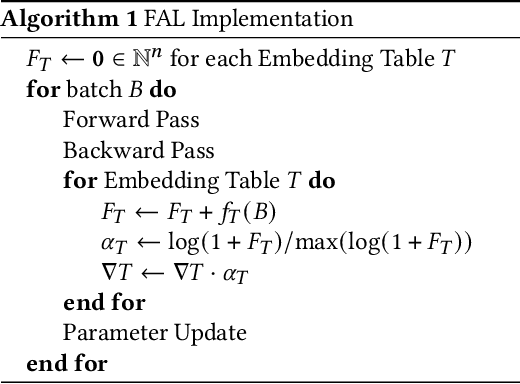
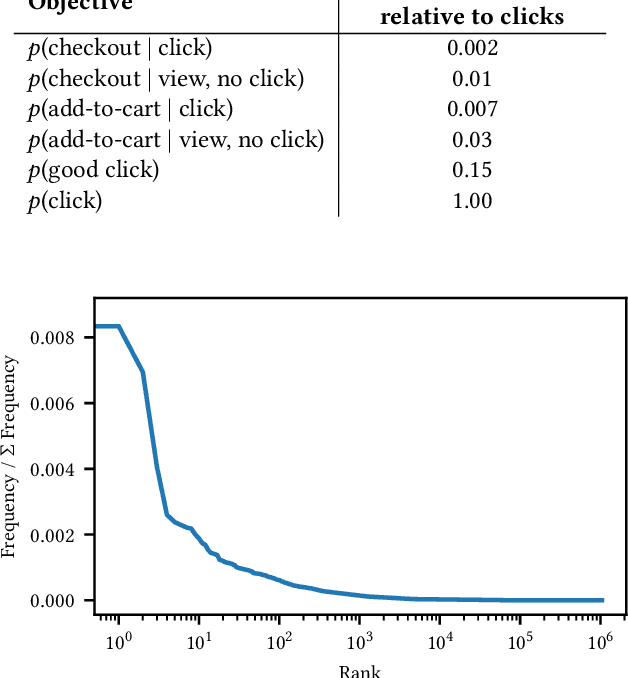
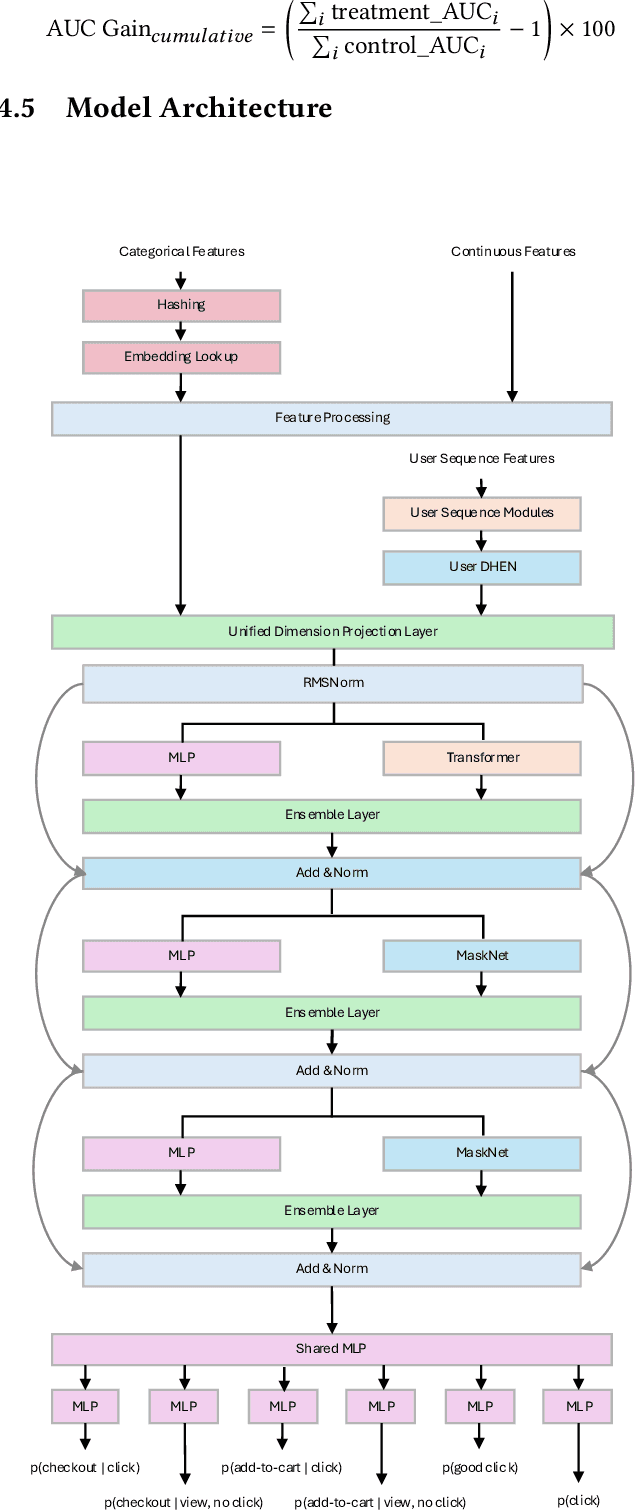
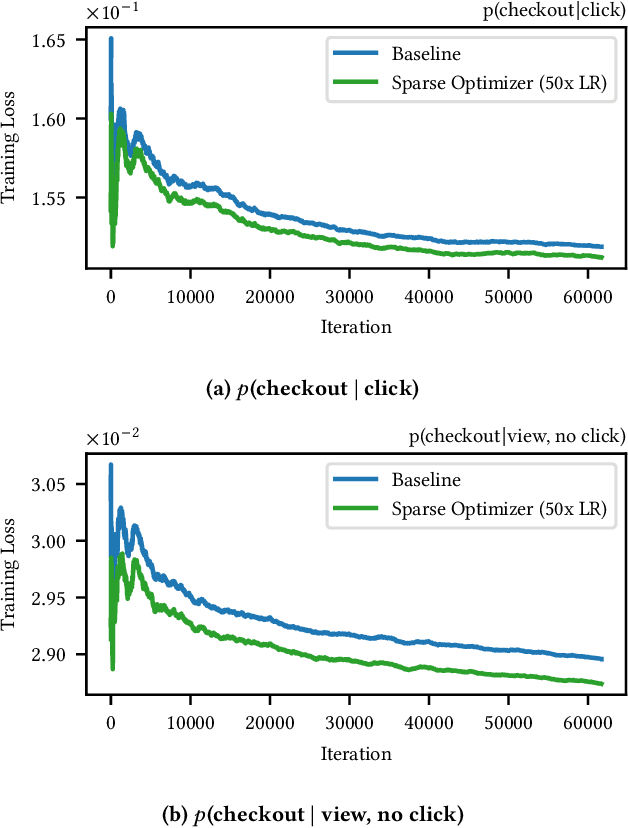
Deep learning for conversion prediction has found widespread applications in online advertising. These models have become more complex as they are trained to jointly predict multiple objectives such as click, add-to-cart, checkout and other conversion types. Additionally, the capacity and performance of these models can often be increased with the use of embedding tables that encode high cardinality categorical features such as advertiser, user, campaign, and product identifiers (IDs). These embedding tables can be pre-trained, but also learned end-to-end jointly with the model to directly optimize the model objectives. Training these large tables is challenging due to: gradient sparsity, the high cardinality of the categorical features, the non-uniform distribution of IDs and the very high label sparsity. These issues make training prone to both slow convergence and overfitting after the first epoch. Previous works addressed the multi-epoch overfitting issue by using: stronger feature hashing to reduce cardinality, filtering of low frequency IDs, regularization of the embedding tables, re-initialization of the embedding tables after each epoch, etc. Some of these techniques reduce overfitting at the expense of reduced model performance if used too aggressively. In this paper, we share key learnings from the development of embedding table optimization and multi-epoch training in Pinterest Ads Conversion models. We showcase how our Sparse Optimizer speeds up convergence, and how multi-epoch overfitting varies in severity between different objectives in a multi-task model depending on label sparsity. We propose a new approach to deal with multi-epoch overfitting: the use of a frequency-adaptive learning rate on the embedding tables and compare it to embedding re-initialization. We evaluate both methods offline using an industrial large-scale production dataset.