 Add to Chrome
 Add to Firefox
 Add to Edge
Collective Robustness Certificates: Exploiting Interdependence in Graph Neural Networks
Feb 06, 2023
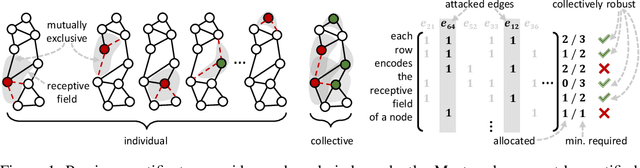
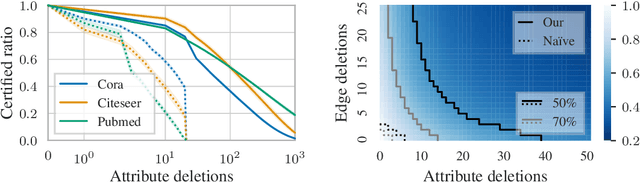

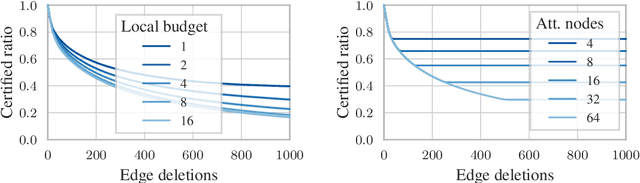
In tasks like node classification, image segmentation, and named-entity recognition we have a classifier that simultaneously outputs multiple predictions (a vector of labels) based on a single input, i.e. a single graph, image, or document respectively. Existing adversarial robustness certificates consider each prediction independently and are thus overly pessimistic for such tasks. They implicitly assume that an adversary can use different perturbed inputs to attack different predictions, ignoring the fact that we have a single shared input. We propose the first collective robustness certificate which computes the number of predictions that are simultaneously guaranteed to remain stable under perturbation, i.e. cannot be attacked. We focus on Graph Neural Networks and leverage their locality property - perturbations only affect the predictions in a close neighborhood - to fuse multiple single-node certificates into a drastically stronger collective certificate. For example, on the Citeseer dataset our collective certificate for node classification increases the average number of certifiable feature perturbations from $7$ to $351$.

Are Defenses for Graph Neural Networks Robust?
Jan 31, 2023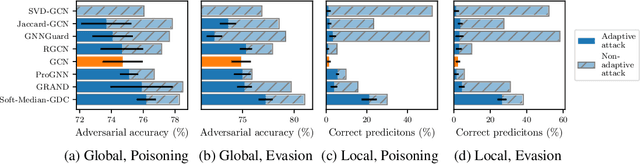
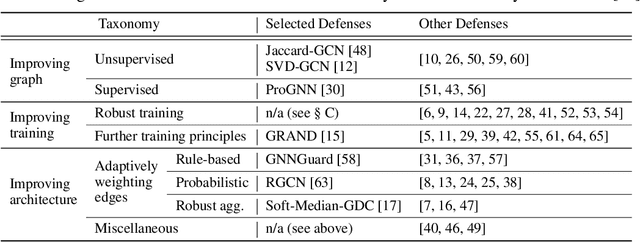
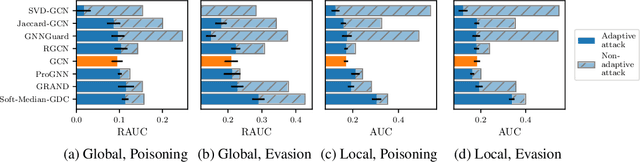
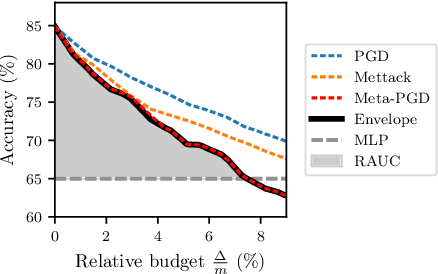
A cursory reading of the literature suggests that we have made a lot of progress in designing effective adversarial defenses for Graph Neural Networks (GNNs). Yet, the standard methodology has a serious flaw - virtually all of the defenses are evaluated against non-adaptive attacks leading to overly optimistic robustness estimates. We perform a thorough robustness analysis of 7 of the most popular defenses spanning the entire spectrum of strategies, i.e., aimed at improving the graph, the architecture, or the training. The results are sobering - most defenses show no or only marginal improvement compared to an undefended baseline. We advocate using custom adaptive attacks as a gold standard and we outline the lessons we learned from successfully designing such attacks. Moreover, our diverse collection of perturbed graphs forms a (black-box) unit test offering a first glance at a model's robustness.
Randomized Message-Interception Smoothing: Gray-box Certificates for Graph Neural Networks
Jan 05, 2023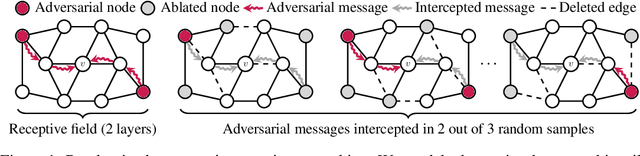
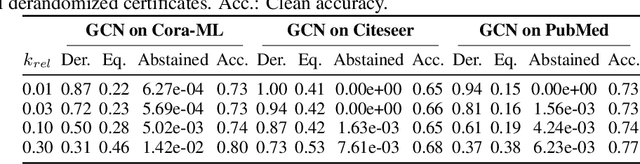
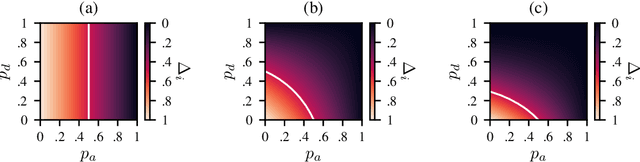
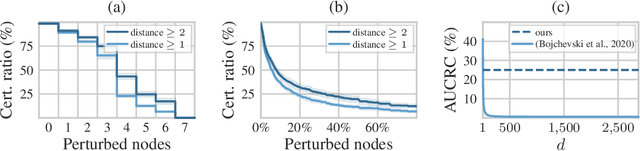
Randomized smoothing is one of the most promising frameworks for certifying the adversarial robustness of machine learning models, including Graph Neural Networks (GNNs). Yet, existing randomized smoothing certificates for GNNs are overly pessimistic since they treat the model as a black box, ignoring the underlying architecture. To remedy this, we propose novel gray-box certificates that exploit the message-passing principle of GNNs: We randomly intercept messages and carefully analyze the probability that messages from adversarially controlled nodes reach their target nodes. Compared to existing certificates, we certify robustness to much stronger adversaries that control entire nodes in the graph and can arbitrarily manipulate node features. Our certificates provide stronger guarantees for attacks at larger distances, as messages from farther-away nodes are more likely to get intercepted. We demonstrate the effectiveness of our method on various models and datasets. Since our gray-box certificates consider the underlying graph structure, we can significantly improve certifiable robustness by applying graph sparsification.
Adversarial Weight Perturbation Improves Generalization in Graph Neural Network
Dec 09, 2022A lot of theoretical and empirical evidence shows that the flatter local minima tend to improve generalization. Adversarial Weight Perturbation (AWP) is an emerging technique to efficiently and effectively find such minima. In AWP we minimize the loss w.r.t. a bounded worst-case perturbation of the model parameters thereby favoring local minima with a small loss in a neighborhood around them. The benefits of AWP, and more generally the connections between flatness and generalization, have been extensively studied for i.i.d. data such as images. In this paper, we extensively study this phenomenon for graph data. Along the way, we first derive a generalization bound for non-i.i.d. node classification tasks. Then we identify a vanishing-gradient issue with all existing formulations of AWP and we propose a new Weighted Truncated AWP (WT-AWP) to alleviate this issue. We show that regularizing graph neural networks with WT-AWP consistently improves both natural and robust generalization across many different graph learning tasks and models.
Localized Randomized Smoothing for Collective Robustness Certification
Oct 28, 2022Models for image segmentation, node classification and many other tasks map a single input to multiple labels. By perturbing this single shared input (e.g. the image) an adversary can manipulate several predictions (e.g. misclassify several pixels). Collective robustness certification is the task of provably bounding the number of robust predictions under this threat model. The only dedicated method that goes beyond certifying each output independently is limited to strictly local models, where each prediction is associated with a small receptive field. We propose a more general collective robustness certificate for all types of models and further show that this approach is beneficial for the larger class of softly local models, where each output is dependent on the entire input but assigns different levels of importance to different input regions (e.g. based on their proximity in the image). The certificate is based on our novel localized randomized smoothing approach, where the random perturbation strength for different input regions is proportional to their importance for the outputs. Localized smoothing Pareto-dominates existing certificates on both image segmentation and node classification tasks, simultaneously offering higher accuracy and stronger guarantees.
Unveiling the Sampling Density in Non-Uniform Geometric Graphs
Oct 15, 2022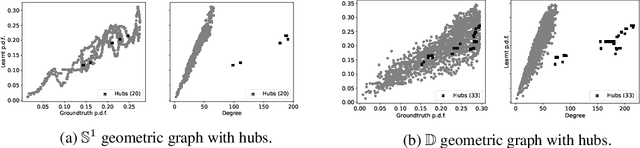
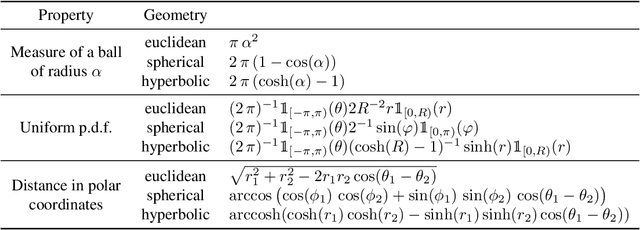
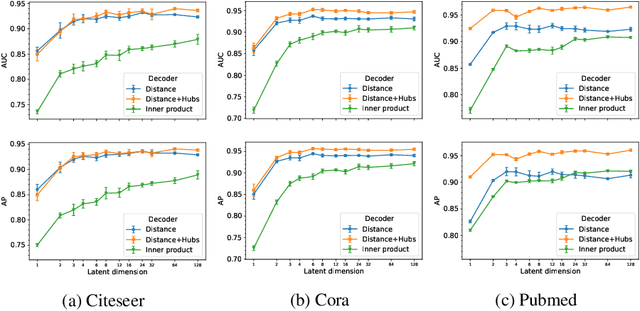
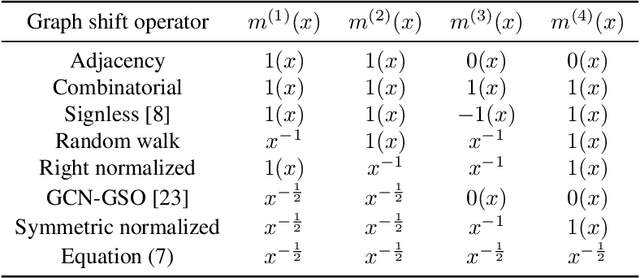
A powerful framework for studying graphs is to consider them as geometric graphs: nodes are randomly sampled from an underlying metric space, and any pair of nodes is connected if their distance is less than a specified neighborhood radius. Currently, the literature mostly focuses on uniform sampling and constant neighborhood radius. However, real-world graphs are likely to be better represented by a model in which the sampling density and the neighborhood radius can both vary over the latent space. For instance, in a social network communities can be modeled as densely sampled areas, and hubs as nodes with larger neighborhood radius. In this work, we first perform a rigorous mathematical analysis of this (more general) class of models, including derivations of the resulting graph shift operators. The key insight is that graph shift operators should be corrected in order to avoid potential distortions introduced by the non-uniform sampling. Then, we develop methods to estimate the unknown sampling density in a self-supervised fashion. Finally, we present exemplary applications in which the learnt density is used to 1) correct the graph shift operator and improve performance on a variety of tasks, 2) improve pooling, and 3) extract knowledge from networks. Our experimental findings support our theory and provide strong evidence for our model.
Robustness of Graph Neural Networks at Scale
Nov 08, 2021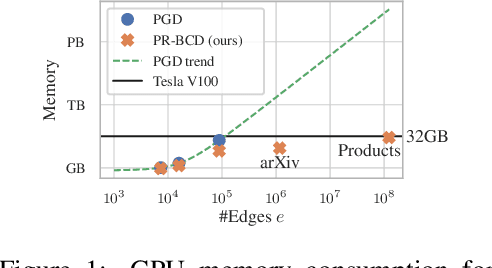
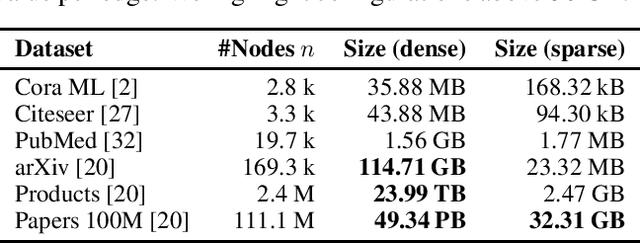
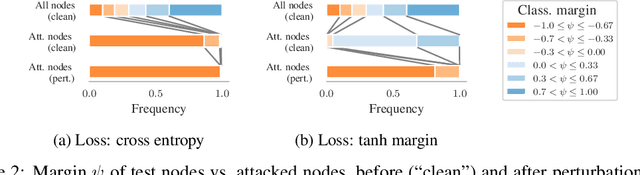
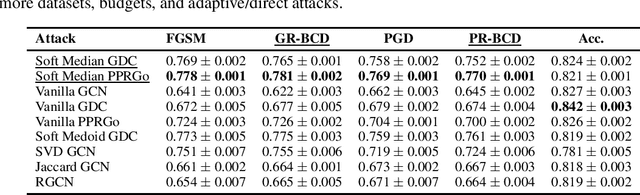
Graph Neural Networks (GNNs) are increasingly important given their popularity and the diversity of applications. Yet, existing studies of their vulnerability to adversarial attacks rely on relatively small graphs. We address this gap and study how to attack and defend GNNs at scale. We propose two sparsity-aware first-order optimization attacks that maintain an efficient representation despite optimizing over a number of parameters which is quadratic in the number of nodes. We show that common surrogate losses are not well-suited for global attacks on GNNs. Our alternatives can double the attack strength. Moreover, to improve GNNs' reliability we design a robust aggregation function, Soft Median, resulting in an effective defense at all scales. We evaluate our attacks and defense with standard GNNs on graphs more than 100 times larger compared to previous work. We even scale one order of magnitude further by extending our techniques to a scalable GNN.
Generalization of Neural Combinatorial Solvers Through the Lens of Adversarial Robustness
Oct 21, 2021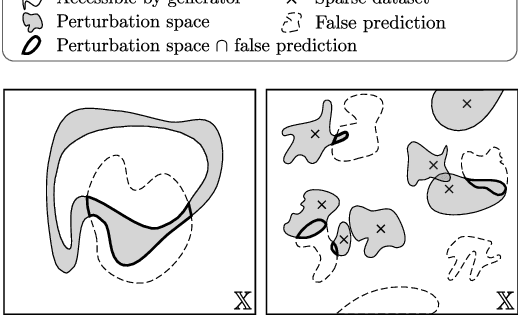
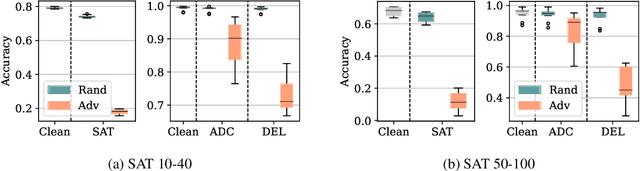
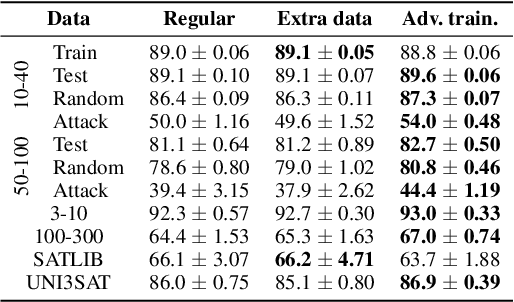
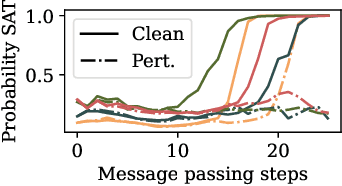
End-to-end (geometric) deep learning has seen first successes in approximating the solution of combinatorial optimization problems. However, generating data in the realm of NP-hard/-complete tasks brings practical and theoretical challenges, resulting in evaluation protocols that are too optimistic. Specifically, most datasets only capture a simpler subproblem and likely suffer from spurious features. We investigate these effects by studying adversarial robustness - a local generalization property - to reveal hard, model-specific instances and spurious features. For this purpose, we derive perturbation models for SAT and TSP. Unlike in other applications, where perturbation models are designed around subjective notions of imperceptibility, our perturbation models are efficient and sound, allowing us to determine the true label of perturbed samples without a solver. Surprisingly, with such perturbations, a sufficiently expressive neural solver does not suffer from the limitations of the accuracy-robustness trade-off common in supervised learning. Although such robust solvers exist, we show empirically that the assessed neural solvers do not generalize well w.r.t. small perturbations of the problem instance.
Efficient Robustness Certificates for Discrete Data: Sparsity-Aware Randomized Smoothing for Graphs, Images and More
Aug 29, 2020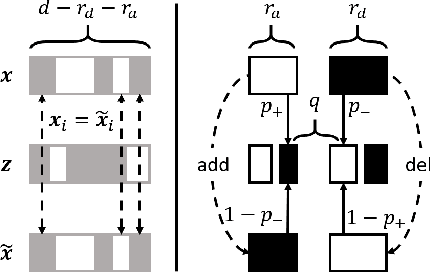
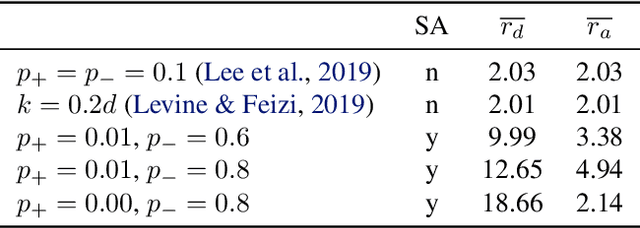
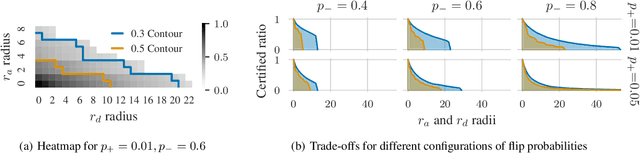
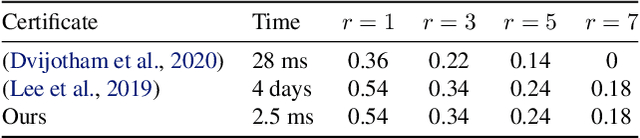
Existing techniques for certifying the robustness of models for discrete data either work only for a small class of models or are general at the expense of efficiency or tightness. Moreover, they do not account for sparsity in the input which, as our findings show, is often essential for obtaining non-trivial guarantees. We propose a model-agnostic certificate based on the randomized smoothing framework which subsumes earlier work and is tight, efficient, and sparsity-aware. Its computational complexity does not depend on the number of discrete categories or the dimension of the input (e.g. the graph size), making it highly scalable. We show the effectiveness of our approach on a wide variety of models, datasets, and tasks -- specifically highlighting its use for Graph Neural Networks. So far, obtaining provable guarantees for GNNs has been difficult due to the discrete and non-i.i.d. nature of graph data. Our method can certify any GNN and handles perturbations to both the graph structure and the node attributes.
Scaling Graph Neural Networks with Approximate PageRank
Jul 03, 2020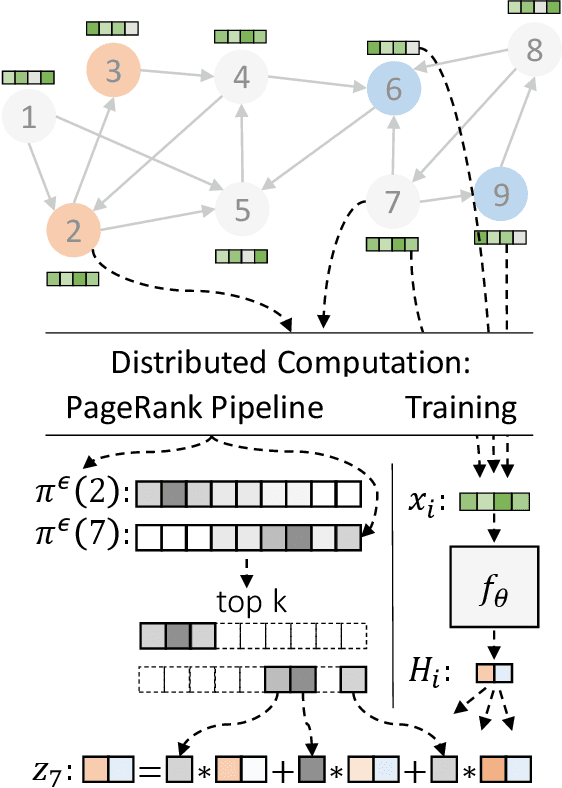

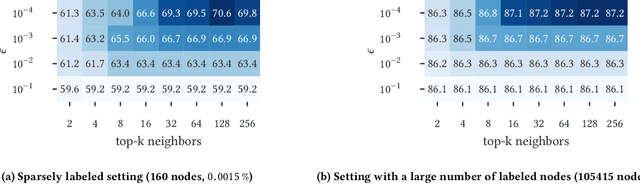

Graph neural networks (GNNs) have emerged as a powerful approach for solving many network mining tasks. However, learning on large graphs remains a challenge - many recently proposed scalable GNN approaches rely on an expensive message-passing procedure to propagate information through the graph. We present the PPRGo model which utilizes an efficient approximation of information diffusion in GNNs resulting in significant speed gains while maintaining state-of-the-art prediction performance. In addition to being faster, PPRGo is inherently scalable, and can be trivially parallelized for large datasets like those found in industry settings. We demonstrate that PPRGo outperforms baselines in both distributed and single-machine training environments on a number of commonly used academic graphs. To better analyze the scalability of large-scale graph learning methods, we introduce a novel benchmark graph with 12.4 million nodes, 173 million edges, and 2.8 million node features. We show that training PPRGo from scratch and predicting labels for all nodes in this graph takes under 2 minutes on a single machine, far outpacing other baselines on the same graph. We discuss the practical application of PPRGo to solve large-scale node classification problems at Google.