 Add to Chrome
 Add to Firefox
 Add to Edge
Tensor Methods: A Unified and Interpretable Approach for Material Design
Feb 11, 2026
When designing new materials, it is often necessary to tailor the material design (with respect to its design parameters) to have some desired properties (e.g. Young's modulus). As the set of design parameters grow, the search space grows exponentially, making the actual synthesis and evaluation of all material combinations virtually impossible. Even using traditional computational methods such as Finite Element Analysis becomes too computationally heavy to search the design space. Recent methods use machine learning (ML) surrogate models to more efficiently determine optimal material designs; unfortunately, these methods often (i) are notoriously difficult to interpret and (ii) under perform when the training data comes from a non-uniform sampling of the design space. We suggest the use of tensor completion methods as an all-in-one approach for interpretability and predictions. We observe classical tensor methods are able to compete with traditional ML in predictions, with the added benefit of their interpretable tensor factors (which are given completely for free, as a result of the prediction). In our experiments, we are able to rediscover physical phenomena via the tensor factors, indicating that our predictions are aligned with the true underlying physics of the problem. This also means these tensor factors could be used by experimentalists to identify potentially novel patterns, given we are able to rediscover existing ones. We also study the effects of both types of surrogate models when we encounter training data from a non-uniform sampling of the design space. We observe more specialized tensor methods that can give better generalization in these non-uniforms sampling scenarios. We find the best generalization comes from a tensor model, which is able to improve upon the baseline ML methods by up to 5% on aggregate $R^2$, and halve the error in some out of distribution regions.

Designing Composites with Target Effective Young's Modulus using Reinforcement Learning
Oct 07, 2021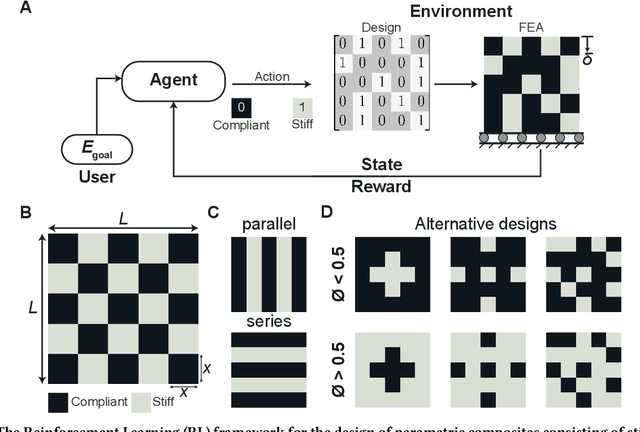
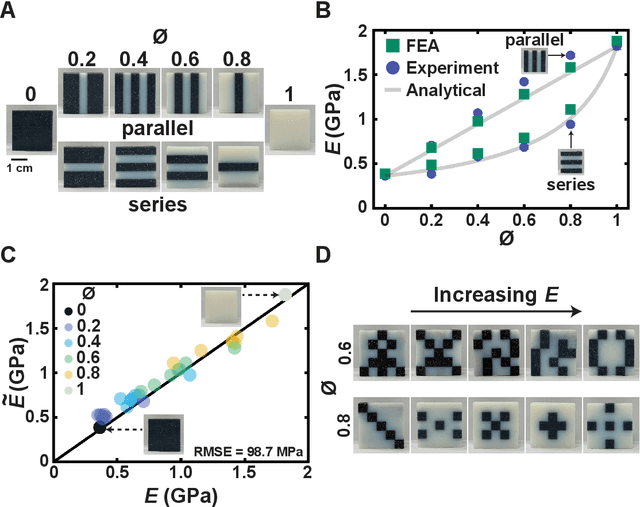

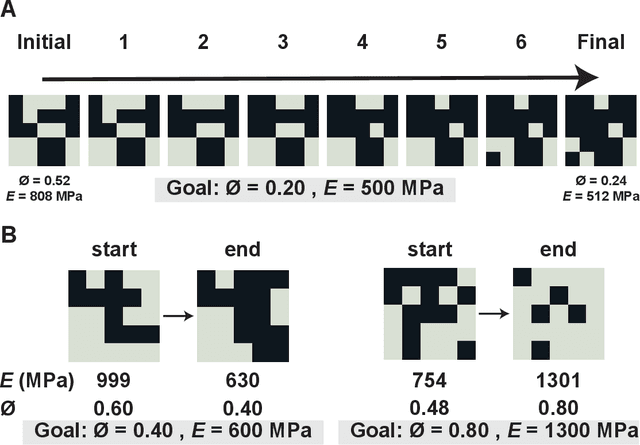
Advancements in additive manufacturing have enabled design and fabrication of materials and structures not previously realizable. In particular, the design space of composite materials and structures has vastly expanded, and the resulting size and complexity has challenged traditional design methodologies, such as brute force exploration and one factor at a time (OFAT) exploration, to find optimum or tailored designs. To address this challenge, supervised machine learning approaches have emerged to model the design space using curated training data; however, the selection of the training data is often determined by the user. In this work, we develop and utilize a Reinforcement learning (RL)-based framework for the design of composite structures which avoids the need for user-selected training data. For a 5 $\times$ 5 composite design space comprised of soft and compliant blocks of constituent material, we find that using this approach, the model can be trained using 2.78% of the total design space consists of $2^{25}$ design possibilities. Additionally, the developed RL-based framework is capable of finding designs at a success rate exceeding 90%. The success of this approach motivates future learning frameworks to utilize RL for the design of composites and other material systems.
Benchmarking the Performance of Bayesian Optimization across Multiple Experimental Materials Science Domains
May 23, 2021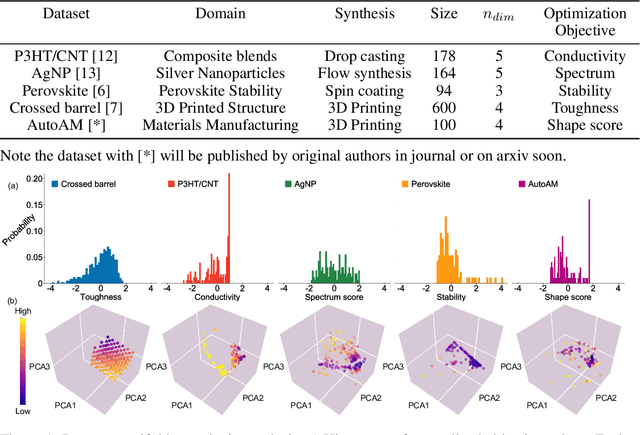
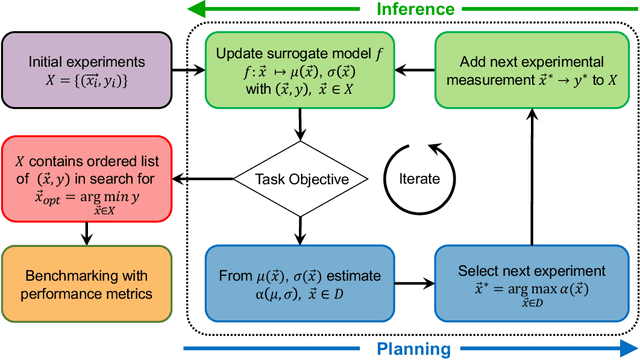
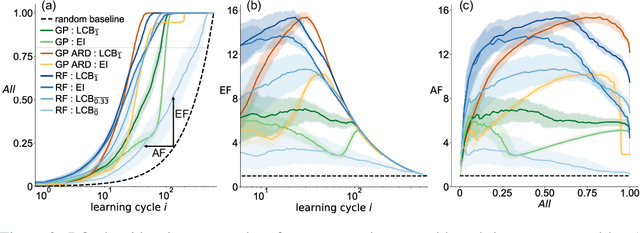
In the field of machine learning (ML) for materials optimization, active learning algorithms, such as Bayesian Optimization (BO), have been leveraged for guiding autonomous and high-throughput experimentation systems. However, very few studies have evaluated the efficiency of BO as a general optimization algorithm across a broad range of experimental materials science domains. In this work, we evaluate the performance of BO algorithms with a collection of surrogate model and acquisition function pairs across five diverse experimental materials systems, namely carbon nanotube polymer blends, silver nanoparticles, lead-halide perovskites, as well as additively manufactured polymer structures and shapes. By defining acceleration and enhancement metrics for general materials optimization objectives, we find that for surrogate model selection, Gaussian Process (GP) with anisotropic kernels (automatic relevance detection, ARD) and Random Forests (RF) have comparable performance and both outperform the commonly used GP without ARD. We discuss the implicit distributional assumptions of RF and GP, and the benefits of using GP with anisotropic kernels in detail. We provide practical insights for experimentalists on surrogate model selection of BO during materials optimization campaigns.