 Add to Chrome
 Add to Firefox
 Add to Edge
Tensor Methods: A Unified and Interpretable Approach for Material Design
Feb 11, 2026
When designing new materials, it is often necessary to tailor the material design (with respect to its design parameters) to have some desired properties (e.g. Young's modulus). As the set of design parameters grow, the search space grows exponentially, making the actual synthesis and evaluation of all material combinations virtually impossible. Even using traditional computational methods such as Finite Element Analysis becomes too computationally heavy to search the design space. Recent methods use machine learning (ML) surrogate models to more efficiently determine optimal material designs; unfortunately, these methods often (i) are notoriously difficult to interpret and (ii) under perform when the training data comes from a non-uniform sampling of the design space. We suggest the use of tensor completion methods as an all-in-one approach for interpretability and predictions. We observe classical tensor methods are able to compete with traditional ML in predictions, with the added benefit of their interpretable tensor factors (which are given completely for free, as a result of the prediction). In our experiments, we are able to rediscover physical phenomena via the tensor factors, indicating that our predictions are aligned with the true underlying physics of the problem. This also means these tensor factors could be used by experimentalists to identify potentially novel patterns, given we are able to rediscover existing ones. We also study the effects of both types of surrogate models when we encounter training data from a non-uniform sampling of the design space. We observe more specialized tensor methods that can give better generalization in these non-uniforms sampling scenarios. We find the best generalization comes from a tensor model, which is able to improve upon the baseline ML methods by up to 5% on aggregate $R^2$, and halve the error in some out of distribution regions.

Efficiently Generating Multidimensional Calorimeter Data with Tensor Decomposition Parameterization
Aug 26, 2025Producing large complex simulation datasets can often be a time and resource consuming task. Especially when these experiments are very expensive, it is becoming more reasonable to generate synthetic data for downstream tasks. Recently, these methods may include using generative machine learning models such as Generative Adversarial Networks or diffusion models. As these generative models improve efficiency in producing useful data, we introduce an internal tensor decomposition to these generative models to even further reduce costs. More specifically, for multidimensional data, or tensors, we generate the smaller tensor factors instead of the full tensor, in order to significantly reduce the model's output and overall parameters. This reduces the costs of generating complex simulation data, and our experiments show the generated data remains useful. As a result, tensor decomposition has the potential to improve efficiency in generative models, especially when generating multidimensional data, or tensors.
Tensor Completion for Surrogate Modeling of Material Property Prediction
Jan 30, 2025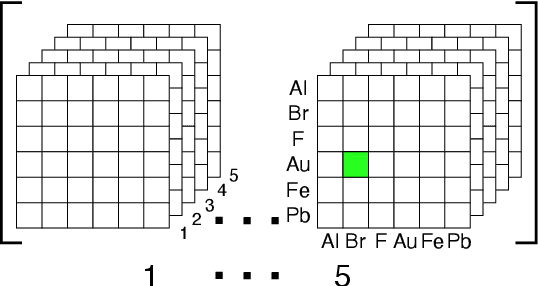

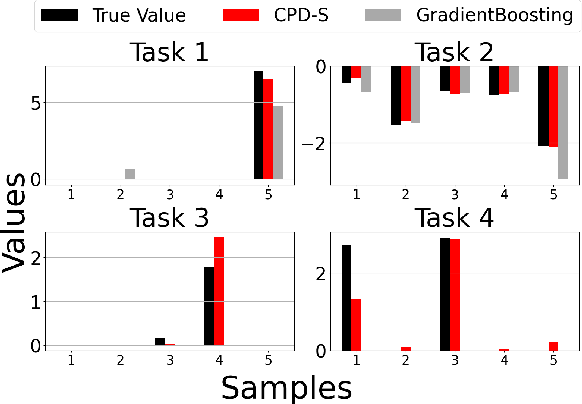
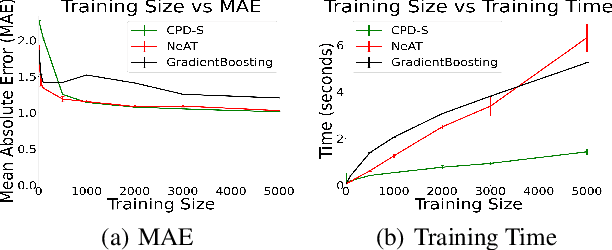
When designing materials to optimize certain properties, there are often many possible configurations of designs that need to be explored. For example, the materials' composition of elements will affect properties such as strength or conductivity, which are necessary to know when developing new materials. Exploring all combinations of elements to find optimal materials becomes very time consuming, especially when there are more design variables. For this reason, there is growing interest in using machine learning (ML) to predict a material's properties. In this work, we model the optimization of certain material properties as a tensor completion problem, to leverage the structure of our datasets and navigate the vast number of combinations of material configurations. Across a variety of material property prediction tasks, our experiments show tensor completion methods achieving 10-20% decreased error compared with baseline ML models such as GradientBoosting and Multilayer Perceptron (MLP), while maintaining similar training speed.
Automating Data Science Pipelines with Tensor Completion
Oct 08, 2024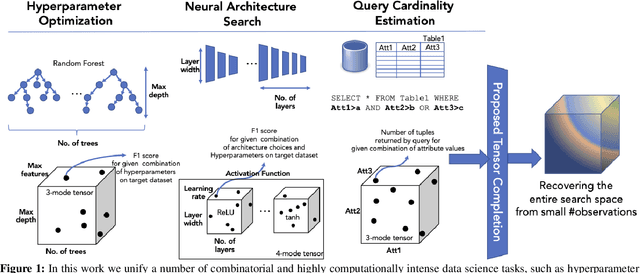
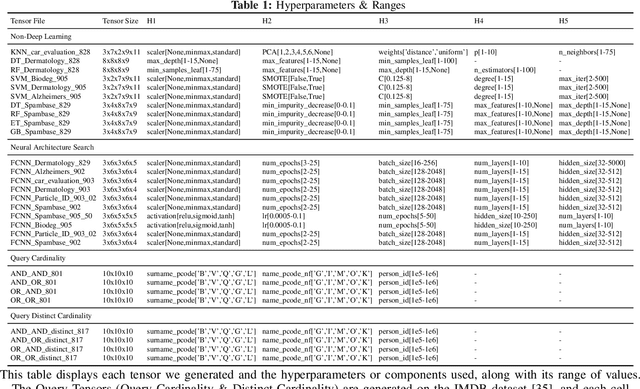
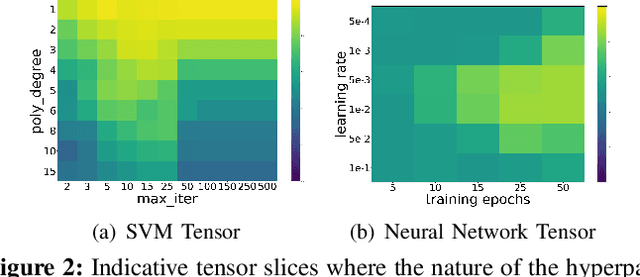
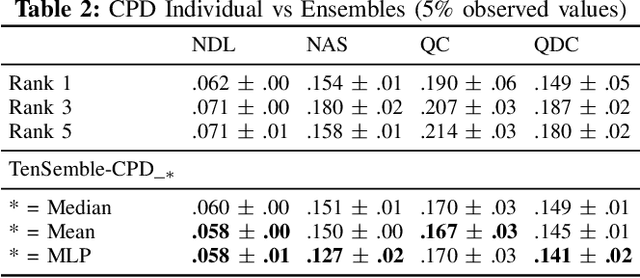
Hyperparameter optimization is an essential component in many data science pipelines and typically entails exhaustive time and resource-consuming computations in order to explore the combinatorial search space. Similar to this problem, other key operations in data science pipelines exhibit the exact same properties. Important examples are: neural architecture search, where the goal is to identify the best design choices for a neural network, and query cardinality estimation, where given different predicate values for a SQL query the goal is to estimate the size of the output. In this paper, we abstract away those essential components of data science pipelines and we model them as instances of tensor completion, where each variable of the search space corresponds to one mode of the tensor, and the goal is to identify all missing entries of the tensor, corresponding to all combinations of variable values, starting from a very small sample of observed entries. In order to do so, we first conduct a thorough experimental evaluation of existing state-of-the-art tensor completion techniques and introduce domain-inspired adaptations (such as smoothness across the discretized variable space) and an ensemble technique which is able to achieve state-of-the-art performance. We extensively evaluate existing and proposed methods in a number of datasets generated corresponding to (a) hyperparameter optimization for non-neural network models, (b) neural architecture search, and (c) variants of query cardinality estimation, demonstrating the effectiveness of tensor completion as a tool for automating data science pipelines. Furthermore, we release our generated datasets and code in order to provide benchmarks for future work on this topic.