 Add to Chrome
 Add to Firefox
 Add to Edge
Tracking Intermittent Particles with Self-Learned Visual Features
Jul 10, 2026
In time-lapse fluorescence imaging, single-particle-tracking is a powerful tool to monitor the dynamics of objects of interest, and extract information about biological processes. However, tracked particles can be subject to occlusion and intermittent detectability. When these phenomena persist over a few frames, tracking algorithms tend to produce multiple tracklets for the same particle. In this work, we introduce self-supervised learning of visual features to compare tracked particles, and we exploit both visual and positional distances to robustly stitch tracklets representing the same particle. We demonstrate the performance of our stitching framework on time-lapse fluorescence sequences of Hydra vulgaris neurons. Results show high stitching precision, and reduction of errors made by previous algorithms on the same data by a factor of two.

Diff-CA: Separating Common and Salient Factors with Diffusion Models
Jun 04, 2026Contrastive Analysis aims to separate factors that are common between two data distributions from those that are salient to only one of them. Existing contrastive methods are based on generative models (e.g., VAEs or GANs) that often suffer from limited reconstruction and image quality, which hampers effective latent factor separation and limits their applicability to high-fidelity image generation and edition. We propose a novel conditioning framework for diffusion models that enables contrastive decomposition without compromising generation quality. We first train a prompt-free, image-conditioned diffusion model, and then learn to decompose the conditioning into a common and a salient factor, using weak supervision. We prove that the additive contrastive factorization, commonly assumed in prior work, is identifiable under mild conditions. This factorization enables targeted operations by swapping or interpolating only the salient factor.
When Prompts Override Vision: Prompt-Induced Hallucinations in LVLMs
Apr 23, 2026Despite impressive progress in capabilities of large vision-language models (LVLMs), these systems remain vulnerable to hallucinations, i.e., outputs that are not grounded in the visual input. Prior work has attributed hallucinations in LVLMs to factors such as limitations of the vision backbone or the dominance of the language component, yet the relative importance of these factors remains unclear. To resolve this ambiguity, We propose HalluScope, a benchmark to better understand the extent to which different factors induce hallucinations. Our analysis indicates that hallucinations largely stem from excessive reliance on textual priors and background knowledge, especially information introduced through textual instructions. To mitigate hallucinations induced by textual instruction priors, we propose HalluVL-DPO, a framework for fine-tuning off-the-shelf LVLMs towards more visually grounded responses. HalluVL-DPO leverages preference optimization using a curated training dataset that we construct, guiding the model to prefer grounded responses over hallucinated ones. We demonstrate that our optimized model effectively mitigates the targeted hallucination failure mode, while preserving or improving performance on other hallucination benchmarks and visual capability evaluations. To support reproducibility and further research, we will publicly release our evaluation benchmark, preference training dataset, and code at https://pegah-kh.github.io/projects/prompts-override-vision/ .
FlowID : Enhancing Forensic Identification with Latent Flow-Matching Models
Mar 31, 2026Every day, many people die under violent circumstances, whether from crimes, war, migration, or climate disasters. Medico-legal and law enforcement institutions document many portraits of the deceased for evidence, but cannot immediately carry out identification on them. While traditional image editing tools can process these photos for public release, the workflow is lengthy and produces suboptimal results. In this work, we leverage advances in image generation models, which can now produce photorealistic human portraits, to introduce FlowID, an identity-preserving facial reconstruction method. Our approach combines single-image fine-tuning, which adapts the generative model to out-of-distribution injured faces, with attention-based masking that localizes edits to damaged regions while preserving identity-critical features. Together, these components enable the removal of artifacts from violent death while retaining sufficient identity information to support identification. To evaluate our method, we introduce InjuredFaces, a novel benchmark for identity-preserving facial reconstruction under severe facial damage. Beyond serving as an evaluation tool for this work, InjuredFaces provides a standardized resource for the community to study and compare methods addressing facial reconstruction in extreme conditions. Experimental results show that FlowID outperforms state-of-the-art open-source methods while maintaining low memory requirements, making it suitable for local deployment without compromising data privacy.
Stochastic Orthogonal Regularization for deep projective priors
May 19, 2025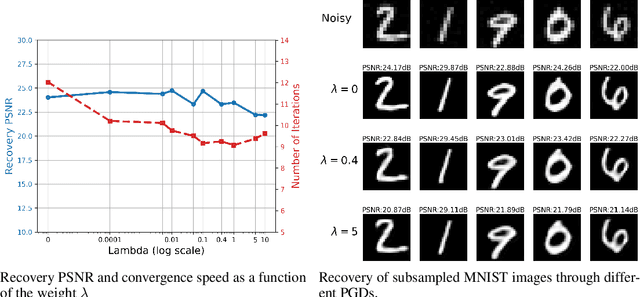
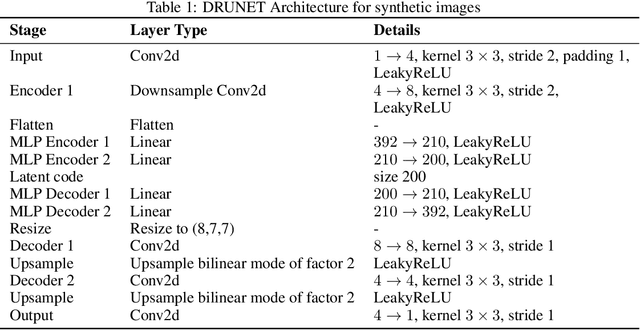
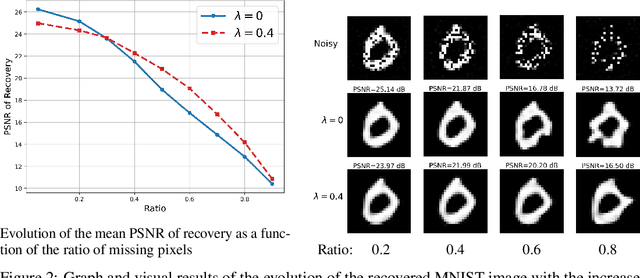
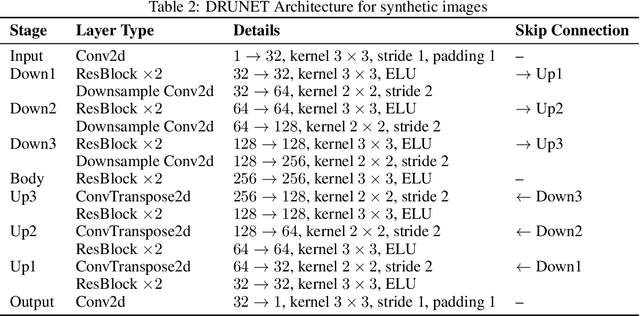
Many crucial tasks of image processing and computer vision are formulated as inverse problems. Thus, it is of great importance to design fast and robust algorithms to solve these problems. In this paper, we focus on generalized projected gradient descent (GPGD) algorithms where generalized projections are realized with learned neural networks and provide state-of-the-art results for imaging inverse problems. Indeed, neural networks allow for projections onto unknown low-dimensional sets that model complex data, such as images. We call these projections deep projective priors. In generic settings, when the orthogonal projection onto a lowdimensional model set is used, it has been shown, under a restricted isometry assumption, that the corresponding orthogonal PGD converges with a linear rate, yielding near-optimal convergence (within the class of GPGD methods) in the classical case of sparse recovery. However, for deep projective priors trained with classical mean squared error losses, there is little guarantee that the hypotheses for linear convergence are satisfied. In this paper, we propose a stochastic orthogonal regularization of the training loss for deep projective priors. This regularization is motivated by our theoretical results: a sufficiently good approximation of the orthogonal projection guarantees linear stable recovery with performance close to orthogonal PGD. We show experimentally, using two different deep projective priors (based on autoencoders and on denoising networks), that our stochastic orthogonal regularization yields projections that improve convergence speed and robustness of GPGD in challenging inverse problem settings, in accordance with our theoretical findings.
SINETRA: a Versatile Framework for Evaluating Single Neuron Tracking in Behaving Animals
Nov 14, 2024Accurately tracking neuronal activity in behaving animals presents significant challenges due to complex motions and background noise. The lack of annotated datasets limits the evaluation and improvement of such tracking algorithms. To address this, we developed SINETRA, a versatile simulator that generates synthetic tracking data for particles on a deformable background, closely mimicking live animal recordings. This simulator produces annotated 2D and 3D videos that reflect the intricate movements seen in behaving animals like Hydra Vulgaris. We evaluated four state-of-the-art tracking algorithms highlighting the current limitations of these methods in challenging scenarios and paving the way for improved cell tracking techniques in dynamic biological systems.
Restyling Unsupervised Concept Based Interpretable Networks with Generative Models
Jul 01, 2024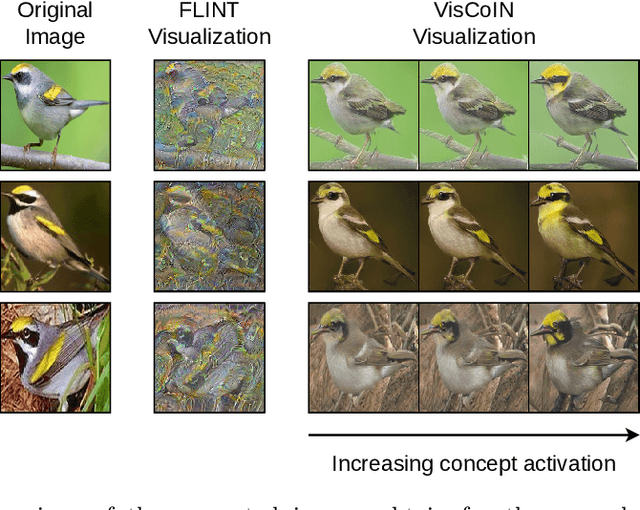

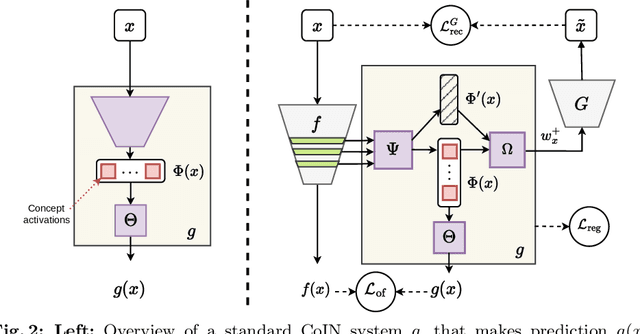
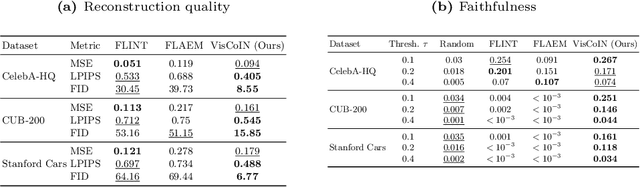
Developing inherently interpretable models for prediction has gained prominence in recent years. A subclass of these models, wherein the interpretable network relies on learning high-level concepts, are valued because of closeness of concept representations to human communication. However, the visualization and understanding of the learnt unsupervised dictionary of concepts encounters major limitations, specially for large-scale images. We propose here a novel method that relies on mapping the concept features to the latent space of a pretrained generative model. The use of a generative model enables high quality visualization, and naturally lays out an intuitive and interactive procedure for better interpretation of the learnt concepts. Furthermore, leveraging pretrained generative models has the additional advantage of making the training of the system more efficient. We quantitatively ascertain the efficacy of our method in terms of accuracy of the interpretable prediction network, fidelity of reconstruction, as well as faithfulness and consistency of learnt concepts. The experiments are conducted on multiple image recognition benchmarks for large-scale images. Project page available at https://jayneelparekh.github.io/VisCoIN_project_page/
A Concept-Based Explainability Framework for Large Multimodal Models
Jun 12, 2024Large multimodal models (LMMs) combine unimodal encoders and large language models (LLMs) to perform multimodal tasks. Despite recent advancements towards the interpretability of these models, understanding internal representations of LMMs remains largely a mystery. In this paper, we present a novel framework for the interpretation of LMMs. We propose a dictionary learning based approach, applied to the representation of tokens. The elements of the learned dictionary correspond to our proposed concepts. We show that these concepts are well semantically grounded in both vision and text. Thus we refer to these as "multi-modal concepts". We qualitatively and quantitatively evaluate the results of the learnt concepts. We show that the extracted multimodal concepts are useful to interpret representations of test samples. Finally, we evaluate the disentanglement between different concepts and the quality of grounding concepts visually and textually. We will publicly release our code.
Diffusion-based image inpainting with internal learning
Jun 06, 2024Diffusion models are now the undisputed state-of-the-art for image generation and image restoration. However, they require large amounts of computational power for training and inference. In this paper, we propose lightweight diffusion models for image inpainting that can be trained on a single image, or a few images. We show that our approach competes with large state-of-the-art models in specific cases. We also show that training a model on a single image is particularly relevant for image acquisition modality that differ from the RGB images of standard learning databases. We show results in three different contexts: texture images, line drawing images, and materials BRDF, for which we achieve state-of-the-art results in terms of realism, with a computational load that is greatly reduced compared to concurrent methods.
A Compact and Semantic Latent Space for Disentangled and Controllable Image Editing
Dec 13, 2023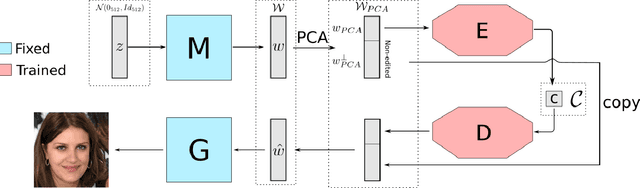
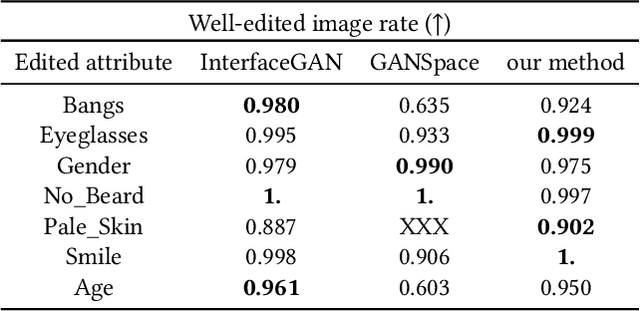
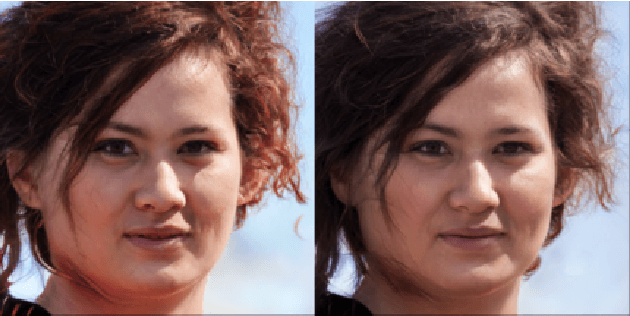
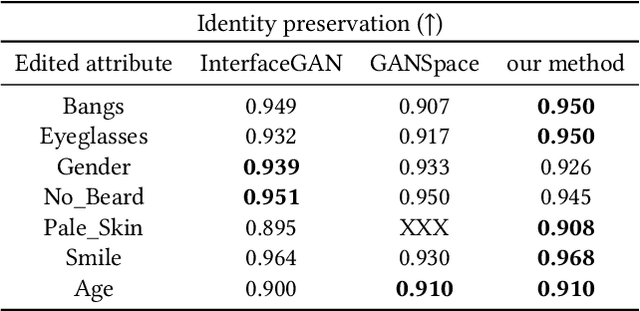
Recent advances in the field of generative models and in particular generative adversarial networks (GANs) have lead to substantial progress for controlled image editing, especially compared with the pre-deep learning era. Despite their powerful ability to apply realistic modifications to an image, these methods often lack properties like disentanglement (the capacity to edit attributes independently). In this paper, we propose an auto-encoder which re-organizes the latent space of StyleGAN, so that each attribute which we wish to edit corresponds to an axis of the new latent space, and furthermore that the latent axes are decorrelated, encouraging disentanglement. We work in a compressed version of the latent space, using Principal Component Analysis, meaning that the parameter complexity of our autoencoder is reduced, leading to short training times ($\sim$ 45 mins). Qualitative and quantitative results demonstrate the editing capabilities of our approach, with greater disentanglement than competing methods, while maintaining fidelity to the original image with respect to identity. Our autoencoder architecture simple and straightforward, facilitating implementation.