 Add to Chrome
 Add to Firefox
 Add to Edge
FlowID : Enhancing Forensic Identification with Latent Flow-Matching Models
Mar 31, 2026
Every day, many people die under violent circumstances, whether from crimes, war, migration, or climate disasters. Medico-legal and law enforcement institutions document many portraits of the deceased for evidence, but cannot immediately carry out identification on them. While traditional image editing tools can process these photos for public release, the workflow is lengthy and produces suboptimal results. In this work, we leverage advances in image generation models, which can now produce photorealistic human portraits, to introduce FlowID, an identity-preserving facial reconstruction method. Our approach combines single-image fine-tuning, which adapts the generative model to out-of-distribution injured faces, with attention-based masking that localizes edits to damaged regions while preserving identity-critical features. Together, these components enable the removal of artifacts from violent death while retaining sufficient identity information to support identification. To evaluate our method, we introduce InjuredFaces, a novel benchmark for identity-preserving facial reconstruction under severe facial damage. Beyond serving as an evaluation tool for this work, InjuredFaces provides a standardized resource for the community to study and compare methods addressing facial reconstruction in extreme conditions. Experimental results show that FlowID outperforms state-of-the-art open-source methods while maintaining low memory requirements, making it suitable for local deployment without compromising data privacy.

Risk estimation for matrix recovery with spectral regularization
Nov 01, 2012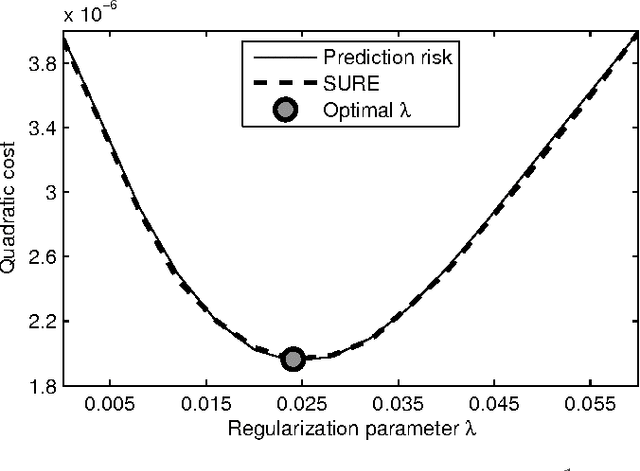
In this paper, we develop an approach to recursively estimate the quadratic risk for matrix recovery problems regularized with spectral functions. Toward this end, in the spirit of the SURE theory, a key step is to compute the (weak) derivative and divergence of a solution with respect to the observations. As such a solution is not available in closed form, but rather through a proximal splitting algorithm, we propose to recursively compute the divergence from the sequence of iterates. A second challenge that we unlocked is the computation of the (weak) derivative of the proximity operator of a spectral function. To show the potential applicability of our approach, we exemplify it on a matrix completion problem to objectively and automatically select the regularization parameter.