 Add to Chrome
 Add to Firefox
 Add to Edge
From sparse recovery to plug-and-play priors, understanding trade-offs for stable recovery with generalized projected gradient descent
Dec 08, 2025
We consider the problem of recovering an unknown low-dimensional vector from noisy, underdetermined observations. We focus on the Generalized Projected Gradient Descent (GPGD) framework, which unifies traditional sparse recovery methods and modern approaches using learned deep projective priors. We extend previous convergence results to robustness to model and projection errors. We use these theoretical results to explore ways to better control stability and robustness constants. To reduce recovery errors due to measurement noise, we consider generalized back-projection strategies to adapt GPGD to structured noise, such as sparse outliers. To improve the stability of GPGD, we propose a normalized idempotent regularization for the learning of deep projective priors. We provide numerical experiments in the context of sparse recovery and image inverse problems, highlighting the trade-offs between identifiability and stability that can be achieved with such methods.

Stochastic Orthogonal Regularization for deep projective priors
May 19, 2025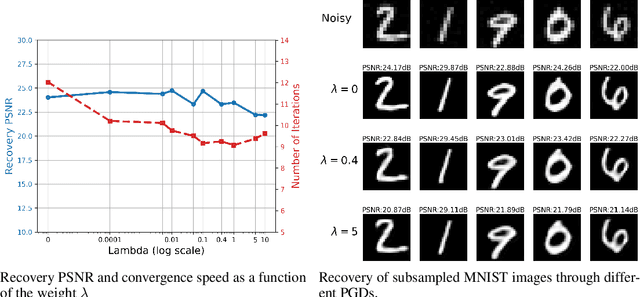
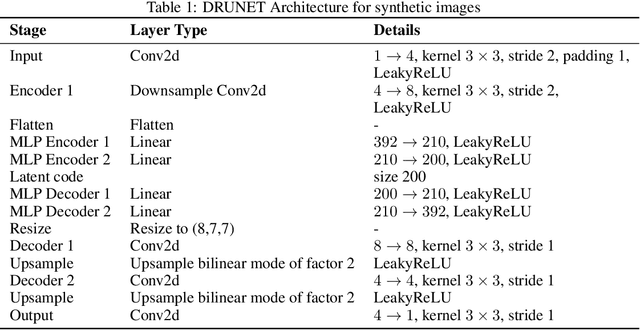
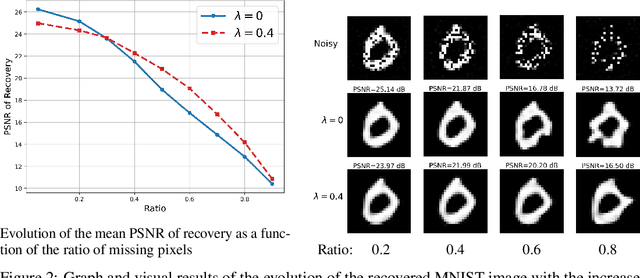
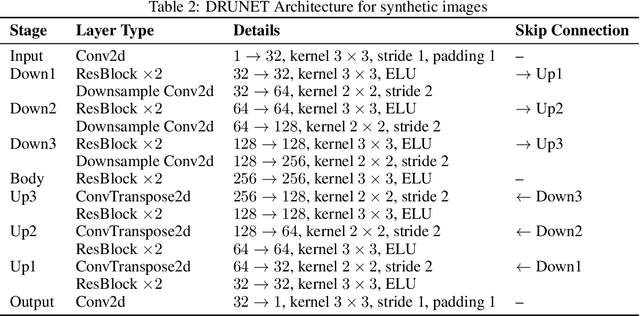
Many crucial tasks of image processing and computer vision are formulated as inverse problems. Thus, it is of great importance to design fast and robust algorithms to solve these problems. In this paper, we focus on generalized projected gradient descent (GPGD) algorithms where generalized projections are realized with learned neural networks and provide state-of-the-art results for imaging inverse problems. Indeed, neural networks allow for projections onto unknown low-dimensional sets that model complex data, such as images. We call these projections deep projective priors. In generic settings, when the orthogonal projection onto a lowdimensional model set is used, it has been shown, under a restricted isometry assumption, that the corresponding orthogonal PGD converges with a linear rate, yielding near-optimal convergence (within the class of GPGD methods) in the classical case of sparse recovery. However, for deep projective priors trained with classical mean squared error losses, there is little guarantee that the hypotheses for linear convergence are satisfied. In this paper, we propose a stochastic orthogonal regularization of the training loss for deep projective priors. This regularization is motivated by our theoretical results: a sufficiently good approximation of the orthogonal projection guarantees linear stable recovery with performance close to orthogonal PGD. We show experimentally, using two different deep projective priors (based on autoencoders and on denoising networks), that our stochastic orthogonal regularization yields projections that improve convergence speed and robustness of GPGD in challenging inverse problem settings, in accordance with our theoretical findings.