 Add to Chrome
 Add to Firefox
 Add to Edge
Learning Common and Salient Generative Factors Between Two Image Datasets
Dec 14, 2025
Recent advancements in image synthesis have enabled high-quality image generation and manipulation. Most works focus on: 1) conditional manipulation, where an image is modified conditioned on a given attribute, or 2) disentangled representation learning, where each latent direction should represent a distinct semantic attribute. In this paper, we focus on a different and less studied research problem, called Contrastive Analysis (CA). Given two image datasets, we want to separate the common generative factors, shared across the two datasets, from the salient ones, specific to only one dataset. Compared to existing methods, which use attributes as supervised signals for editing (e.g., glasses, gender), the proposed method is weaker, since it only uses the dataset signal. We propose a novel framework for CA, that can be adapted to both GAN and Diffusion models, to learn both common and salient factors. By defining new and well-adapted learning strategies and losses, we ensure a relevant separation between common and salient factors, preserving a high-quality generation. We evaluate our approach on diverse datasets, covering human faces, animal images and medical scans. Our framework demonstrates superior separation ability and image quality synthesis compared to prior methods.

A Compact and Semantic Latent Space for Disentangled and Controllable Image Editing
Dec 13, 2023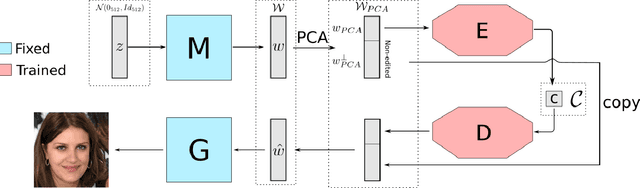
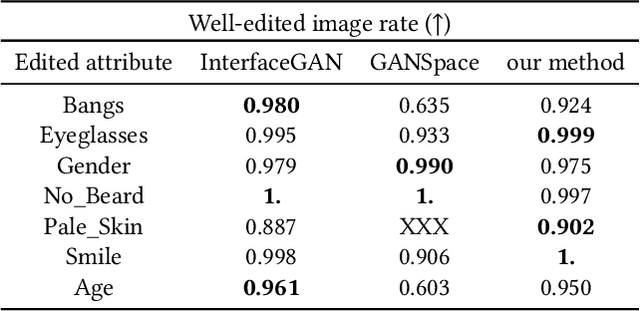
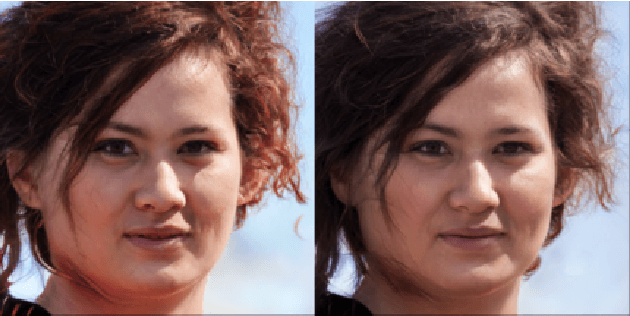
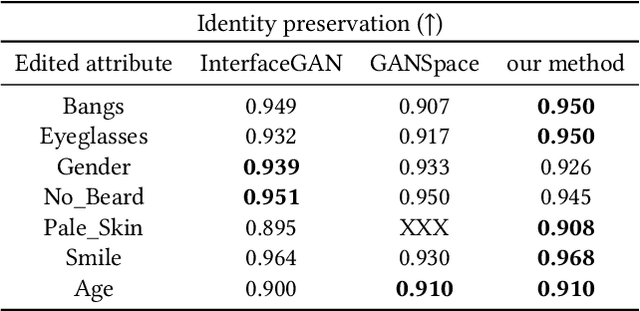
Recent advances in the field of generative models and in particular generative adversarial networks (GANs) have lead to substantial progress for controlled image editing, especially compared with the pre-deep learning era. Despite their powerful ability to apply realistic modifications to an image, these methods often lack properties like disentanglement (the capacity to edit attributes independently). In this paper, we propose an auto-encoder which re-organizes the latent space of StyleGAN, so that each attribute which we wish to edit corresponds to an axis of the new latent space, and furthermore that the latent axes are decorrelated, encouraging disentanglement. We work in a compressed version of the latent space, using Principal Component Analysis, meaning that the parameter complexity of our autoencoder is reduced, leading to short training times ($\sim$ 45 mins). Qualitative and quantitative results demonstrate the editing capabilities of our approach, with greater disentanglement than competing methods, while maintaining fidelity to the original image with respect to identity. Our autoencoder architecture simple and straightforward, facilitating implementation.