 Add to Chrome
 Add to Firefox
 Add to Edge
Pediatric Bone Age Prediction Using Deep Learning
Jul 18, 2026
Pediatric bone age prediction is a crucial task in clinical practice that can help diagnose endocrine disorders and provide insight into a child's growth and development. However, conventional bone age prediction methods are often labor-intensive and require specialized radiological expertise. This paper presents a Deep Learning (DL)-based approach to pediatric bone age prediction using EfficientNet with Additive Attention, a state-of-the-art neural network architecture for image classification and regression tasks. The method utilizes over 12,000 X-ray images from the RSNA bone age dataset. It involves image preprocessing, transforming them into three-channel images, and training a Convolutional Neural Network (CNN) to automatically learn the features of hand bone images. This approach provides a more effective and accurate solution for predicting bone age, which is critical in diagnosing pediatric endocrine diseases. This work uses two variations of the EfficientNet model (B0 and B4), where EfficientNetB4 is also finetuned with the Additive Attention mechanism. These three models predict the age for the original age, and their comparison is shown in curves. The predicted ages depict that in most cases, EfficientNetB4 and EfficientNetB4 with Additive Attention (EN-AA) successfully predicted the bone ages more accurately regarding the original age, and their performance was better than the EfficientNetB0. Specific performance metrics are provided to underscore this improvement. Learning curves for training and validation loss confirm effective learning without overfitting or underfitting, further validating our approach's efficacy in pediatric endocrine disease diagnosis.

Investigation of Polycystic Ovary Syndrome (PCOS) Diagnosis Using Machine Learning Approaches
Jul 18, 2026Polycystic Ovarian Syndrome (PCOS) is a widespread hormone problem for women of childbearing age. Women with PCOS may not ovulate; they might have high levels of androgens and have many small cysts on the ovaries. It can cause missed or irregular menstrual periods, excess hair growth, acne, infertility, and weight gain. Machine Learning (ML) can effectively diagnose this disease at an earlier stage as tons of medical data are available now. Traditional approaches to detect PCOS encompass a combination of clinical evaluation, medical history assessment, physical examination, and laboratory tests. These approaches aim to identify the characteristic symptoms and hormonal imbalances associated with PCOS. Physical examination requires good resources and costs time and money. In recent times, data-driven techniques have substantially advanced disease prediction within the medical field. We aim to utilize ML approaches, incorporating unique feature selection algorithms, to predict PCOS. This paper introduces a data-driven approach to PCOS diagnosis, combining Feature Engineering and ML. Several feature selection approaches have been considered to select sets of features for training the ML model, including CatBoost, Extreme Gradient Boosting (XGBoost), Light Gradient Boosting Machine (LGBM), AdaBoost, Random Forest (RF). Results demonstrate that AdaBoost, with ten features selected by RF Feature Importance and Highest Correlation (HC), provides the highest test accuracy.
AquaAugmentor: A Novel Feature Augmentation Algorithm for Water Potability Prediction
Jul 17, 2026Access to potable water is crucial for health, economic development, and sustainability. However, accurately classifying water quality remains a significant challenge due to the complexity and variability of water source data. This paper addresses the challenge of predicting water potability through machine learning and deep learning algorithms. It introduces a novel feature augmentation algorithm, AquaAugmentor, to enhance the predictive performance of these models for low-dimensional datasets. Utilizing a dataset that includes chemical attributes of water, such as pH, hardness, solids, chloramines, sulfate, and others. This study evaluates the performance of the models with and without AquaAugmentor. Each model applied to classify water as potable or non-potable and its performance is then evaluated and compared based on test accuracy and AUC score. The results highlight the strengths and limitations of our proposed algorithm, providing insights into the most effective techniques for improving the predictive performance of water quality classification. This study contributes to the broader efforts of ensuring safe water access and serves as a framework for employing machine learning in environmental quality assessments. The findings aim to assist researchers, policymakers, and public health officials in making informed decisions based on reliable machine learning predictions.
* Published in 2024 6th International Conference on Sustainable Technologies for Industry 5.0 (STI), 14-15 December, Dhaka, Bangladesh
BanLemma: A Word Formation Dependent Rule and Dictionary Based Bangla Lemmatizer
Nov 06, 2023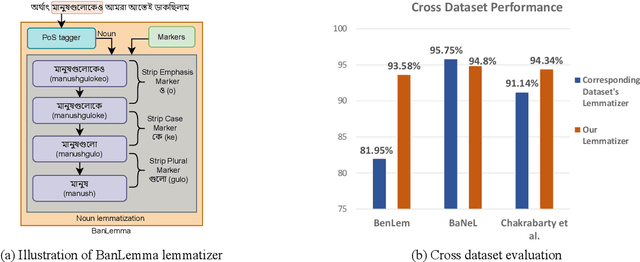
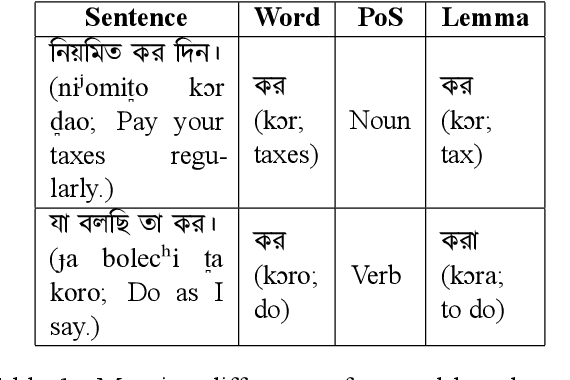
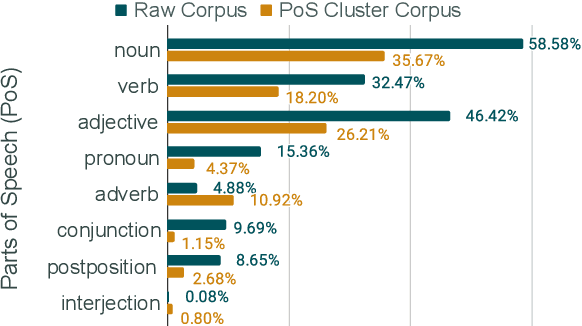
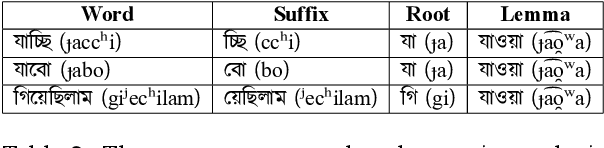
Lemmatization holds significance in both natural language processing (NLP) and linguistics, as it effectively decreases data density and aids in comprehending contextual meaning. However, due to the highly inflected nature and morphological richness, lemmatization in Bangla text poses a complex challenge. In this study, we propose linguistic rules for lemmatization and utilize a dictionary along with the rules to design a lemmatizer specifically for Bangla. Our system aims to lemmatize words based on their parts of speech class within a given sentence. Unlike previous rule-based approaches, we analyzed the suffix marker occurrence according to the morpho-syntactic values and then utilized sequences of suffix markers instead of entire suffixes. To develop our rules, we analyze a large corpus of Bangla text from various domains, sources, and time periods to observe the word formation of inflected words. The lemmatizer achieves an accuracy of 96.36% when tested against a manually annotated test dataset by trained linguists and demonstrates competitive performance on three previously published Bangla lemmatization datasets. We are making the code and datasets publicly available at https://github.com/eblict-gigatech/BanLemma in order to contribute to the further advancement of Bangla NLP.
SentiGOLD: A Large Bangla Gold Standard Multi-Domain Sentiment Analysis Dataset and its Evaluation
Jun 09, 2023
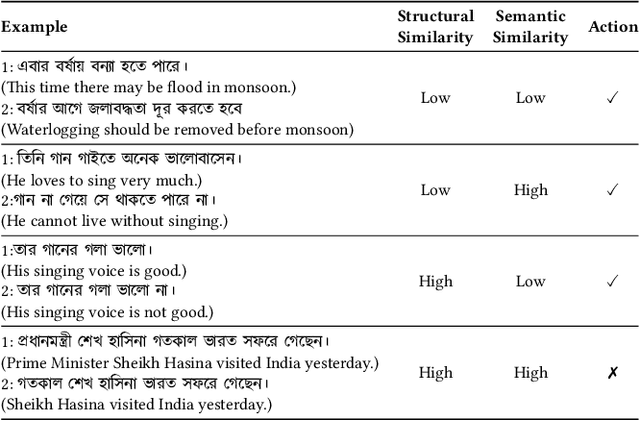
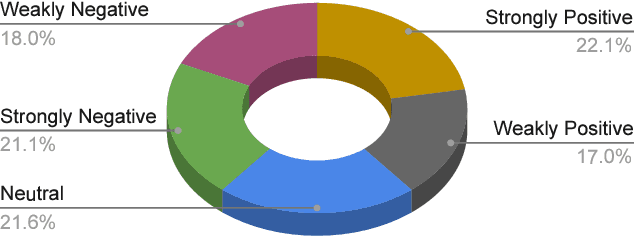
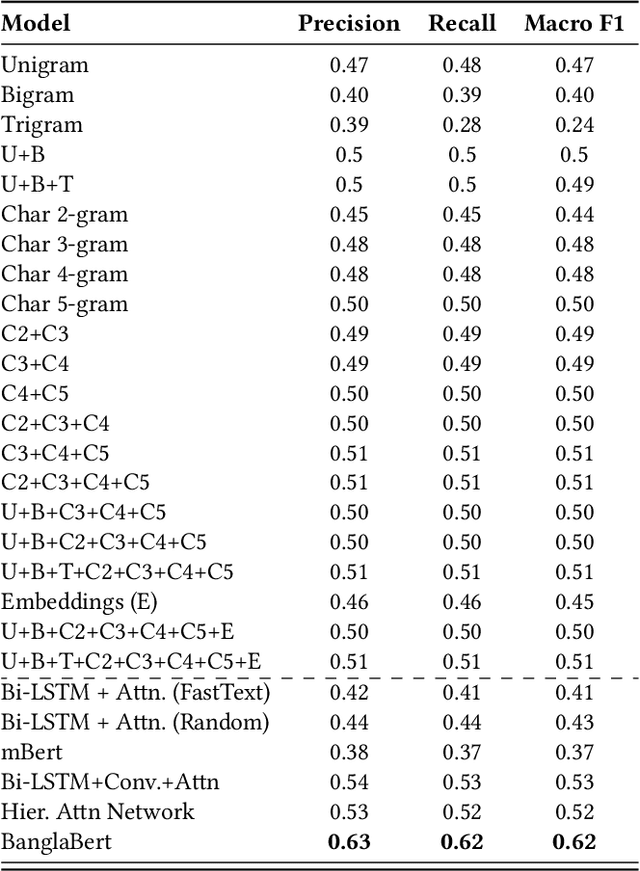
This study introduces SentiGOLD, a Bangla multi-domain sentiment analysis dataset. Comprising 70,000 samples, it was created from diverse sources and annotated by a gender-balanced team of linguists. SentiGOLD adheres to established linguistic conventions agreed upon by the Government of Bangladesh and a Bangla linguistics committee. Unlike English and other languages, Bangla lacks standard sentiment analysis datasets due to the absence of a national linguistics framework. The dataset incorporates data from online video comments, social media posts, blogs, news, and other sources while maintaining domain and class distribution rigorously. It spans 30 domains (e.g., politics, entertainment, sports) and includes 5 sentiment classes (strongly negative, weakly negative, neutral, and strongly positive). The annotation scheme, approved by the national linguistics committee, ensures a robust Inter Annotator Agreement (IAA) with a Fleiss' kappa score of 0.88. Intra- and cross-dataset evaluation protocols are applied to establish a standard classification system. Cross-dataset evaluation on the noisy SentNoB dataset presents a challenging test scenario. Additionally, zero-shot experiments demonstrate the generalizability of SentiGOLD. The top model achieves a macro f1 score of 0.62 (intra-dataset) across 5 classes, setting a benchmark, and 0.61 (cross-dataset from SentNoB) across 3 classes, comparable to the state-of-the-art. Fine-tuned sentiment analysis model can be accessed at https://sentiment.bangla.gov.bd.