 Add to Chrome
 Add to Firefox
 Add to Edge
MolSight: Molecular Property Prediction with Images
May 11, 2026
Every molecule ever synthesised can be drawn as a 2D skeletal diagram, yet in modern property prediction this universally available representation has received less focus in favour of molecular graphs, 3D conformers, or billion-parameter language models, each imposing its own computational and data-engineering overhead. We present $\textbf{MolSight}$, the first systematic large-scale study of vision-based Molecular Property Prediction (MPP). Using 10 vision architectures, 7 pre-training strategies, and $2\,M$ molecule images, we evaluate performance across 10 downstream tasks spanning physical-property regression, drug-discovery classification, and quantum-chemistry prediction. To account for the wide variation in structural complexity across pre-training molecules, we further propose a $\textbf{chemistry-informed curriculum}$: five structural complexity descriptors partition the corpus into five tiers of increasing chemical difficulty, consistently outperforming non-curriculum baselines. We show that a single rendered bond-line image, processed by a vision encoder, is sufficient for competitive molecular property prediction, i.e. $\textit{chemical insight from sight alone}$. The best curriculum-trained configuration achieves the top result on $\textbf{5 of 10}$ benchmarks and top two on $\textbf{all 10}$, at $\textbf{$\textit{80$\times$ lower}$}$ FLOPs than the nearest multi-modal competitor.

Conversational Behavior Modeling Foundation Model With Multi-Level Perception
Feb 11, 2026Human conversation is organized by an implicit chain of thoughts that manifests as timed speech acts. Capturing this perceptual pathway is key to building natural full-duplex interactive systems. We introduce a framework that models this process as multi-level perception, and then reasons over conversational behaviors via a Graph-of-Thoughts (GoT). Our approach formalizes the intent-to-action pathway with a hierarchical labeling scheme, predicting high-level communicative intents and low-level speech acts to learn their causal and temporal dependencies. To train this system, we develop a high quality corpus that pairs controllable, event-rich dialogue data with human-annotated labels. The GoT framework structures streaming predictions as an evolving graph, enabling a transformer to forecast the next speech act, generate concise justifications for its decisions, and dynamically refine its reasoning. Experiments on both synthetic and real duplex dialogues show that the framework delivers robust behavior detection, produces interpretable reasoning chains, and establishes a foundation for benchmarking conversational reasoning in full duplex spoken dialogue systems.
Enabling Conversational Behavior Reasoning Capabilities in Full-Duplex Speech
Dec 25, 2025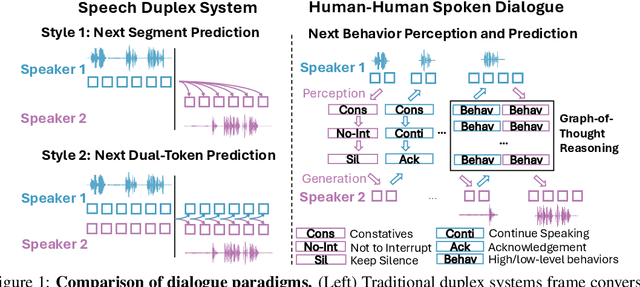

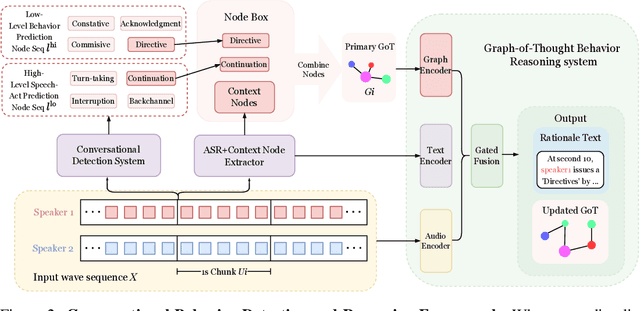

Human conversation is organized by an implicit chain of thoughts that manifests as timed speech acts. Capturing this causal pathway is key to building natural full-duplex interactive systems. We introduce a framework that enables reasoning over conversational behaviors by modeling this process as causal inference within a Graph-of-Thoughts (GoT). Our approach formalizes the intent-to-action pathway with a hierarchical labeling scheme, predicting high-level communicative intents and low-level speech acts to learn their causal and temporal dependencies. To train this system, we develop a hybrid corpus that pairs controllable, event-rich simulations with human-annotated rationales and real conversational speech. The GoT framework structures streaming predictions as an evolving graph, enabling a multimodal transformer to forecast the next speech act, generate concise justifications for its decisions, and dynamically refine its reasoning. Experiments on both synthetic and real duplex dialogues show that the framework delivers robust behavior detection, produces interpretable reasoning chains, and establishes a foundation for benchmarking conversational reasoning in full duplex spoken dialogue systems.
LCS-CTC: Leveraging Soft Alignments to Enhance Phonetic Transcription Robustness
Aug 05, 2025Phonetic speech transcription is crucial for fine-grained linguistic analysis and downstream speech applications. While Connectionist Temporal Classification (CTC) is a widely used approach for such tasks due to its efficiency, it often falls short in recognition performance, especially under unclear and nonfluent speech. In this work, we propose LCS-CTC, a two-stage framework for phoneme-level speech recognition that combines a similarity-aware local alignment algorithm with a constrained CTC training objective. By predicting fine-grained frame-phoneme cost matrices and applying a modified Longest Common Subsequence (LCS) algorithm, our method identifies high-confidence alignment zones which are used to constrain the CTC decoding path space, thereby reducing overfitting and improving generalization ability, which enables both robust recognition and text-free forced alignment. Experiments on both LibriSpeech and PPA demonstrate that LCS-CTC consistently outperforms vanilla CTC baselines, suggesting its potential to unify phoneme modeling across fluent and non-fluent speech.