 Add to Chrome
 Add to Firefox
 Add to Edge
Kozuchi Agent: A Language-Agnostic Open-Weight Agent for Software Repair
Aug 16, 2026
Industrial software-engineering teams increasingly need LLM agents that turn bug reports into correct patches, yet benchmark-scale operation adds long horizons, tool-use discipline, context persistence, heterogeneous clusters, and evaluation reuse. We present Kozuchi Agent, a language-agnostic open-weight repair agent and CI-operated evaluation pipeline. Explicit phases, persistent state, deterministic tools, a model-independent action interface, and cross-agent test-time selection make runs auditable and repeatable. With locally hosted Qwen3.5-27B, no fine-tuning, and TTS@8, Kozuchi resolves 374/500 SWE-bench Verified instances on the official evaluator. Unchanged on Multi-SWE-bench Java, the same 27-billion-parameter agent resolves 41/128 instances (32.03%), ranking first among strict open-weight submissions and fourth of 42 overall; on Python it ranks 12th of 135 and first among open-weight systems. Per-phase behavior remains within +/-5 percentage points across languages. Remaining failures mainly reflect semantic correctness, Java-specific harness issues, and selection errors. Across both tracks, results compare favorably with open/local peers by parameter count. Analysis of candidate diversity, selector regret, and patch reliability shows that the remaining gap is primarily semantic correctness and selection rather than edit formatting or proprietary-model access. Operationally, reusable CI stages reduce operator touch-points from five to one across heterogeneous internal clusters.

From Sweep to Seam: Interleaved Cross-Block Post-Training Quantization
Aug 10, 2026Compressing large language models to two bits or fewer is increasingly feasible through block-wise post-training quantization; cross-block variants reconstruct neighboring Transformer blocks within a moving window. In the fixed two-block setting studied here, the matched sequential baseline moves this window through the network once, so errors introduced early in the sweep are not revisited. We propose Interleaved Cross-Block Quantization (ICBQ), a scheduling modification that revisits the boundary pair between consecutive chunks. Each seam pair is refined twice: first at the end of one chunk and again at the start of the next. The method retains the local two-block objective and reuses the calibration inputs of existing block-wise PTQ pipelines. Under stated local contraction and smoothness assumptions, we derive a depth-wise upper-bound comparison in which seam revisits multiply the propagated term while the residual remains bounded independently of depth. In the reported experiments, ICBQ reduces ternary-quantization perplexity relative to the matched Sequential CBQ baseline, yields finite perplexity in configurations where the baseline has severe degradation, and can also be used with 3-bit and 2-bit GPTQ.
LOGOS: A Living Logic for AI Agent Teams That Evolve With Humans
Jul 12, 2026AI agents are evolving from answer engines into persistent teams that use tools, delegate work, learn from experience, and modify the artifacts that shape their future behavior. The defining question for deployment is no longer merely what agents can do, but who controls what they are allowed to become. We introduce logos, a pluggable layer for self-evolution and governance that strengthens existing multiagent frameworks rather than replacing them. logos compiles heterogeneous multimodal inputs, including documents, images, audio, tables, databases, APIs, and human instructions into versioned agent packs containing agents, tools, knowledge, tests, permissions, and policies. During operation, it transforms agent activity into portable, auditable event traces and applies fail-closed verification across frameworks and backends. Every learned prompt, memory, skill, tool, role, or workflow remains an untrusted release candidate until held-out execution evidence, human-controlled policy, and explicit authorization permit its promotion. This architecture enables "verifiable human-agent loop engineering": agents can act, ask, learn, and propose improvements, while humans can steer objectives, permissions, approvals, and irreversible actions without interrupting continuous operation. logos provides a living logic for accountable automation. Agents may evolve at machine speed, but only evidence and human authority can close the loop.
Signs Beat Floats: Low-Rank Double-Binary Adaptation for On-Device Fine-Tuning
May 22, 2026On-device adaptation of large language models commonly keeps a quantized base model frozen while training and deploying a small, task-specific LoRA adapter. In the unmerged adapter-mode setting, however, the adapter is more than a compact storage module; it introduces an additional dense floating-point branch, maintains a trainable state for local updates, and acts as a unit of communication and hot-swapping.We introduce LoRDBA, a LoRA-compatible adapter that replaces both low-rank factors with binary sign carriers while representing magnitudes through lightweight, channel-wise scales, converting the dense adapter branch into two sign-accumulation matrix multiplications interleaved with channel-wise scaling. A finite-sample analysis shows that reconstruction quality is governed by the residual-to-magnitude ratio of the original LoRA factors. In adapter-mode experiments, LoRDBA outperforms low-bit baselines at matched model sizes while matching fp16 LoRA quality in selected regimes. The unmerged adapter incurs at most 8% prefill latency overhead at matched rank r=16 despite an over 10x reduction in adapter footprint, with moderate training memory overhead of approximately 1.6x that of fp16 LoRA.
OneComp: One-Line Revolution for Generative AI Model Compression
Mar 30, 2026Deploying foundation models is increasingly constrained by memory footprint, latency, and hardware costs. Post-training compression can mitigate these bottlenecks by reducing the precision of model parameters without significantly degrading performance; however, its practical implementation remains challenging as practitioners navigate a fragmented landscape of quantization algorithms, precision budgets, data-driven calibration strategies, and hardware-dependent execution regimes. We present OneComp, an open-source compression framework that transforms this expert workflow into a reproducible, resource-adaptive pipeline. Given a model identifier and available hardware, OneComp automatically inspects the model, plans mixed-precision assignments, and executes progressive quantization stages, ranging from layer-wise compression to block-wise refinement and global refinement. A key architectural choice is treating the first quantized checkpoint as a deployable pivot, ensuring that each subsequent stage improves the same model and that quality increases as more compute is invested. By converting state-of-the-art compression research into an extensible, open-source, hardware-aware pipeline, OneComp bridges the gap between algorithmic innovation and production-grade model deployment.
Sign Lock-In: Randomly Initialized Weight Signs Persist and Bottleneck Sub-Bit Model Compression
Feb 19, 2026Sub-bit model compression seeks storage below one bit per weight; as magnitudes are aggressively compressed, the sign bit becomes a fixed-cost bottleneck. Across Transformers, CNNs, and MLPs, learned sign matrices resist low-rank approximation and are spectrally indistinguishable from an i.i.d. Rademacher baseline. Despite this apparent randomness, most weights retain their initialization signs; flips primarily occur via rare near-zero boundary crossings, suggesting that sign-pattern randomness is largely inherited from initialization. We formalize this behavior with sign lock-in theory, a stopping-time analysis of sign flips under SGD noise. Under bounded updates and a rare re-entry condition into a small neighborhood around zero, the number of effective sign flips exhibits a geometric tail. Building on this mechanism, we introduce a gap-based initialization and a lightweight outward-drift regularizer, reducing the effective flip rate to approximately $10^{-3}$ with only about a one-point increase in perplexity.
More Than Bits: Multi-Envelope Double Binary Factorization for Extreme Quantization
Dec 31, 2025For extreme low-bit quantization of large language models (LLMs), Double Binary Factorization (DBF) is attractive as it enables efficient inference without sacrificing accuracy. However, the scaling parameters of DBF are too restrictive; after factoring out signs, all rank components share the same magnitude profile, resulting in performance saturation. We propose Multi-envelope DBF (MDBF), which retains a shared pair of 1-bit sign bases but replaces the single envelope with a rank-$l$ envelope. By sharing sign matrices among envelope components, MDBF effectively maintains a binary carrier and utilizes the limited memory budget for magnitude expressiveness. We also introduce a closed-form initialization and an alternating refinement method to optimize MDBF. Across the LLaMA and Qwen families, MDBF enhances perplexity and zero-shot accuracy over previous binary formats at matched bits per weight while preserving the same deployment-friendly inference primitive.
PHOTON: Hierarchical Autoregressive Modeling for Lightspeed and Memory-Efficient Language Generation
Dec 22, 2025Transformers operate as horizontal token-by-token scanners; at each generation step, the model attends to an ever-growing sequence of token-level states. This access pattern increases prefill latency and makes long-context decoding increasingly memory-bound, as KV-cache reads and writes dominate inference throughput rather than arithmetic computation. We propose Parallel Hierarchical Operation for Top-down Networks (PHOTON), a hierarchical autoregressive model that replaces flat scanning with vertical, multi-resolution context access. PHOTON maintains a hierarchy of latent streams: a bottom-up encoder progressively compresses tokens into low-rate contextual states, while lightweight top-down decoders reconstruct fine-grained token representations. Experimental results show that PHOTON is superior to competitive Transformer-based language models regarding the throughput-quality trade-off, offering significant advantages in long-context and multi-query tasks. This reduces decode-time KV-cache traffic, yielding up to $10^{3}\times$ higher throughput per unit memory.
Three approaches to facilitate DNN generalization to objects in out-of-distribution orientations and illuminations: late-stopping, tuning batch normalization and invariance loss
Oct 30, 2021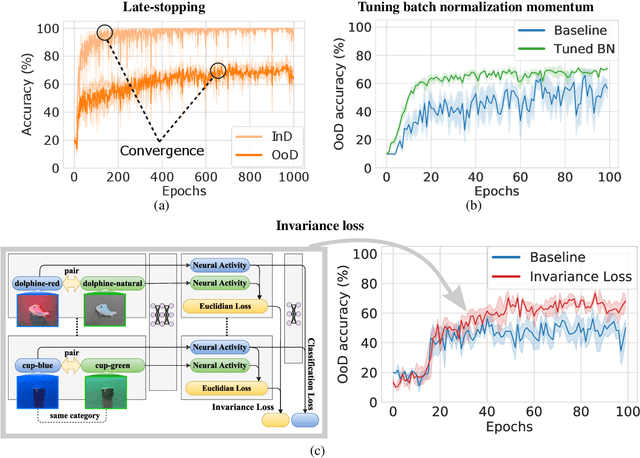

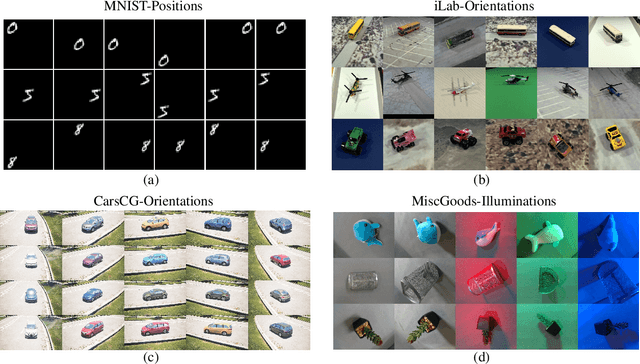

The training data distribution is often biased towards objects in certain orientations and illumination conditions. While humans have a remarkable capability of recognizing objects in out-of-distribution (OoD) orientations and illuminations, Deep Neural Networks (DNNs) severely suffer in this case, even when large amounts of training examples are available. In this paper, we investigate three different approaches to improve DNNs in recognizing objects in OoD orientations and illuminations. Namely, these are (i) training much longer after convergence of the in-distribution (InD) validation accuracy, i.e., late-stopping, (ii) tuning the momentum parameter of the batch normalization layers, and (iii) enforcing invariance of the neural activity in an intermediate layer to orientation and illumination conditions. Each of these approaches substantially improves the DNN's OoD accuracy (more than 20% in some cases). We report results in four datasets: two datasets are modified from the MNIST and iLab datasets, and the other two are novel (one of 3D rendered cars and another of objects taken from various controlled orientations and illumination conditions). These datasets allow to study the effects of different amounts of bias and are challenging as DNNs perform poorly in OoD conditions. Finally, we demonstrate that even though the three approaches focus on different aspects of DNNs, they all tend to lead to the same underlying neural mechanism to enable OoD accuracy gains -- individual neurons in the intermediate layers become more selective to a category and also invariant to OoD orientations and illuminations.
Bermuda Triangles: GNNs Fail to Detect Simple Topological Structures
May 01, 2021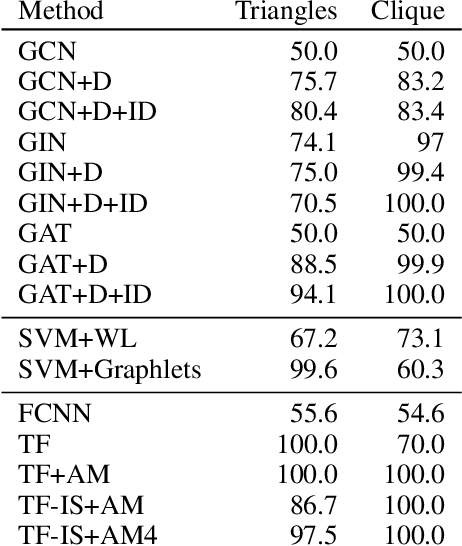
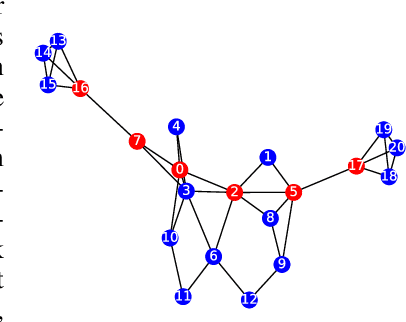
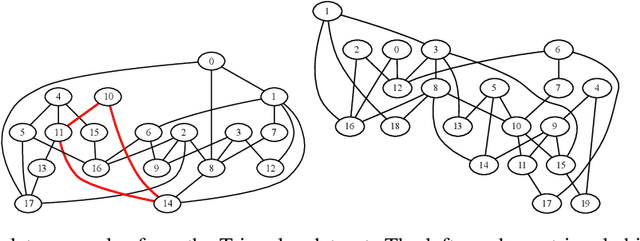
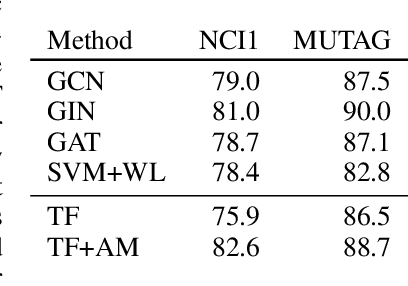
Most graph neural network architectures work by message-passing node vector embeddings over the adjacency matrix, and it is assumed that they capture graph topology by doing that. We design two synthetic tasks, focusing purely on topological problems -- triangle detection and clique distance -- on which graph neural networks perform surprisingly badly, failing to detect those "bermuda" triangles. Datasets and their generation scripts are publicly available on github.com/FujitsuLaboratories/bermudatriangles and dataset.labs.fujitsu.com.