 Add to Chrome
 Add to Firefox
 Add to Edge
KumoRFM-2: Scaling Foundation Models for Relational Learning
Apr 14, 2026
We introduce KumoRFM-2, the next iteration of a pre-trained foundation model for relational data. KumoRFM-2 supports in-context learning as well as fine-tuning and is applicable to a wide range of predictive tasks. In contrast to tabular foundation models, KumoRFM-2 natively operates on relational data, processing one or more connected tables simultaneously without manual table flattening or target variable generation, all while preserving temporal consistency. KumoRFM-2 leverages a large corpus of synthetic and real-world data to pre-train across four axes: the row and column dimensions at the individual table level, and the foreign key and cross-sample dimensions at the database level. In contrast to its predecessor, KumoRFM-2 injects task information as early as possible, enabling sharper selection of task-relevant columns and improved robustness to noisy data. Through extensive experiments on 41 challenging benchmarks and analysis around expressivity and sensitivity, we demonstrate that KumoRFM-2 outperforms supervised and foundational approaches by up to 8%, while maintaining strong performance under extreme settings of cold start and noisy data. To our knowledge, this is the first time a few-shot foundation model has been shown to surpass supervised approaches on common benchmark tasks, with performance further improving upon fine-tuning. Finally, while KumoRFM-1 was limited to small-scale in-memory datasets, KumoRFM-2 scales to billion-scale relational datasets.

PyG 2.0: Scalable Learning on Real World Graphs
Jul 22, 2025PyG (PyTorch Geometric) has evolved significantly since its initial release, establishing itself as a leading framework for Graph Neural Networks. In this paper, we present Pyg 2.0 (and its subsequent minor versions), a comprehensive update that introduces substantial improvements in scalability and real-world application capabilities. We detail the framework's enhanced architecture, including support for heterogeneous and temporal graphs, scalable feature/graph stores, and various optimizations, enabling researchers and practitioners to tackle large-scale graph learning problems efficiently. Over the recent years, PyG has been supporting graph learning in a large variety of application areas, which we will summarize, while providing a deep dive into the important areas of relational deep learning and large language modeling.
ContextGNN: Beyond Two-Tower Recommendation Systems
Nov 29, 2024


Recommendation systems predominantly utilize two-tower architectures, which evaluate user-item rankings through the inner product of their respective embeddings. However, one key limitation of two-tower models is that they learn a pair-agnostic representation of users and items. In contrast, pair-wise representations either scale poorly due to their quadratic complexity or are too restrictive on the candidate pairs to rank. To address these issues, we introduce Context-based Graph Neural Networks (ContextGNNs), a novel deep learning architecture for link prediction in recommendation systems. The method employs a pair-wise representation technique for familiar items situated within a user's local subgraph, while leveraging two-tower representations to facilitate the recommendation of exploratory items. A final network then predicts how to fuse both pair-wise and two-tower recommendations into a single ranking of items. We demonstrate that ContextGNN is able to adapt to different data characteristics and outperforms existing methods, both traditional and GNN-based, on a diverse set of practical recommendation tasks, improving performance by 20% on average.
PyTorch Frame: A Modular Framework for Multi-Modal Tabular Learning
Mar 31, 2024
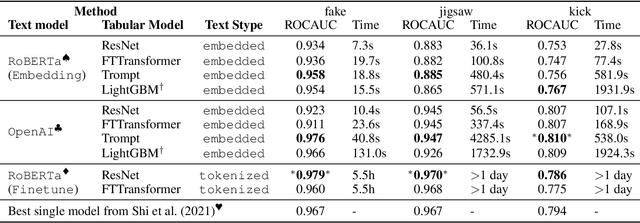
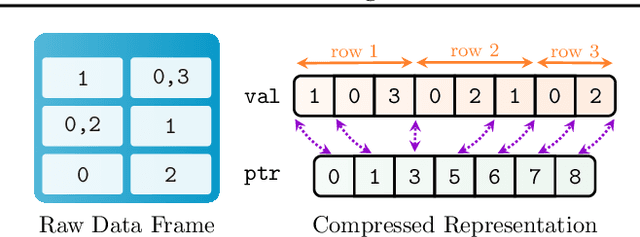
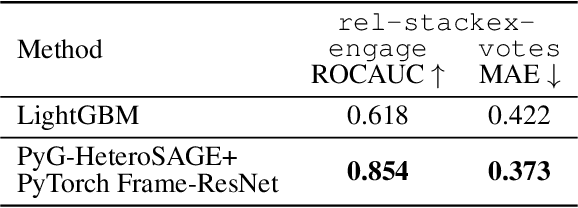
We present PyTorch Frame, a PyTorch-based framework for deep learning over multi-modal tabular data. PyTorch Frame makes tabular deep learning easy by providing a PyTorch-based data structure to handle complex tabular data, introducing a model abstraction to enable modular implementation of tabular models, and allowing external foundation models to be incorporated to handle complex columns (e.g., LLMs for text columns). We demonstrate the usefulness of PyTorch Frame by implementing diverse tabular models in a modular way, successfully applying these models to complex multi-modal tabular data, and integrating our framework with PyTorch Geometric, a PyTorch library for Graph Neural Networks (GNNs), to perform end-to-end learning over relational databases.