 Add to Chrome
 Add to Firefox
 Add to Edge
Towards Responsible Multimodal Medical Reasoning via Context-Aligned Vision-Language Models
Apr 09, 2026
Medical vision-language models (VLMs) show strong performance on radiology tasks but often produce fluent yet weakly grounded conclusions due to over-reliance on a dominant modality. We introduce a context-aligned reasoning framework that enforces agreement across heterogeneous clinical evidence before generating diagnostic conclusions. The proposed approach augments a frozen VLM with structured contextual signals derived from radiomic statistics, explainability activations, and vocabulary-grounded semantic cues. Instead of producing free-form responses, the model generates structured outputs containing supporting evidence, uncertainty estimates, limitations, and safety notes. We observe that auxiliary signals alone provide limited benefit; performance gains emerge only when these signals are integrated through contextual verification. Experiments on chest X-ray datasets demonstrate that context alignment improves discriminative performance (AUC 0.918 to 0.925) while maintaining calibrated uncertainty. The framework also substantially reduces hallucinated keywords (1.14 to 0.25) and produces more concise reasoning explanations (19.4 to 15.3 words) without increasing model confidence (0.70 to 0.68). Cross-dataset evaluation on CheXpert further reveals that modality informativeness significantly influences reasoning behavior. These results suggest that enforcing multi-evidence agreement improves both reliability and trustworthiness in medical multimodal reasoning, while preserving the underlying model architecture.

MedLogic-AQA: Enhancing Medical Question Answering with Abstractive Models Focusing on Logical Structures
Oct 20, 2024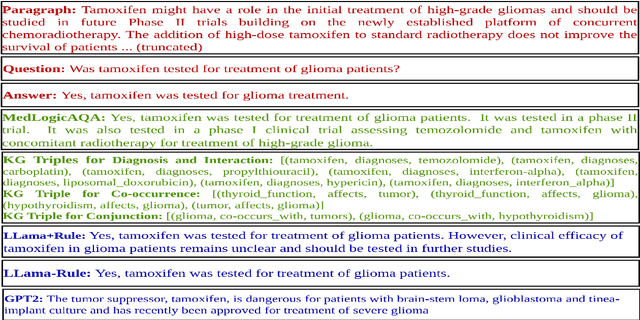
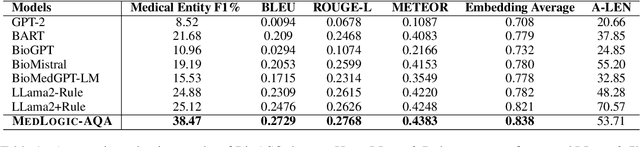
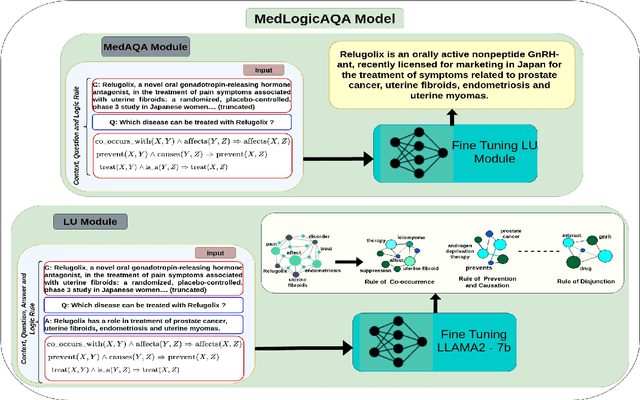

In Medical question-answering (QA) tasks, the need for effective systems is pivotal in delivering accurate responses to intricate medical queries. However, existing approaches often struggle to grasp the intricate logical structures and relationships inherent in medical contexts, thus limiting their capacity to furnish precise and nuanced answers. In this work, we address this gap by proposing a novel Abstractive QA system MedLogic-AQA that harnesses First Order Logic (FOL) based rules extracted from both context and questions to generate well-grounded answers. Through initial experimentation, we identified six pertinent first-order logical rules, which were then used to train a Logic-Understanding (LU) model capable of generating logical triples for a given context, question, and answer. These logic triples are then integrated into the training of MedLogic-AQA, enabling effective and coherent reasoning during answer generation. This distinctive fusion of logical reasoning with abstractive QA equips our system to produce answers that are logically sound, relevant, and engaging. Evaluation with respect to both automated and human-based demonstrates the robustness of MedLogic-AQA against strong baselines. Through empirical assessments and case studies, we validate the efficacy of MedLogic-AQA in elevating the quality and comprehensiveness of answers in terms of reasoning as well as informativeness