 Add to Chrome
 Add to Firefox
 Add to Edge
CORE: Collaborative Reasoning via Cross Teaching
Jan 29, 2026
Large language models exhibit complementary reasoning errors: on the same instance, one model may succeed with a particular decomposition while another fails. We propose Collaborative Reasoning (CORE), a training-time collaboration framework that converts peer success into a learning signal via a cross-teaching protocol. Each problem is solved in two stages: a cold round of independent sampling, followed by a contexted rescue round in which models that failed receive hint extracted from a successful peer. CORE optimizes a combined reward that balances (i) correctness, (ii) a lightweight DPP-inspired diversity term to reduce error overlap, and (iii) an explicit rescue bonus for successful recovery. We evaluate CORE across four standard reasoning datasets GSM8K, MATH, AIME, and GPQA. With only 1,000 training examples, a pair of small open source models (3B+4B) reaches Pass@2 of 99.54% on GSM8K and 92.08% on MATH, compared to 82.50% and 74.82% for single-model training. On harder datasets, the 3B+4B pair reaches Pass@2 of 77.34% on GPQA (trained on 348 examples) and 79.65% on AIME (trained on 792 examples), using a training-time budget of at most 1536 context tokens and 3072 generated tokens. Overall, these results show that training-time collaboration can reliably convert model complementarity into large gains without scaling model size.

SD-E$^2$: Semantic Exploration for Reasoning Under Token Budgets
Jan 25, 2026Small language models (SLMs) struggle with complex reasoning because exploration is expensive under tight compute budgets. We introduce Semantic Diversity-Exploration-Exploitation (SD-E$^2$), a reinforcement learning framework that makes exploration explicit by optimizing semantic diversity in generated reasoning trajectories. Using a frozen sentence-embedding model, SD-E$^2$ assigns a diversity reward that captures (i) the coverage of semantically distinct solution strategies and (ii) their average pairwise dissimilarity in embedding space, rather than surface-form novelty. This diversity reward is combined with outcome correctness and solution efficiency in a z-score-normalized multi-objective objective that stabilizes training. On GSM8K, SD-E$^2$ surpasses the base Qwen2.5-3B-Instruct and strong GRPO baselines (GRPO-CFL and GRPO-CFEE) by +27.4, +5.2, and +1.5 percentage points, respectively, while discovering on average 9.8 semantically distinct strategies per question. We further improve MedMCQA to 49.64% versus 38.37% for the base model and show gains on the harder AIME benchmark (1983-2025), reaching 13.28% versus 6.74% for the base. These results indicate that rewarding semantic novelty yields a more compute-efficient exploration-exploitation signal for training reasoning-capable SLMs. By introducing cognitive adaptation-adjusting the reasoning process structure rather than per-token computation-SD-E$^2$ offers a complementary path to efficiency gains in resource-constrained models.
MedLogic-AQA: Enhancing Medical Question Answering with Abstractive Models Focusing on Logical Structures
Oct 20, 2024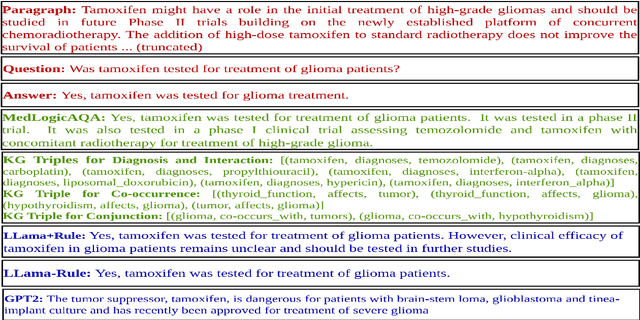
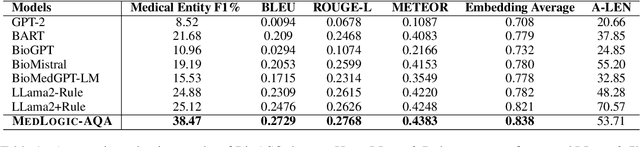
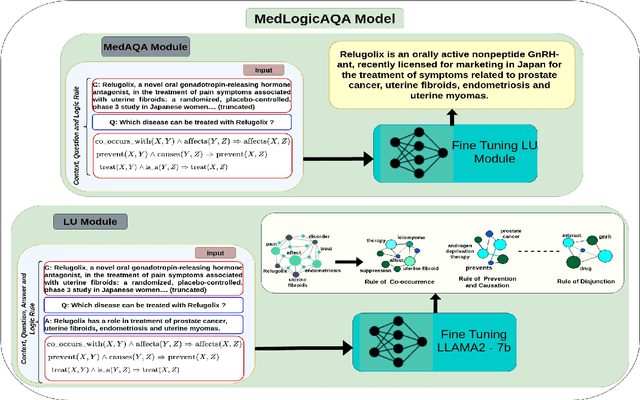

In Medical question-answering (QA) tasks, the need for effective systems is pivotal in delivering accurate responses to intricate medical queries. However, existing approaches often struggle to grasp the intricate logical structures and relationships inherent in medical contexts, thus limiting their capacity to furnish precise and nuanced answers. In this work, we address this gap by proposing a novel Abstractive QA system MedLogic-AQA that harnesses First Order Logic (FOL) based rules extracted from both context and questions to generate well-grounded answers. Through initial experimentation, we identified six pertinent first-order logical rules, which were then used to train a Logic-Understanding (LU) model capable of generating logical triples for a given context, question, and answer. These logic triples are then integrated into the training of MedLogic-AQA, enabling effective and coherent reasoning during answer generation. This distinctive fusion of logical reasoning with abstractive QA equips our system to produce answers that are logically sound, relevant, and engaging. Evaluation with respect to both automated and human-based demonstrates the robustness of MedLogic-AQA against strong baselines. Through empirical assessments and case studies, we validate the efficacy of MedLogic-AQA in elevating the quality and comprehensiveness of answers in terms of reasoning as well as informativeness
Tabular and Deep Reinforcement Learning for Gittins Index
May 02, 2024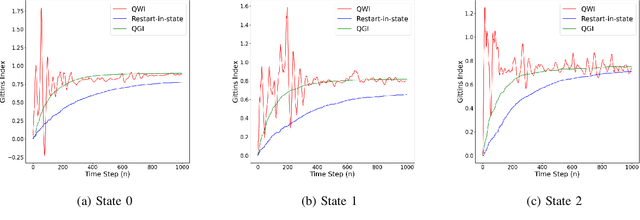
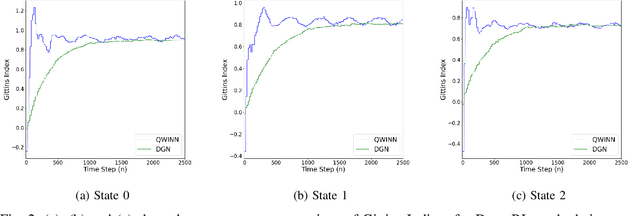
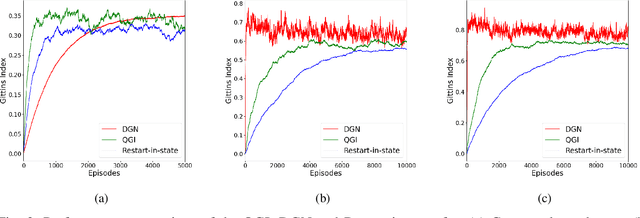
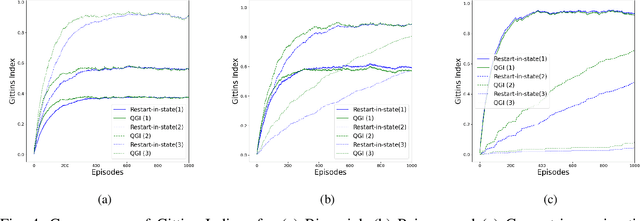
In the realm of multi-arm bandit problems, the Gittins index policy is known to be optimal in maximizing the expected total discounted reward obtained from pulling the Markovian arms. In most realistic scenarios however, the Markovian state transition probabilities are unknown and therefore the Gittins indices cannot be computed. One can then resort to reinforcement learning (RL) algorithms that explore the state space to learn these indices while exploiting to maximize the reward collected. In this work, we propose tabular (QGI) and Deep RL (DGN) algorithms for learning the Gittins index that are based on the retirement formulation for the multi-arm bandit problem. When compared with existing RL algorithms that learn the Gittins index, our algorithms have a lower run time, require less storage space (small Q-table size in QGI and smaller replay buffer in DGN), and illustrate better empirical convergence to the Gittins index. This makes our algorithm well suited for problems with large state spaces and is a viable alternative to existing methods. As a key application, we demonstrate the use of our algorithms in minimizing the mean flowtime in a job scheduling problem when jobs are available in batches and have an unknown service time distribution. \