 Add to Chrome
 Add to Firefox
 Add to Edge
The Tell-Tale Trace: Detecting Reasoning Failures in LLMs Using Chain-of-Thought Dynamics
Aug 04, 2026
Chain-of-thought (CoT) reasoning improves large language model (LLM) performance while also providing an observable interface to the model's reasoning process. Existing approaches that leverage verbalized CoTs to monitor reasoning correctness, however, largely evaluate the semantic correctness or consistency of individual intermediate steps, rather than how the reasoning process evolves across the trace. As a result, failures distributed across the reasoning trajectory, rather than those localized to a single incorrect step, remain comparatively underexplored. Furthermore, verbalized CoTs need not faithfully reflect the model's internal reasoning, motivating analyses that do not treat individual statements as literal accounts of internal computation. In this work, we therefore ask whether the dynamics of visible CoT can be leveraged to systematically distinguish successful from failed reasoning without assuming such semantic faithfulness. We study a range of LLMs on verifiable Boolean satisfiability tasks with variable complexity, enabling controlled comparisons near each model's capability frontier. Tagging CoT sentences by reasoning function reveals premature verification collapse on SAT problems: incorrect traces enter clause checking earlier, repeat similar operations, and finalize sooner. On UNSAT problems, models presumptuously move towards incorrect SAT conclusions, checking candidate assignments rather than deriving contradictions across constructed cases. Subsequently, a targeted proof-search prompt intervention raises Llama3-70B accuracy from 13.3% to 85%, correcting 84.6% of these errors. These results show that capability failures can manifest as distributed, task-dependent changes in the structure of visible reasoning, and that CoT dynamics agnostic to whether the verbalized trace reflects the model's internal computations can help diagnose and correct failures.

Probing the Origins of Reasoning Performance: Representational Quality for Mathematical Problem-Solving in RL vs. SFT Fine-Tuned Models
Jul 28, 2026Large reasoning models trained via reinforcement learning (RL) have been increasingly shown to outperform their supervised fine-tuned (SFT) counterparts on mathematical reasoning tasks; Yet the mechanistic basis for this advantage remains unclear. We therefore ask, what internal representational differences enable RL models' superior performance? Our work presents two converging lines of evidence: First, linear probes trained on layer-wise hidden states reveal that RL models tend to achieve higher accuracy in predicting answer correctness compared to SFT models, indicating more linearly separable and structured representations. Second, mean ablation studies show that RL models develop a hierarchical architecture where deeper layers become progressively more critical, whereas SFT models distribute importance uniformly across layers. Together, these findings demonstrate that RL training fundamentally restructures how models represent and process reasoning problems. Finally, we analyze token-count variability under repeated sampling across problems to assess adaptive compute allocation. While we observe higher variability in some RL-tuned models than in their SFT counterparts, we see strong consistency in others, suggesting that token allocation may depend more on the overall training pipeline than on RL versus SFT alone. We believe this token-allocation variability reveals the spread of plausible on-policy reasoning, highlighting which models exhibit stable policies versus those that are under-determined, potentially non-identifiable solution behaviour.
ResearchRubrics: A Benchmark of Prompts and Rubrics For Evaluating Deep Research Agents
Nov 10, 2025Deep Research (DR) is an emerging agent application that leverages large language models (LLMs) to address open-ended queries. It requires the integration of several capabilities, including multi-step reasoning, cross-document synthesis, and the generation of evidence-backed, long-form answers. Evaluating DR remains challenging because responses are lengthy and diverse, admit many valid solutions, and often depend on dynamic information sources. We introduce ResearchRubrics, a standardized benchmark for DR built with over 2,800+ hours of human labor that pairs realistic, domain-diverse prompts with 2,500+ expert-written, fine-grained rubrics to assess factual grounding, reasoning soundness, and clarity. We also propose a new complexity framework for categorizing DR tasks along three axes: conceptual breadth, logical nesting, and exploration. In addition, we develop human and model-based evaluation protocols that measure rubric adherence for DR agents. We evaluate several state-of-the-art DR systems and find that even leading agents like Gemini's DR and OpenAI's DR achieve under 68% average compliance with our rubrics, primarily due to missed implicit context and inadequate reasoning about retrieved information. Our results highlight the need for robust, scalable assessment of deep research capabilities, to which end we release ResearchRubrics(including all prompts, rubrics, and evaluation code) to facilitate progress toward well-justified research assistants.
Zeroth-Order Topological Insights into Iterative Magnitude Pruning
Jun 17, 2022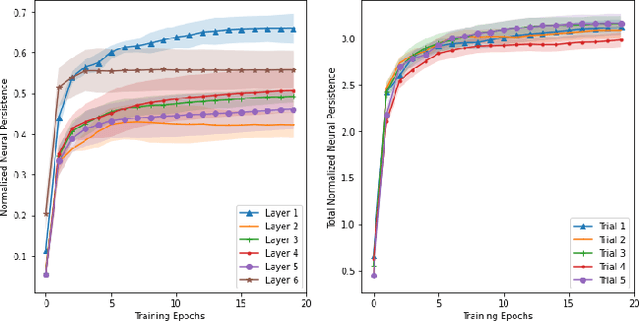
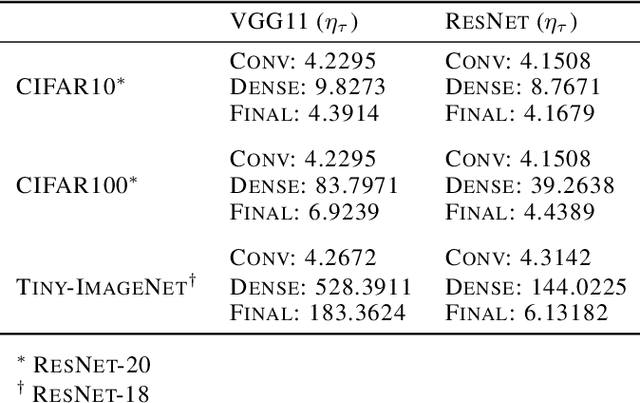
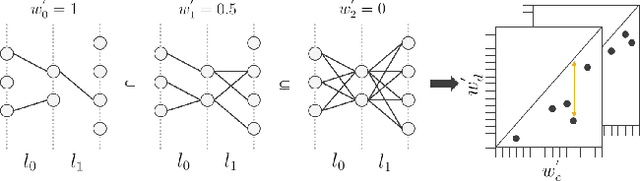
Modern-day neural networks are famously large, yet also highly redundant and compressible; there exist numerous pruning strategies in the deep learning literature that yield over 90% sparser sub-networks of fully-trained, dense architectures while still maintaining their original accuracies. Amongst these many methods though -- thanks to its conceptual simplicity, ease of implementation, and efficacy -- Iterative Magnitude Pruning (IMP) dominates in practice and is the de facto baseline to beat in the pruning community. However, theoretical explanations as to why a simplistic method such as IMP works at all are few and limited. In this work, we leverage the notion of persistent homology to gain insights into the workings of IMP and show that it inherently encourages retention of those weights which preserve topological information in a trained network. Subsequently, we also provide bounds on how much different networks can be pruned while perfectly preserving their zeroth order topological features, and present a modified version of IMP to do the same.