 Add to Chrome
 Add to Firefox
 Add to Edge
Phonetic forced alignment for low-resource language varieties: Model training and evaluation on Chengdu Mandarin
Jul 23, 2026
Phonetic forced alignment is a key technique in phonetic research, yet existing alignment systems lack specialized models for low-resource language varieties. We address this by training text-dependent and text-independent aligners for Chengdu Mandarin using a 17-hour corpus and a custom G2P dictionary. We trained a text-dependent GMM-HMM model (Chengdu-MFA) and fine-tuned a pretrained audio encoder on frame classification with Chengdu-MFA's pseudo label for text-independent alignment (Chengdu-FC). Evaluation on an expert-annotated test set show that both methods significantly outperform Standard Mandarin baselines. Chengdu-MFA reduced average phone boundary differences by 31.8%, while Chengdu-FC achieved a 61.2% reduction. This work establishes a practical bootstrapping pipeline for developing accurate aligners for under-resourced varieties without labor- and time-intensive manual annotation.

Revisiting Acceptability Judgements
May 24, 2023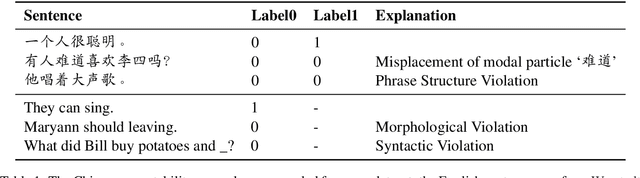
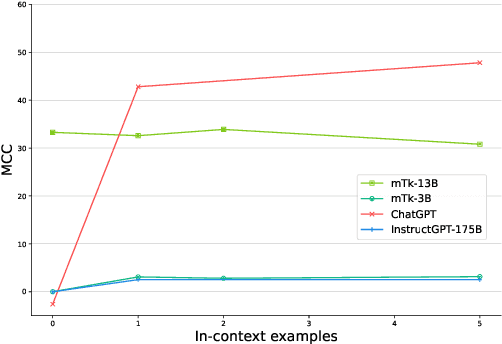
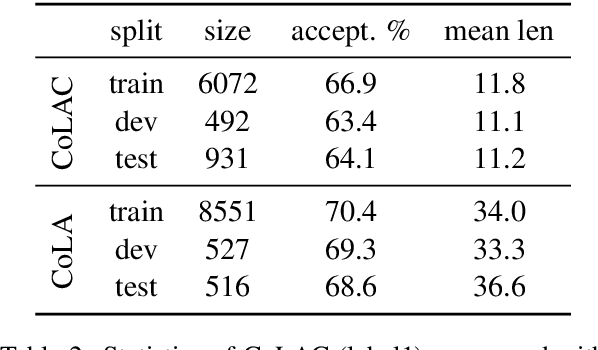
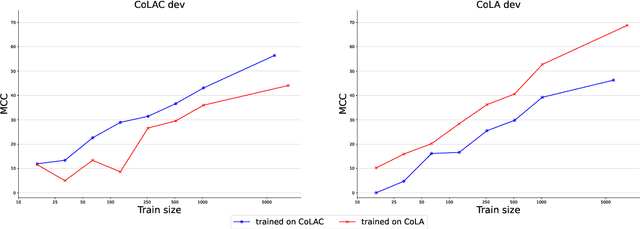
Years have passed since the NLP community has last focused on linguistic acceptability. In this work, we revisit this topic in the context of large language models. We introduce CoLAC - Corpus of Linguistic Acceptability in Chinese, the first large-scale non-English acceptability dataset that is verified by native speakers and comes with two sets of labels. Our experiments show that even the largest InstructGPT model performs only at chance level on CoLAC, while ChatGPT's performance (48.30 MCC) is also way below supervised models (59.03 MCC) and human (65.11 MCC). Through cross-lingual transfer experiments and fine-grained linguistic analysis, we demonstrate for the first time that knowledge of linguistic acceptability can be transferred across typologically distinct languages, as well as be traced back to pre-training.