 Add to Chrome
 Add to Firefox
 Add to Edge
Bucketing the Good Apples: A Method for Diagnosing and Improving Causal Abstraction
May 04, 2026
We present a method for diagnosing interpretation in neural networks by identifying an input subspace where a proposed interpretation is highly faithful. Our method is particularly useful for causal-abstraction-style interpretability, where a high-level causal hypothesis is evaluated by interchange interventions. Rather than treating interchange intervention accuracy as a single global summary, we refine this framework by partitioning the input space into well-interpreted and under-interpreted regions according to pairwise interchange-intervention behavior. This turns causal abstraction from a purely global evaluation into a more diagnostic tool: it not only measures whether an interpretation works, but also reveals where it works, where it fails, and what distinguishes the two cases. This diagnostic view also provides practical heuristics for improving interpretations. By analyzing the structure of the well-interpreted and under-interpreted regions, we can identify missing distinctions in a high-level hypothesis, discover previously unmodeled intermediate variables, and combine complementary partial interpretations into a stronger one. We instantiate this idea as a simple four-step recipe and show that it yields informative error analyses across multiple causal abstraction settings. In a toy logic task, recursively applying the recipe recovers a high-level hypothesis from scratch. More broadly, our results suggest that partitioning the input space is a useful step toward more precise, constructive, and scalable mechanistic interpretability.

Generation Space Size: Understanding and Calibrating Open-Endedness of LLM Generations
Oct 14, 2025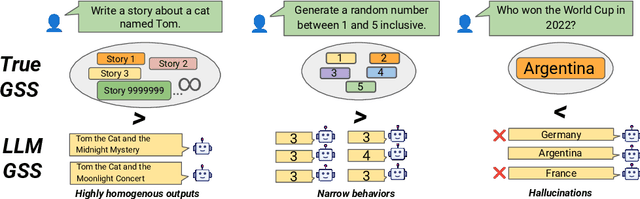

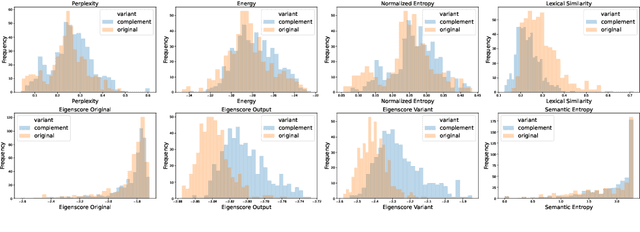

Different open-ended generation tasks require different degrees of output diversity. However, current LLMs are often miscalibrated. They collapse to overly homogeneous outputs for creative tasks and hallucinate diverse but incorrect responses for factual tasks. We argue that these two failure modes are unified by, and can both be addressed by, the notion of effective generation space size (GSS) -- the set of semantically distinct outputs a model considers for a prompt. We present GSSBench, a task suite of prompt pairs with ground-truth GSS relationships to assess different metrics and understand where models diverge from desired behavior. We find that hallucination detection metrics, particularly EigenScore, consistently outperform standard diversity and uncertainty quantification metrics, while using only model internals, providing interpretable insights into a model's internal task representations. We demonstrate three applications of GSS: (1) detecting prompt ambiguity and predicting clarification questions for better grounding, (2) interpreting overthinking and underthinking in reasoning models, and (3) steering models to expand their generation space to yield high-quality and diverse outputs.