 Add to Chrome
 Add to Firefox
 Add to Edge
Towards Autonomous Railway Operations: A Semi-Hierarchical Deep Reinforcement Learning Approach to the Vehicle Rescheduling Problem
May 11, 2026
Managing disruptions in railway traffic management is a major challenge. Rising traffic density and infrastructure limits increase complexity, making the Vehicle Routing and Scheduling Problem (VRSP) difficult to solve reliably and in real time. While Operational Research (OR) methods are widely used, most dispatching still relies on human expertise due to the problem's exponential combinatorial complexity. Reinforcement Learning (RL) has gained attention for its potential in multi-agent coordination, but existing RL approaches often underperform OR methods and struggle to scale in dense rail networks. This paper addresses this gap from a machine learning perspective by introducing a semi-hierarchical RL formulation tailored to operational railway constraints. The method separates dispatching from routing through dedicated action and observation spaces, enabling policies to specialise in distinct decision scopes and addressing the imbalance between rare dispatch decisions and frequent routing updates. The approach is evaluated on the Flatland-RL simulator across five difficulty levels and 50 random seeds, with 7 to 80 trains. Results show substantially improved coordination, resource utilisation, and robustness compared with heuristic baselines and monolithic RL, nearly doubling the number of trains reaching their destinations, while keeping deadlock rates below 5% and adaptively sequencing, delaying, or cancelling trains under heavy congestion.

Flatland Competition 2020: MAPF and MARL for Efficient Train Coordination on a Grid World
Mar 30, 2021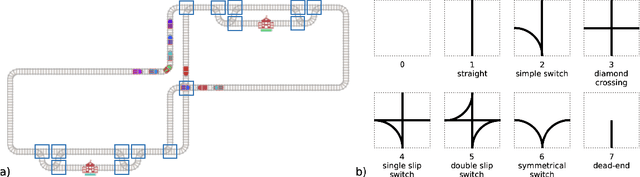
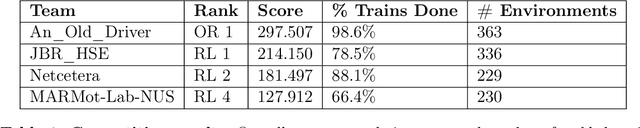
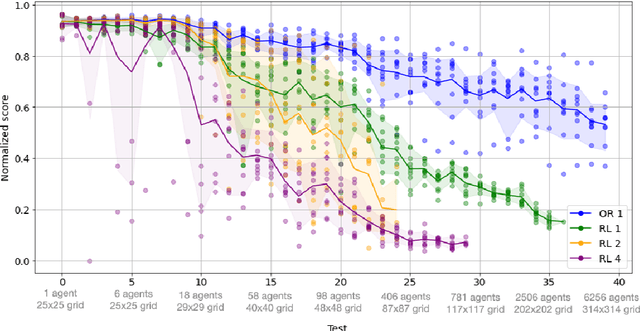
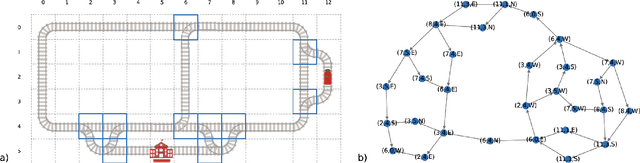
The Flatland competition aimed at finding novel approaches to solve the vehicle re-scheduling problem (VRSP). The VRSP is concerned with scheduling trips in traffic networks and the re-scheduling of vehicles when disruptions occur, for example the breakdown of a vehicle. While solving the VRSP in various settings has been an active area in operations research (OR) for decades, the ever-growing complexity of modern railway networks makes dynamic real-time scheduling of traffic virtually impossible. Recently, multi-agent reinforcement learning (MARL) has successfully tackled challenging tasks where many agents need to be coordinated, such as multiplayer video games. However, the coordination of hundreds of agents in a real-life setting like a railway network remains challenging and the Flatland environment used for the competition models these real-world properties in a simplified manner. Submissions had to bring as many trains (agents) to their target stations in as little time as possible. While the best submissions were in the OR category, participants found many promising MARL approaches. Using both centralized and decentralized learning based approaches, top submissions used graph representations of the environment to construct tree-based observations. Further, different coordination mechanisms were implemented, such as communication and prioritization between agents. This paper presents the competition setup, four outstanding solutions to the competition, and a cross-comparison between them.
Flatland-RL : Multi-Agent Reinforcement Learning on Trains
Dec 11, 2020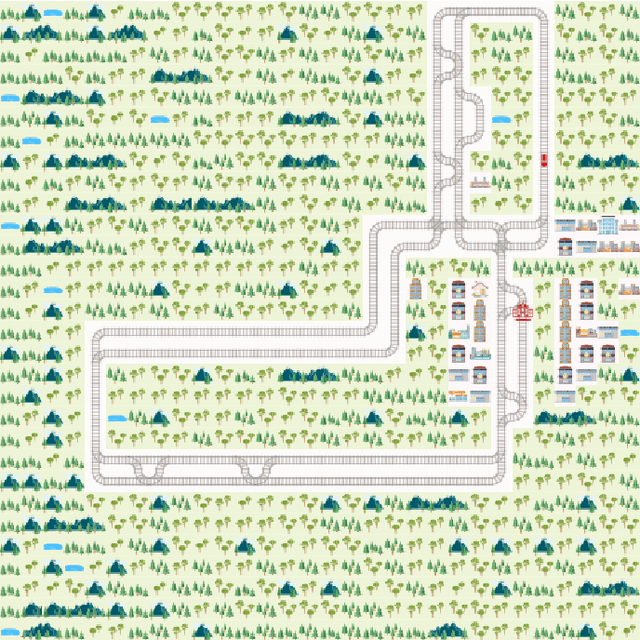
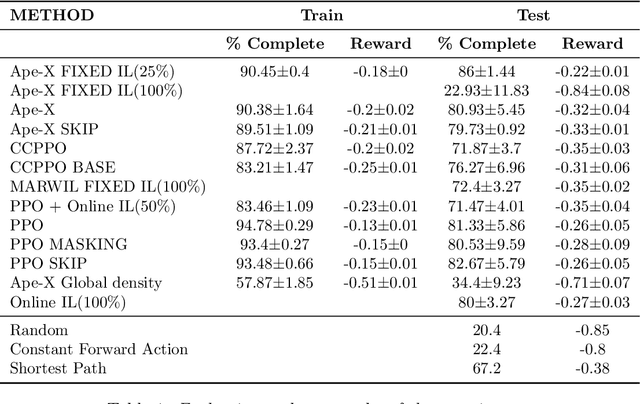
Efficient automated scheduling of trains remains a major challenge for modern railway systems. The underlying vehicle rescheduling problem (VRSP) has been a major focus of Operations Research (OR) since decades. Traditional approaches use complex simulators to study VRSP, where experimenting with a broad range of novel ideas is time consuming and has a huge computational overhead. In this paper, we introduce a two-dimensional simplified grid environment called "Flatland" that allows for faster experimentation. Flatland does not only reduce the complexity of the full physical simulation, but also provides an easy-to-use interface to test novel approaches for the VRSP, such as Reinforcement Learning (RL) and Imitation Learning (IL). In order to probe the potential of Machine Learning (ML) research on Flatland, we (1) ran a first series of RL and IL experiments and (2) design and executed a public Benchmark at NeurIPS 2020 to engage a large community of researchers to work on this problem. Our own experimental results, on the one hand, demonstrate that ML has potential in solving the VRSP on Flatland. On the other hand, we identify key topics that need further research. Overall, the Flatland environment has proven to be a robust and valuable framework to investigate the VRSP for railway networks. Our experiments provide a good starting point for further research and for the participants of the NeurIPS 2020 Flatland Benchmark. All of these efforts together have the potential to have a substantial impact on shaping the mobility of the future.
Improving Sample Efficiency and Multi-Agent Communication in RL-based Train Rescheduling
Apr 28, 2020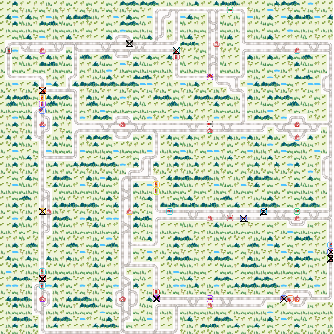
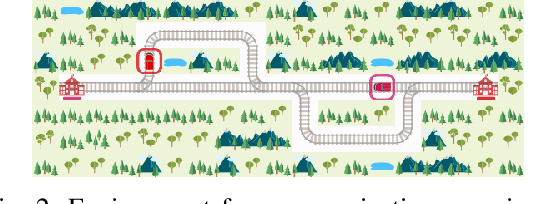
We present preliminary results from our sixth placed entry to the Flatland international competition for train rescheduling, including two improvements for optimized reinforcement learning (RL) training efficiency, and two hypotheses with respect to the prospect of deep RL for complex real-world control tasks: first, that current state of the art policy gradient methods seem inappropriate in the domain of high-consequence environments; second, that learning explicit communication actions (an emerging machine-to-machine language, so to speak) might offer a remedy. These hypotheses need to be confirmed by future work. If confirmed, they hold promises with respect to optimizing highly efficient logistics ecosystems like the Swiss Federal Railways railway network.