 Add to Chrome
 Add to Firefox
 Add to Edge
Do Language Models Consistently Encode the Current Year?
Aug 16, 2026
A consistent concept of the current time is important for temporal reasoning, yet how language models represent the current time is not well understood. We contribute two tasks that probe the current year in conceptually distinct ways: an associative task, which infers the current year from verb tense, and a declarative task, which directly queries for the current year. Both tasks estimate current years within one year of the post-training data cutoff of instruction-tuned language models. For base models, predictions on the associative task serve as a strong proxy for the pre-training data cutoff, with an average error of only 10 months across 13 models. However, their internal mechanisms diverge: the associative task uses mechanisms similar to factual recall, while the declarative task lacks consistent causal pathways. This divergence poses a challenge for updating the current year in language models. None of prompting, SFT, or weight editing succeed in shifting the associative and declarative years simultaneously. Prompting updates the declarative year (94.6% success across 351 target years) but leaves the associative year nearly unchanged (1.7% success). Year-shifted SFT also fails to shift the associative year, matching the target year in only one of eight models. Weight editing, while effective for both tasks individually, does not generalize across both. Overall, our results show that the current year is not consistently encoded in language models: The associative notion, deeply ingrained in linguistic structures learned in pre-training, uses different causal mechanisms and resists the same modifications that easily shift the declarative notion learned in post-training.

BoxingGym: Benchmarking Progress in Automated Experimental Design and Model Discovery
Jan 02, 2025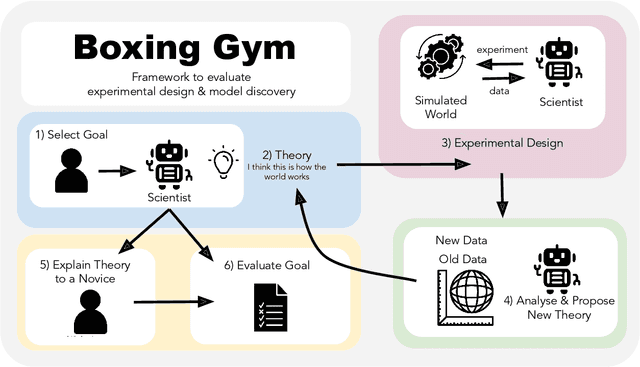
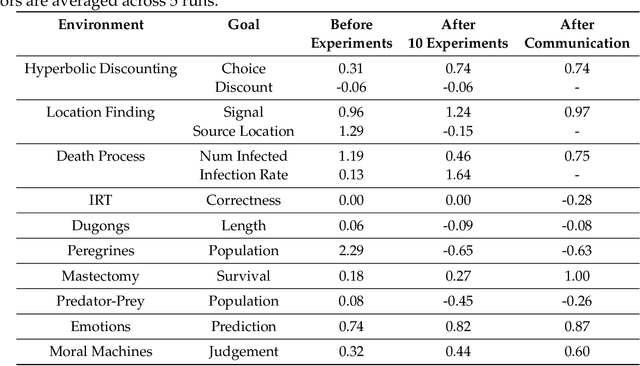
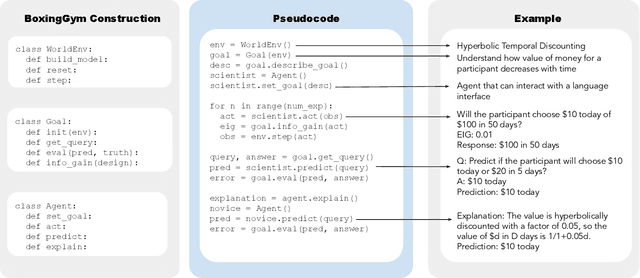
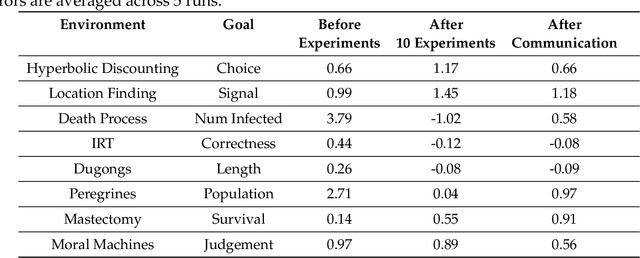
Understanding the world and explaining it with scientific theories is a central aspiration of artificial intelligence research. Proposing theories, designing experiments to test them, and then revising them based on data are fundamental to scientific discovery. Despite the significant promise of LLM-based scientific agents, no benchmarks systematically test LLM's ability to propose scientific models, collect experimental data, and revise them in light of new data. We introduce BoxingGym, a benchmark with 10 environments for systematically evaluating both experimental design (e.g. collecting data to test a scientific theory) and model discovery (e.g. proposing and revising scientific theories). To enable tractable and quantitative evaluation, we implement each environment as a generative probabilistic model with which a scientific agent can run interactive experiments. These probabilistic models are drawn from various real-world scientific domains ranging from psychology to ecology. To quantitatively evaluate a scientific agent's ability to collect informative experimental data, we compute the expected information gain (EIG), an information-theoretic quantity which measures how much an experiment reduces uncertainty about the parameters of a generative model. A good scientific theory is a concise and predictive explanation. Therefore, to quantitatively evaluate model discovery, we ask a scientific agent to explain their model and then assess whether this explanation enables another scientific agent to make reliable predictions about this environment. In addition to this explanation-based evaluation, we compute standard model evaluation metrics such as prediction errors. We find that current LLMs, such as GPT-4o, struggle with both experimental design and model discovery. We find that augmenting the LLM-based agent with an explicit statistical model does not reliably improve these results.