 Add to Chrome
 Add to Firefox
 Add to Edge
SemEval-2026 Task 9: Detecting Multilingual, Multicultural and Multievent Online Polarization
Apr 08, 2026
We present SemEval-2026 Task 9, a shared task on online polarization detection, covering 22 languages and comprising over 110K annotated instances. Each data instance is multi-labeled with the presence of polarization, polarization type, and polarization manifestation. Participants were asked to predict labels in three sub-tasks: (1) detecting the presence of polarization, (2) identifying the type of polarization, and (3) recognizing the polarization manifestation. The three tasks attracted over 1,000 participants worldwide and more than 10k submission on Codabench. We received final submissions from 67 teams and 73 system description papers. We report the baseline results and analyze the performance of the best-performing systems, highlighting the most common approaches and the most effective methods across different subtasks and languages. The dataset of this task is publicly available.

Exploring Boundaries and Intensities in Offensive and Hate Speech: Unveiling the Complex Spectrum of Social Media Discourse
Apr 18, 2024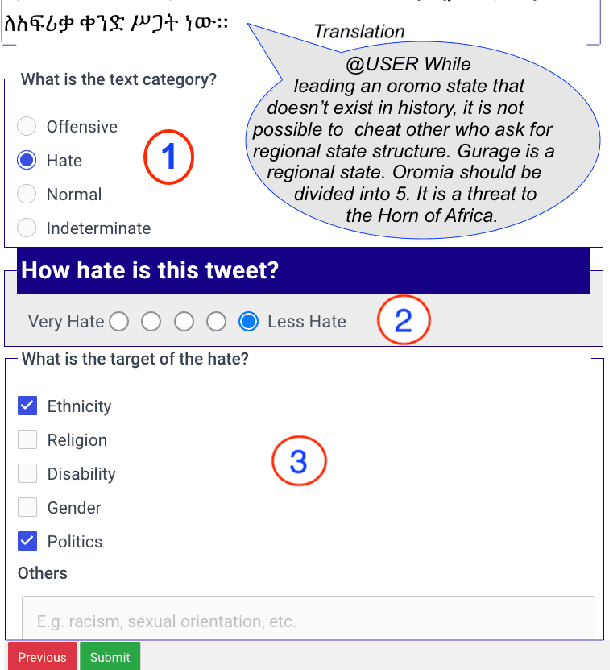
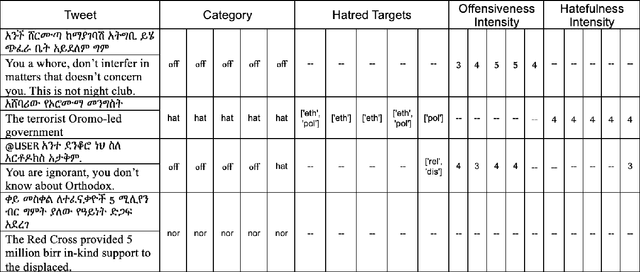
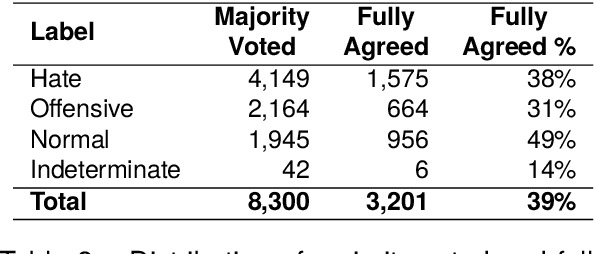

The prevalence of digital media and evolving sociopolitical dynamics have significantly amplified the dissemination of hateful content. Existing studies mainly focus on classifying texts into binary categories, often overlooking the continuous spectrum of offensiveness and hatefulness inherent in the text. In this research, we present an extensive benchmark dataset for Amharic, comprising 8,258 tweets annotated for three distinct tasks: category classification, identification of hate targets, and rating offensiveness and hatefulness intensities. Our study highlights that a considerable majority of tweets belong to the less offensive and less hate intensity levels, underscoring the need for early interventions by stakeholders. The prevalence of ethnic and political hatred targets, with significant overlaps in our dataset, emphasizes the complex relationships within Ethiopia's sociopolitical landscape. We build classification and regression models and investigate the efficacy of models in handling these tasks. Our results reveal that hate and offensive speech can not be addressed by a simplistic binary classification, instead manifesting as variables across a continuous range of values. The Afro-XLMR-large model exhibits the best performances achieving F1-scores of 75.30%, 70.59%, and 29.42% for the category, target, and regression tasks, respectively. The 80.22% correlation coefficient of the Afro-XLMR-large model indicates strong alignments.