 Add to Chrome
 Add to Firefox
 Add to Edge
Conceptualizing Embeddings: Sparse Disentanglement for Vision-Language Models
May 21, 2026
Vision-language models learn powerful multimodal embeddings, yet their internal semantics remain opaque. While sparse autoencoders (SAEs) can extract interpretable features, they rely on expanding the representation dimension, which compromises the original geometry and introduces redundancy. We introduce CEDAR (Conceptual Embedding Disentanglement via Adaptive Rotation), a post-hoc method that reveals the compositional structure of pretrained embeddings without increasing dimensionality. By learning an invertible transformation with a top-$k$ sparsity bottleneck, CEDAR concentrates semantic information into axis-aligned disentangled coordinates. In CLIP-like architecture, individual coordinates can be interpreted with textual concepts, while for generative models such as BLIP, they can be decoded into natural language descriptions. Experiments demonstrate that CEDAR achieves a competitive reconstruction-sparsity trade-off while producing explanations that are more interpretable and better aligned with human perception. Our results suggest that the apparent entanglement in vision-language representations can be resolved through a suitable change of basis, eliminating the need for overcomplete expansions.

ProtoQuant: Quantization of Prototypical Parts For General and Fine-Grained Image Classification
Feb 06, 2026Prototypical parts-based models offer a "this looks like that" paradigm for intrinsic interpretability, yet they typically struggle with ImageNet-scale generalization and often require computationally expensive backbone finetuning. Furthermore, existing methods frequently suffer from "prototype drift," where learned prototypes lack tangible grounding in the training distribution and change their activation under small perturbations. We present ProtoQuant, a novel architecture that achieves prototype stability and grounded interpretability through latent vector quantization. By constraining prototypes to a discrete learned codebook within the latent space, we ensure they remain faithful representations of the training data without the need to update the backbone. This design allows ProtoQuant to function as an efficient, interpretable head that scales to large-scale datasets. We evaluate ProtoQuant on ImageNet and several fine-grained benchmarks (CUB-200, Cars-196). Our results demonstrate that ProtoQuant achieves competitive classification accuracy while generalizing to ImageNet and comparable interpretability metrics to other prototypical-parts-based methods.
DAVE: Distribution-aware Attribution via ViT Gradient Decomposition
Feb 06, 2026Vision Transformers (ViTs) have become a dominant architecture in computer vision, yet producing stable and high-resolution attribution maps for these models remains challenging. Architectural components such as patch embeddings and attention routing often introduce structured artifacts in pixel-level explanations, causing many existing methods to rely on coarse patch-level attributions. We introduce DAVE \textit{(\underline{D}istribution-aware \underline{A}ttribution via \underline{V}iT Gradient D\underline{E}composition)}, a mathematically grounded attribution method for ViTs based on a structured decomposition of the input gradient. By exploiting architectural properties of ViTs, DAVE isolates locally equivariant and stable components of the effective input--output mapping. It separates these from architecture-induced artifacts and other sources of instability.
Personalized Interpretability -- Interactive Alignment of Prototypical Parts Networks
Jun 05, 2025Concept-based interpretable neural networks have gained significant attention due to their intuitive and easy-to-understand explanations based on case-based reasoning, such as "this bird looks like those sparrows". However, a major limitation is that these explanations may not always be comprehensible to users due to concept inconsistency, where multiple visual features are inappropriately mixed (e.g., a bird's head and wings treated as a single concept). This inconsistency breaks the alignment between model reasoning and human understanding. Furthermore, users have specific preferences for how concepts should look, yet current approaches provide no mechanism for incorporating their feedback. To address these issues, we introduce YoursProtoP, a novel interactive strategy that enables the personalization of prototypical parts - the visual concepts used by the model - according to user needs. By incorporating user supervision, YoursProtoP adapts and splits concepts used for both prediction and explanation to better match the user's preferences and understanding. Through experiments on both the synthetic FunnyBirds dataset and a real-world scenario using the CUB, CARS, and PETS datasets in a comprehensive user study, we demonstrate the effectiveness of YoursProtoP in achieving concept consistency without compromising the accuracy of the model.
This looks like what? Challenges and Future Research Directions for Part-Prototype Models
Feb 13, 2025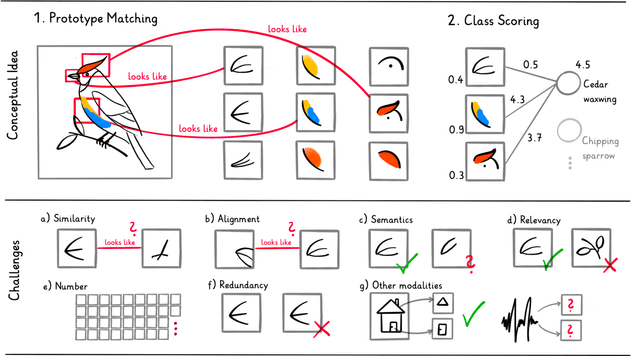
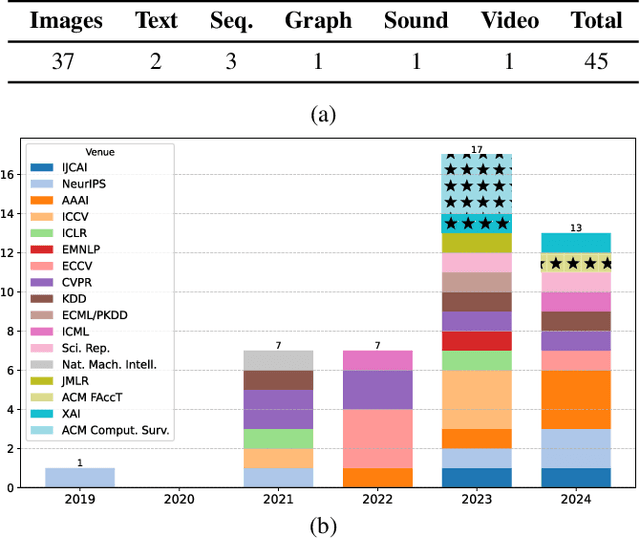
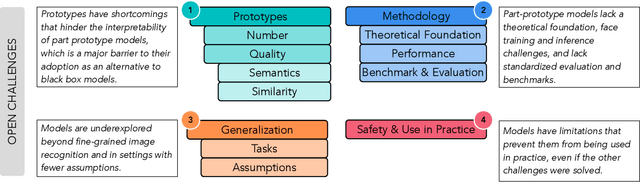
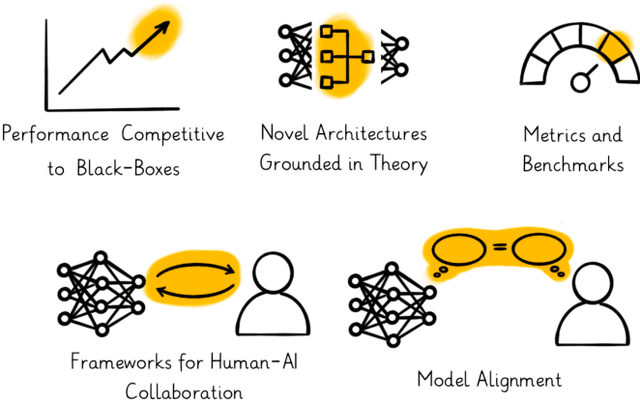
The growing interest in eXplainable Artificial Intelligence (XAI) has prompted research into models with built-in interpretability, the most prominent of which are part-prototype models. Part-Prototype Models (PPMs) make decisions by comparing an input image to a set of learned prototypes, providing human-understandable explanations in the form of ``this looks like that''. Despite their inherent interpretability, PPMS are not yet considered a valuable alternative to post-hoc models. In this survey, we investigate the reasons for this and provide directions for future research. We analyze papers from 2019 to 2024, and derive a taxonomy of the challenges that current PPMS face. Our analysis shows that the open challenges are quite diverse. The main concern is the quality and quantity of prototypes. Other concerns are the lack of generalization to a variety of tasks and contexts, and general methodological issues, including non-standardized evaluation. We provide ideas for future research in five broad directions: improving predictive performance, developing novel architectures grounded in theory, establishing frameworks for human-AI collaboration, aligning models with humans, and establishing metrics and benchmarks for evaluation. We hope that this survey will stimulate research and promote intrinsically interpretable models for application domains. Our list of surveyed papers is available at https://github.com/aix-group/ppm-survey.
OMENN: One Matrix to Explain Neural Networks
Dec 03, 2024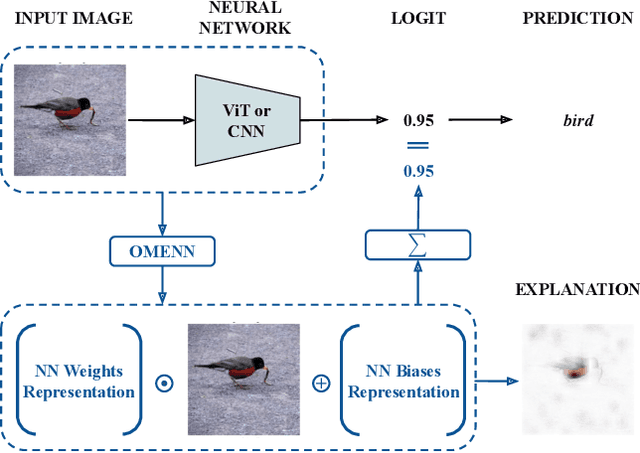
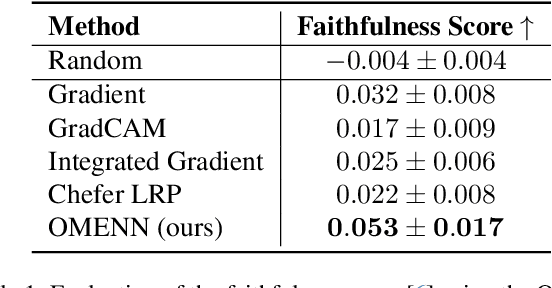
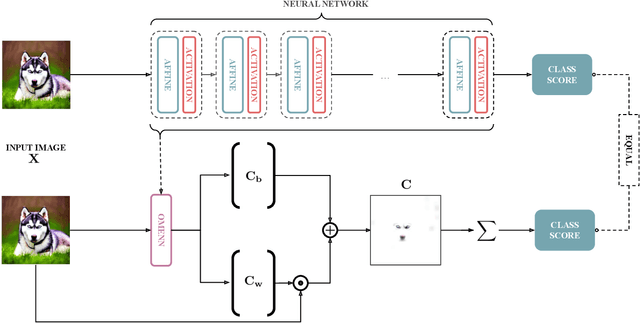
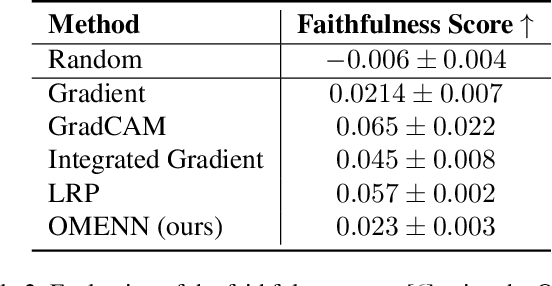
Deep Learning (DL) models are often black boxes, making their decision-making processes difficult to interpret. This lack of transparency has driven advancements in eXplainable Artificial Intelligence (XAI), a field dedicated to clarifying the reasoning behind DL model predictions. Among these, attribution-based methods such as LRP and GradCAM are widely used, though they rely on approximations that can be imprecise. To address these limitations, we introduce One Matrix to Explain Neural Networks (OMENN), a novel post-hoc method that represents a neural network as a single, interpretable matrix for each specific input. This matrix is constructed through a series of linear transformations that represent the processing of the input by each successive layer in the neural network. As a result, OMENN provides locally precise, attribution-based explanations of the input across various modern models, including ViTs and CNNs. We present a theoretical analysis of OMENN based on dynamic linearity property and validate its effectiveness with extensive tests on two XAI benchmarks, demonstrating that OMENN is competitive with state-of-the-art methods.
Avaya Conversational Intelligence: A Real-Time System for Spoken Language Understanding in Human-Human Call Center Conversations
Sep 02, 2019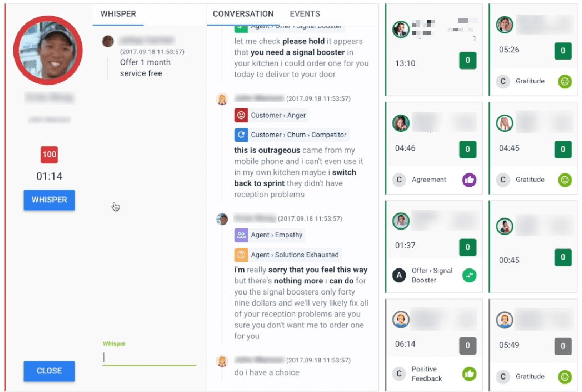
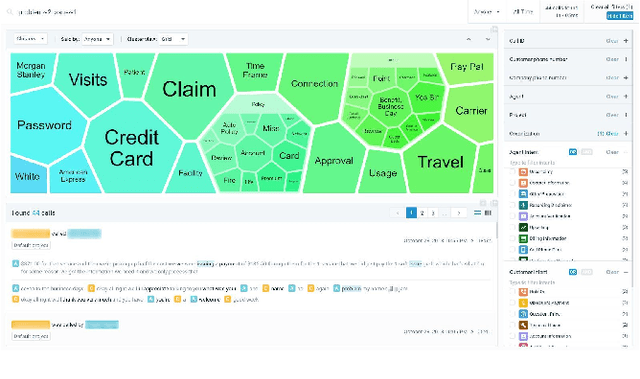
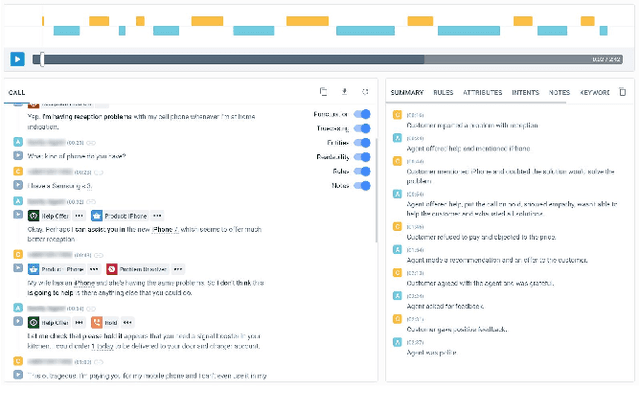
Avaya Conversational Intelligence(ACI) is an end-to-end, cloud-based solution for real-time Spoken Language Understanding for call centers. It combines large vocabulary, real-time speech recognition, transcript refinement, and entity and intent recognition in order to convert live audio into a rich, actionable stream of structured events. These events can be further leveraged with a business rules engine, thus serving as a foundation for real-time supervision and assistance applications. After the ingestion, calls are enriched with unsupervised keyword extraction, abstractive summarization, and business-defined attributes, enabling offline use cases, such as business intelligence, topic mining, full-text search, quality assurance, and agent training. ACI comes with a pretrained, configurable library of hundreds of intents and a robust intent training environment that allows for efficient, cost-effective creation and customization of customer-specific intents.