 Add to Chrome
 Add to Firefox
 Add to Edge
Explainable Deepfake Detection Challenge
Jul 23, 2026
Deepfake detection is moving beyond binary classification decisions toward systems that can also explain the visual evidence supporting those decisions. This transition is important for real-world verification settings, where diverse users need to understand not only whether an image is manipulated, but also why it is considered suspicious. The Explainable Deepfake Detection Challenge at ACM Multimedia 2026 is designed to benchmark this joint capability. Built on XPlainVerse, a million-scale benchmark for explainable deepfake detection, the challenge evaluates methods on image classification and grounded natural-language explanation generation. Participants submit a real/fake label together with two explanations for each image: a detailed complex explanation for technical users and a concise simple explanation for general users. The evaluation combines classification metrics with semantic similarity, simplicity, and intent-aware grounding metrics that assess whether explanations identify the relevant manipulated entities and supporting visual evidence. The methodologies developed through the challenge will contribute to the development of next-generation explainable deepfake detectors. Evaluation script, baseline models, and accompanying code are available on https://github.com/Abhijeet8901/XPlainVerse-ACMChallenge.

XPlainVerse: A Million-Scale Benchmark for Explainable Deepfake Detection
Jul 03, 2026As deepfake detection models increasingly produce natural language explanations, their reasoning often remains weakly grounded in visual artifacts, limiting reliability and user trust. Existing benchmarks mainly evaluate classification accuracy, overlooking whether explanations reflect the actual manipulations. This gap hinders progress toward deployable, explainable deepfake detection systems. To this end, we introduce XPlainVerse, a large-scale benchmark designed for joint deepfake detection and human-centered explanation. XPlainVerse comprises one million real and manipulated images, pairing authentic images from five established sources with forgeries generated by twelve off-the-shelf image editing and synthesis models. We further propose a multi-stage filtering pipeline, Edit-Check, to verify if manipulations satisfy their intended edits, enabling reliable reasoning supervision at scale. Beyond dataset scale, XPlainVerse provides two complementary explanation styles: technical explanations for expert analysis and simplified explanations optimized for non-technical users. To evaluate explanation quality beyond surface similarity, we propose novel metrics, EntityScore and EvidenceScore, that measure reasoning fidelity by checking whether explanations correctly identify manipulated entities and visual evidence. Human annotations on 2,000 explanation pairs validate our dataset quality against human judgment. We believe XPlainVerse will establish grounded explanation quality as a measurable dimension of deepfake detection and support scalable research on trustworthy, interpretable models.
Deep Learning-Based MR Image Re-parameterization
Jun 11, 2022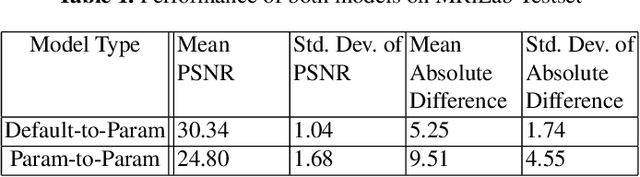
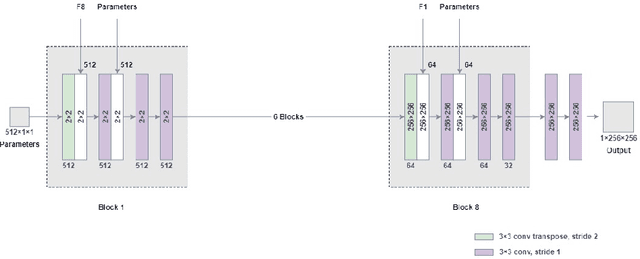
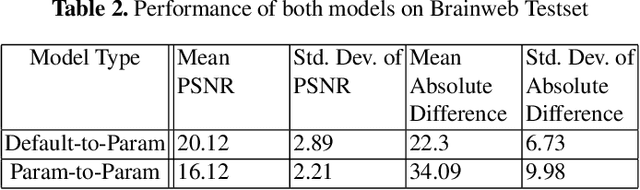
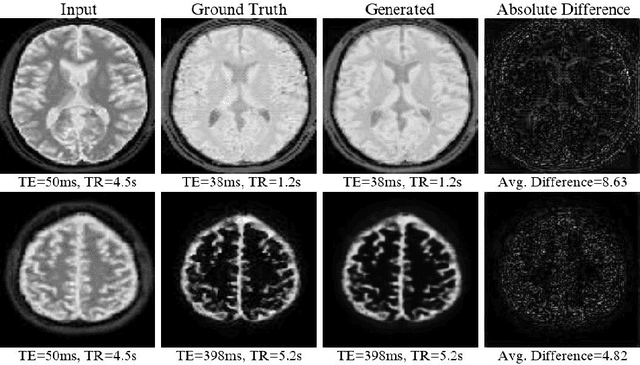
Magnetic resonance (MR) image re-parameterization refers to the process of generating via simulations of an MR image with a new set of MRI scanning parameters. Different parameter values generate distinct contrast between different tissues, helping identify pathologic tissue. Typically, more than one scan is required for diagnosis; however, acquiring repeated scans can be costly, time-consuming, and difficult for patients. Thus, using MR image re-parameterization to predict and estimate the contrast in these imaging scans can be an effective alternative. In this work, we propose a novel deep learning (DL) based convolutional model for MRI re-parameterization. Based on our preliminary results, DL-based techniques hold the potential to learn the non-linearities that govern the re-parameterization.