 Add to Chrome
 Add to Firefox
 Add to Edge
Score-Control for Hallucination Reduction in Diffusion Models
May 29, 2026
Diffusion models have emerged as the backbone of modern generative AI, powering advances in vision, language, audio and other modalities. Despite their success, they suffer from hallucinations, implausible samples that lie outside the support of true data distribution, which degrade reliability and trust. In this work, we first empirically confirm previously proposed hypothesis that score smoothness causes hallucinations in Image Generation diffusion models and provide a density-based perspective. We further formalize this notion by linking the hallucinations probability mass to lipschitz constant of the learned score function. Motivated by this, we introduce a Variance-Guided Score Modulation (VSM) strategy that controls the score Jacobian, in turn reducing score smoothness and better approximating the ground truth score that decreases hallucinations. Empirical results on synthetic and real-world datasets demonstrate that our approach reduces hallucinations (up to ~25%) while maintaining high fidelity and diversity, providing a principled step toward more reliable diffusion-based image generation. We also propose two benchmark datasets with extreme semantic variation for systematic hallucination evaluation. Code and Datasets are publicly available at https://github.com/bhosalems/VSM.

CRAFT: Critic-Refined Adaptive Key-Frame Targeting for Multimodal Video Question Answering
May 18, 2026Grounded multi-video question answering over real-world news events requires systems to surface query-relevant evidence across heterogeneous video archives while attributing every claim to its supporting source. We introduce CRAFT (Critic-Refined Adaptive Key-Frame Targeting), a query-conditioned pipeline that combines dynamic keyframe selection, per-video ASR with multilingual fallback, and a hybrid critic loop to iteratively verify and repair claims before consolidation. The pipeline integrates UNLI temporal entailment, DeBERTa-v3 cross-claim screening, and a Llama-3.2-3B adjudicator, with a final citation-merging stage that emits each fact once with all supporting source identifiers. On MAGMaR 2026, CRAFT achieves the best overall average (0.739), reference recall (0.810), and citation F1 (0.635). We further evaluate on a MAGMaR-style conversion of WikiVideo with 52 non-overlapping event queries, where CRAFT also performs strongly (0.823 Avg), showing that its claim-centric evidence aggregation generalizes beyond MAGMaR. Ablations show that atomic claims, ASR, and the critic loop drive the main gains over the vanilla query-conditioned baseline. Code and implementation details are publicly available at https://github.com/bhosalems/CRAFT.
FairLLaVA: Fairness-Aware Parameter-Efficient Fine-Tuning for Large Vision-Language Assistants
Mar 27, 2026While powerful in image-conditioned generation, multimodal large language models (MLLMs) can display uneven performance across demographic groups, highlighting fairness risks. In safety-critical clinical settings, such disparities risk producing unequal diagnostic narratives and eroding trust in AI-assisted decision-making. While fairness has been studied extensively in vision-only and language-only models, its impact on MLLMs remains largely underexplored. To address these biases, we introduce FairLLaVA, a parameter-efficient fine-tuning method that mitigates group disparities in visual instruction tuning without compromising overall performance. By minimizing the mutual information between target attributes, FairLLaVA regularizes the model's representations to be demographic-invariant. The method can be incorporated as a lightweight plug-in, maintaining efficiency with low-rank adapter fine-tuning, and provides an architecture-agnostic approach to fair visual instruction following. Extensive experiments on large-scale chest radiology report generation and dermoscopy visual question answering benchmarks show that FairLLaVA consistently reduces inter-group disparities while improving both equity-scaled clinical performance and natural language generation quality across diverse medical imaging modalities. Code can be accessed at https://github.com/bhosalems/FairLLaVA.
ICPR 2024 Competition on Rider Intention Prediction
Mar 11, 2025The recent surge in the vehicle market has led to an alarming increase in road accidents. This underscores the critical importance of enhancing road safety measures, particularly for vulnerable road users like motorcyclists. Hence, we introduce the rider intention prediction (RIP) competition that aims to address challenges in rider safety by proactively predicting maneuvers before they occur, thereby strengthening rider safety. This capability enables the riders to react to the potential incorrect maneuvers flagged by advanced driver assistance systems (ADAS). We collect a new dataset, namely, rider action anticipation dataset (RAAD) for the competition consisting of two tasks: single-view RIP and multi-view RIP. The dataset incorporates a spectrum of traffic conditions and challenging navigational maneuvers on roads with varying lighting conditions. For the competition, we received seventy-five registrations and five team submissions for inference of which we compared the methods of the top three performing teams on both the RIP tasks: one state-space model (Mamba2) and two learning-based approaches (SVM and CNN-LSTM). The results indicate that the state-space model outperformed the other methods across the entire dataset, providing a balanced performance across maneuver classes. The SVM-based RIP method showed the second-best performance when using random sampling and SMOTE. However, the CNN-LSTM method underperformed, primarily due to class imbalance issues, particularly struggling with minority classes. This paper details the proposed RAAD dataset and provides a summary of the submissions for the RIP 2024 competition.
DHFormer: A Vision Transformer-Based Attention Module for Image Dehazing
Dec 15, 2023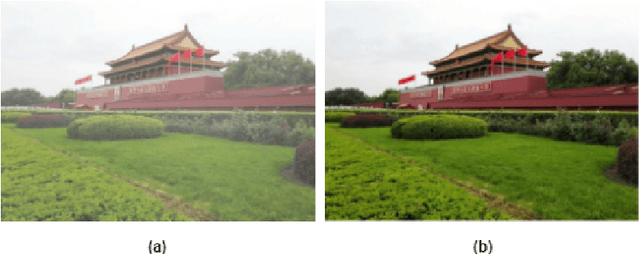
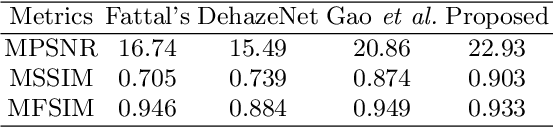
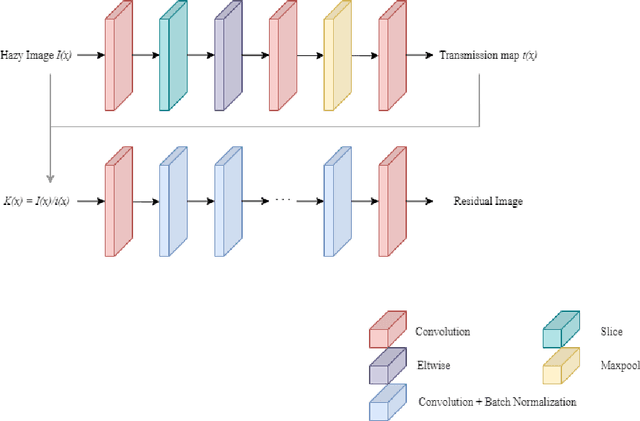
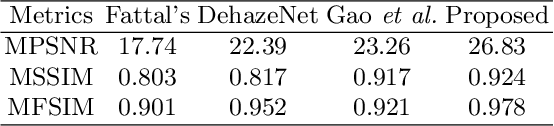
Images acquired in hazy conditions have degradations induced in them. Dehazing such images is a vexed and ill-posed problem. Scores of prior-based and learning-based approaches have been proposed to mitigate the effect of haze and generate haze-free images. Many conventional methods are constrained by their lack of awareness regarding scene depth and their incapacity to capture long-range dependencies. In this paper, a method that uses residual learning and vision transformers in an attention module is proposed. It essentially comprises two networks: In the first one, the network takes the ratio of a hazy image and the approximated transmission matrix to estimate a residual map. The second network takes this residual image as input and passes it through convolution layers before superposing it on the generated feature maps. It is then passed through global context and depth-aware transformer encoders to obtain channel attention. The attention module then infers the spatial attention map before generating the final haze-free image. Experimental results, including several quantitative metrics, demonstrate the efficiency and scalability of the suggested methodology.